
Information service of the Pontifical Mission Societies since 1927
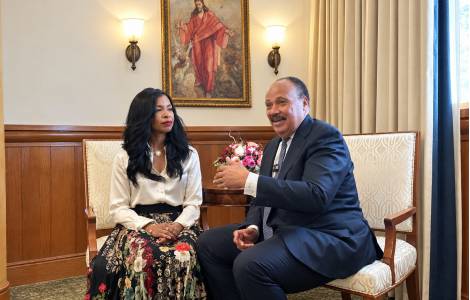
Photo: Fides News Agency
by Marie-Lucile Kubacki
Salt Lake City (Fides News Agency) -On the sidelines of the G20 Interfaith Forum, taking place in Salt Lake City from October 15 to 17, 2026, Fides news agency spoke with Martin Luther King III, son of the famous pastor and civil rights leader, and his wife, Arndrea Waters King, a social justice activist and president of the Drum Major Institute. In this interview, they discuss the role of religious leaders in addressing divisions, loving one’s enemies, and the spiritual legacy of nonviolence.
During the G 20 Interfaith forum, you said that faith leaders had the most important role to play. Why do you believe that, and how can they play this role?
Martin Luther King III: I think faith leaders have always had the pulse of the public, and people are looking to them for integrity. They are looking for unity; they are looking for a message that everyone can support. So I believe faith leaders have a special calling. Because of that, they are in a very unique role. As a result, their words can bring us together, or they can create division. In some cases, they have created more division. But when that role is used to its fullest, it creates something amazing — the beloved community, I would say.
Your father’s commitment to non-violence was deeply rooted in his Christian faith. How can love for the enemy be possible?
Martin Luther King III: I have a unique circumstance: my dad was killed when I was ten years old, and my grandmother was killed when I was sixteen. Yet I had to learn not to hate. I had to learn to love because I had examples of love and forgiveness. I cannot tell anyone they should do that. I can only share my story and say, “This worked for me. Maybe you ought to consider it also in your life,” because it is more redeeming than the opposite, which would be to remain bitter your whole life.
Arndrea Waters King: I will give two practical ways of doing that. Number one: Dr King talked about separating the evil act from the individual. There are actions that you do not like. You find a way to separate the act from the individual. That is number one, and then you stand against that act. Number two: he talked a lot about being glad that Jesus did not say to like your enemies. He said, “Love your enemies.” We have talked about the fact that, when we are talking about love, we are talking about the highest level, which is not sentimental at all. It is an acknowledgement. That is the love we are talking about. He went on to say, “I am so glad that we were not instructed to like our enemies, because there are some people I just will not like.” When I hear Martin Luther King Jr say that, it makes me feel a little bit better. He goes on to say, “I am not going to like the person who bombed my house. I am not going to like the person who bombed the church and killed four innocent kids.” There are some people we are not going to like, but we are not called to like everyone. We are called to love. Again, love means understanding that it is not sentimental; it is an acknowledgement. And we go back to the fact that we separate the evil act from the individual.
You have continued your parents’ struggle against racism and violence. From your experience, how can the Christian faith guide the response to those who suffer violence and racism?
Martin Luther King III: The first thing is that you have to acknowledge the truth, acknowledge that there is a problem. Often, we just go along: “Well, we do not want to talk about race. We do not want to talk about these wrong things.” It is said that a people who do not remember their history are doomed to repeat the mistakes of the past. The Ecclesial Communities have to say, “No, we are going to have these very difficult conversations.” Because the only way you can address something is first to acknowledge that it exists. Once you have acknowledged it, you can begin a strategic focus to address it.
Arndrea Waters King: One of the things I would like to remind people of is that one of Martin Luther King Jr’s greatest inspirations was Howard Thurman. Howard Thurman was a beautiful Christian mystic. In fact, when Martin Luther King Jr travelled, he would always have his travel Bible and one other book. It was a book written by Howard Thurman, called Jesus and the Disinherited. That whole notion is about Jesus, Christianity and the oppressed, and how Jesus is always on the side of the oppressed. It talks about social justice and the call for people of faith — why and how to be involved.
How do you view the growing use of religious arguments in nationalist rhetoric ?
Martin Luther King III: In a sense, it feels segregated. Yes, you do separate to move to a higher level, but segregation and nationalism, to me, are not the highest level we can reach. They create more division and, again, segregation, rather than what my father would have defined as the beloved community. It also has remnants of racism. We need to be moving away from racism, not towards racism and segregation.
Arndrea Waters King: When you really look at the philosophy of Martin Luther King Jr and Reverend C. T. Vivian, for whom I worked, who was a Christian minister, it is about the very notion of all of us coming together, standing together, working together. The civil rights movement was multicultural and multireligious, and obviously many of the ministers were Christian ministers. We were talking earlier about the concept of love. When you look at the example of Jesus Christ, if you are really understanding those messages I find it very challenging to find that voice of Christ, that voice of love, that voice of unity, within the philosophy of Christian nationalism and excluding others. We were talking earlier about the different levels of love that Martin Luther King discussed, going from the basic level that he said none of us should embrace: utilitarian love, where you only love something as long as it is useful to you. Then there is friendship love. He said that is not the highest level of love, because you love your friends because your friends love you. Humanitarian love is a beautiful love, but it is not the highest level, because, he said, you run the risk of loving everything in general and nothing in particular. Romantic love, as wonderful as it is, is not the highest level. Then, of course, he talked about a mother’s love, but the highest love is agape. That love is based on the interconnectedness of all of us as humanity. That is how we go about building the beloved community. It is about taking the sentimentality out and raising love to this highest level, which is an acknowledgement: acknowledging that we are all children of God and seeing our reflection everywhere we go, and that we are all interconnected because we were all created by the Creator.
What does that look like practically for faith leaders when division starts to seep into their churches or local communities?
Arndrea Waters King: Last year, we had the unique privilege of attending the Nobel Peace Prize ceremony. One of the things that struck us both was that there is a Nobel Museum covering all the Nobel laureates. We found out that the exhibit on Martin Luther King Jr is the most visited exhibit among all the laureates. I do not say that from a place of pride. I believe it points to that message again: there is this quest and this hunger for that message, and that message is one of unity and of all of us coming together. So I think it is for all people of goodwill to continue to turn back to that.
As we were also talking about earlier, Martin Luther King Jr’s last book was Where Do We Go from Here: Chaos or Community? I do not know anyone in this world who has not felt touched by chaos in the last few years. Now it is time for all of us to build community. But it is also a reminder that each of us has a unique, prominent and irreplaceable role in building that beloved community. It is time for each of us to find that role and be part of building the beloved community. (Fides News Agency 1/11/2026)



 BEATIFICATION OF FULTON SHEEN/IV - Sons and Daughters of the same Father. Fulton Sheen and racial segregation
 VATICAN - Tribalism and the Church, Archbishop Nwachukwu to new bishops: “A bishop is not bishop of one group or another; he is bishop of all”
 US House bill calls to halt aid to Nigeria over anti-Christian violence
 AFRICA/SOUTH AFRICA - Catholic bishops denounce the increase in violence against migrants
 AMERICA/CUBA - Caritas continues distributing humanitarian aid: “We cannot reach everyone, but we want to remain close to those most in need”
 LEO XIV IN SPAIN - The Pope in the port of Arguineguín: “Every individual that arrives asks us what remains of our humanity”
 VATICAN/MONGOLIA - Leo XIV receives Cardinal Marengo and the abbot of Gandan Monastery, the heart of Mongolian Buddhism
 ASIA/UNITED ARAB EMIRATES - Abu Dhabi celebrates the 800th anniversary of the death of Saint Francis. Bishop Martinelli: He became a man of peace from the horrors of war he experienced