
Information service of the Pontifical Mission Societies since 1927
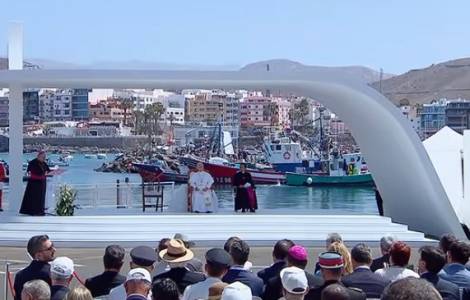
Gran Canaria (Fides News Agency) – “The Church cannot ignore these waters or any place where hunger, thirst, violence, fear or exile continue to wound human dignity.” With these words, Pope Leo XIV addressed the migrant reception centers gathered this morning, June 11, at the port of Arguineguín, in Las Palmas de Gran Canaria, during his apostolic journey to Spain.
The Pope used the image of the sea, which he described as a place of passage but also of suffering, to illustrate his message. “So many wounded lives arrive, stripped of almost everything, but never of their dignity,” he noted, emphasizing that the Gospel “pulls us out of our comfortable position as spectators and places before us a brother or a sister who has arrived.”
Drawing on chapter 25 of the Gospel of Matthew, the Pope recalled that it is a warning that “no believer can take lightly” because it challenges us to recognize Christ in migrants.
The Pope recalled the image of the “fisher of men” from the Gospel and drew a direct link between the Church’s mission and the suffering of migrants at sea. “The Successor of Peter cannot ignore these docks,” he affirmed, also recalling the situation in places like El Hierro, “this island, small in size but great in humanity, has witnessed the arrival of thousands of people, torn from their homelands and entrusted to the fragility of a boat.” “Jesus’ disciples cannot dismiss the cries of those who call out in the night,” he added.
The Pope described the Mediterranean and the Atlantic as places where not only nature but also human evil is at work. He condemned the actions of organized crime groups and human traffickers who “enslave women and children,” as well as the indifference of many who “allow the poor to be swallowed up by exploitation or forgetfulness.”
In light of this, he recalled God’s intervention, which conquers chaos and paves the way, and the crossing of the Red Sea and Jesus’ words in the face of the storm: “Peace! Be still!” “If Christ commands the sea to be still, the Church cannot remain silent about those who are abandoned to its waters.”
The Pope also expressed his gratitude for the witness of those working in reception centers and thanked them for their daily commitment, where “mercy begins with small gestures,” from immediate assistance to human connection. He warned against reducing migrants to mere numbers: “When the migrant ceases to be “just one more,” a mere category or a statistic. Only then can we understand that that little girl could be our daughter, and that those faces could be part of our family. Then, our conscience is left with no excuses.”
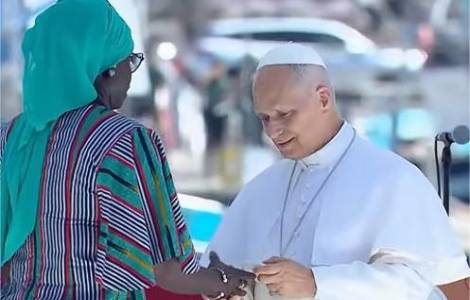
A particularly moving moment was dedicated to the testimony of a Nigerian woman who had been a victim of human trafficking and could not be present in person for security reasons. “Through your words, we hear the drama of so many people who are forced to leave because poverty, war, threats or exploitation closed off all their paths,” Leo XIV told her. “If others have put a price on your body, know that God has never ceased to recognize your inestimable worth,” he affirmed, assuring her that the dignity of every person remains intact even after exploitation and violence. “Your life does not belong to those who harmed you…Your life belongs to God, who has given you a dignity that cannot be taken from you. We want to walk with you until that truth feels stronger than the pain.”
Addressing the migrants directly, Leo XIV reiterated their dignity: “You are not just numbers or files. You are people who have left behind families and homes. You have dreams that no one has the right to despise.” In this context, he warned against criminal networks that promise “easy paradises,” calling it “siren songs” and “industries of death.” “Do not surrender your lives to those who trade with them,” the Pope said.
The Pope broadened his reflection to include political and social responsibilities, declaring that the migration situation must become “an appeal to the conscience” of the nations of origin, of the transit nations, and destination, as well as for Europe and the international community. In this sense, he emphasized that “we must not become accustomed to the fact "that the Mediterranean and the Atlantic are becoming cemeteries without gravestones.”
“The Church, too, must allow herself to be challenged.” Welcoming migrants, he emphasized, “cannot be a secondary matter.” “We kneel before the altar to adore Christ present in the Eucharist, from whom we receive the strength and the motivation to live charity; for this reason, we cannot then “pass by” the small boats and rafts,” he insisted, evoking the parable of the Good Samaritan.
The Pope called for concrete political measures and safe, legal migration routes, reminding everyone that while there is a “right to seek refuge when life is threatened, there is also the right not to have to migrate: the right to remain in one’s own home without hunger, war, persecution, violence…”
At the conclusion of the meeting, Leo XIV entrusted the migrants to Our Lady of Mount Carmel and once again warned against indifference: “It is not enough to manage arrivals, distribute statistics or reinforce borders.” Every boat that arrives, he said, “brings a question along with the migrants: what kind of world have we built, if so many brothers and sisters must risk death to seek life?” “May history not accuse us of turning the pain of those who suffer into a common sight along our shores.” (LGR) (Fides News Agency, 11/6/2026)



 POPE IN FRANCE/VI - Leo XIV in Paris: A missionary topography
 Leo XIV: in the lives of new martyrs and witnesses, the reflection of Christ’s victory over death
 EUROPE/ROMANIA - Faith that unites peoples: The memory of Pope Luciani celebrated in the church of Italian migrants
 Cardinal Aveline, Archbishop de Moulins-Beaufort, and missionary renewal in France
 AMERICA/CUBA - Caritas continues distributing humanitarian aid: “We cannot reach everyone, but we want to remain close to those most in need”
 EUROPE/ITALY: Sister Inês Paulo Albino: "The presence of children, wherever they are, should guide us to a change of perspective"
 Pope in France/III - Metz, at the roots of European peace in the “city of three borders”