
Information service of the Pontifical Mission Societies since 1927
phptp MLK
by Marie-Lucile Kubacki
Saint Louis (Fides News Agency) On the way to the cathedral, a white Chevrolet Express van stands out. A sign in its window reads: “Alabama Catholics headed to celebrate Ven. Bl. Fulton Sheen.”
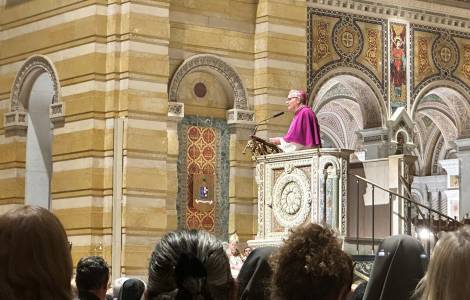
Inside the cathedral, the crowd keeps growing. Some have travelled from the dioceses of St Louis and Peoria; others have come from farther away. Priests, religious men and women, and lay faithful fill the church. A few women wear mantillas; others have chosen elegant dresses or suits. Sweatshirts mingle with formal clothes.
People of different ages and styles have come together for the evening prayer on the eve of Archbishop Fulton J. Sheen’s beatification.
Cameras focus on the pilgrims, asking where they have come from and what Sheen means to them. Some of the oldest remember the television programs their parents or grandparents watched when they were children. Most were too young to have watched his broadcasts. They know him instead as both a spiritual figure and a pioneer of Catholic broadcasting. Many say they wanted to be present for what they see as a “moment in history.”
Bishop Barron’s homily
Archbishop Mitchell Rozanski of St Louis presides at the vespers. The atmosphere is solemn. Four U.S. cardinals, Seán O’Malley, Raymond Burke, Blase Cupich and Robert McElroy, open the procession. Cardinal Luis Antonio Tagle, Pro-Prefect of the Dicastery for Evangelization, also takes part in the prayerful assembly. Then the choir’s clear voices rise with the hymn “Receive this hymn, O noble priest.” The psalm follows: “The Lord is my light and my help; whom shall I fear?” After the reading from the First Letter of Peter, an appeal to shepherd the flock willingly and by example, Bishop Robert Barron, who leads the Diocese of Winona-Rochester in Minnesota and founded the Catholic media organisation Word on Fire, delivers the homily.
Barron tells the congregation that Sheen has been his “model and inspiration” since the beginning of his own work in evangelization. He describes Sheen as a pivotal figure in the modern history of the Church, one who opened the way to evangelizing the world through electronic media. At the height of his television career, Barron recalls, Sheen reached an audience of millions. But the preacher’s fame is not the heart of the homily. The question is what made him holy. Barron’s answer is friendship with Christ.
Christianity, as Sheen presented it, is not an abstract philosophy or simply a set of moral convictions, but a relationship with a living person. To explain what that friendship involves, Barron turns to Sheen’s autobiography, Treasure in Clay, and to the prophet Isaiah’s call. He sets out three movements in the spiritual life: an encounter with God’s holiness, a recognition of one’s own frailty, and a response to being sent.
Grace comes first, Barron says. The spiritual life does not begin with personal ambitions or achievements, but with the realization that God is at work.
In Sheen’s story, that grace was present from childhood: in his baptism in El Paso, Illinois; in a bishop’s prediction that the young altar server would one day study in Louvain; and in the moment, as a seminarian, when he felt his faith suffused with light.
Barron also points to Sheen’s devotion to Mary and, above all, his daily Holy Hour before the Blessed Sacrament. Prayer was a way of remaining in Christ’s presence and of being made ready to serve.
The gift of recognizing oneself as a sinner
That readiness, Barron argues, depended on Sheen’s capacity to acknowledge his weaknesses. In Treasure in Clay, Sheen admits that he enjoyed the honours and privileges of his position and the recognition that came with being a popular professor and preacher. The image in the book’s title captures the contrast: a precious treasure carried in a fragile vessel. For Barron, Sheen’s willingness to recognize his vanity and failures was not a contradiction of holiness, but part of it. The awareness of sin, he says, comes not from moving away from God, but from encountering the light of grace.
Sheen in the footsteps of the missionary Saints
Barron then reflects on mission. “Once bathed in grace, once purified, the follower of Christ is sent,” he says. He traces that call through Sheen’s studies in Louvain, his teaching and his broadcasts.
Sheen wanted to bring the thought of St Thomas Aquinas to bear on the questions of his own time, Barron explains, and deliberately studied “the art, science, philosophy, and literature of the secular world” so that his teaching would remain outward-looking and oriented towards mission.
Sheen saw radio and television as ways to extend the reach of his work. “He knew this would expand the walls of his classroom exponentially,” Barron says of Sheen’s decision to speak on the Catholic Hour. Later, when some academics questioned the wisdom of presenting complex Catholic teaching to a mass television audience, Sheen did not hesitate. “He was, of course, more than qualified academically, but he was also endowed with splendid gifts for popular communication,” Barron says. “And he proved that a sophisticated presentation of the faith could play on the widest stage possible.”
For Barron, this makes Sheen a forerunner of the Church’s contemporary call to evangelize. “I believe that Fulton Sheen is par excellence the saint of the new evangelization,” he says. He links that mission to the Second Vatican Council, which Pope John XXIII conceived as a missionary council: one called to bring “the light of Christ to all people,” to move the Church beyond “its self-protective walls” and into contact with wider society. Barron recalls Paul VI’s teaching in Evangelii nuntiandii that evangelization is the Church’s essential mission.
John Paul II later made the new evangelization central to his pontificate, Barron says, and successive popes continued to develop the theme. Sheen took up the Council’s vision with passion, he adds, but had anticipated its emphasis throughout his ministry: “Anyone who seeks fresh language to bring the Gospel to our culture, anyone who preaches the ancient word with a heart on fire, anyone who dares to use the media of communication available to us today is indebted to Fulton Sheen.”
The missionary saints in the cathedral’s mosaics
As Bishop Barron finishes his homily, eyes lift toward the cathedral’s mosaics to pray. “Look up towards the south transept,” Michael Pera, provincial archivist of the Society of the Sacred Heart, had advised us. There is Rose Philippine Duchesne, depicted in a mosaic designed by Hildreth Meière. French-born Duchesne came to the United States in 1818 with four companions from the Society, the religious congregation founded by Madeleine Sophie Barat. They travelled to Missouri to establish schools. Other missionary figures appear in the basilica dedicated to St Louis, the city’s patron. Other missionary figures appear in the basilica dedicated to St Louis, the city’s patron. St Isaac Jogues, the French Jesuit missionary and martyr of New France, is shown with St. René Goupil, a 17th-century French Jesuit lay missionary martyred during the missions to North America, and St. Kateri Tekakwitha, the first Native American saint, known as the "Lily of the Mohawks." St Frances Xavier Cabrini, born in Italy and founder of the Missionary Sisters of the Sacred Heart, is there too.
Together, the figures suggest a history of Catholic mission in North America: work among Indigenous communities, the witness of the first martyrs, and the pastoral presence of the Church among immigrants. Sheen belongs to that history, Barron’s homily suggests, not because he used new media, but because he put them at the service of a mission that had begun long before radio or television.
The vespers end. Pilgrims linger on the steps, talking in the evening air. A family approaches Barron and asks for a blessing. In a supermarket, a priest is stopped by a young man. “What’s all this crowd?” he asks. The conversation turns to Fulton Sheen.
“Do you know Fulton Sheen?”
“No…”
So the priest begins to tell him.
(Fides News Agency, 24/9/2026)



 Mission beyond the illusions of efficiency: following in the footsteps of Venerable Little Sister Magdeleine of Jesus
 Rome, Sassari, the world: The birth of World Mission Sunday in five stages
 BEATIFICATION OF FULTON SHEEN/III - An American at the Second Vatican Council: Archbishop Sheen’s contribution to the Decree “Ad gentes” on the Church’s missionary activity
 ASIA/LEBANON - The beatification of Patriarch Hoyek in Lebanon's new time of trial
 CHINA/VATICAN - From “exceptional event” to a common practice: Chinese bishops take part in Holy See initiatives
 In Malawi, a whole stadium celebrates 100 years of World Mission Sunday: “United in Christ, united in mission”
 ASIA/SOUTH KOREA - The adventure “accompanied by small prayers” of Junho Chu, “digital missionary”
 VATICAN - Cardinal Tagle to “Catholic Influencers”: Let us be “influenced” and changed by the Love of Christ