
Information service of the Pontifical Mission Societies since 1927
by Marie-Lucile Kubacki
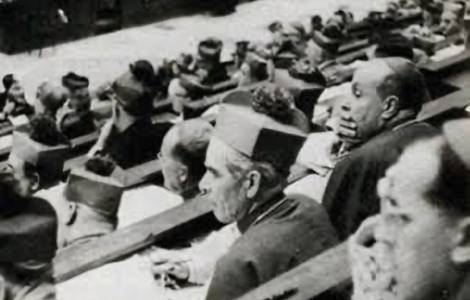
Vatican City (Fides News Agency) – It is a little-known episode of the Second Vatican Council, but its decree on the missions owes much to a single American bishop: Fulton J. Sheen.
Among the nearly 2,500 bishops who sat through the Council's four sessions between October 1962 and December 1965, Sheen took an active part in its debates and left a substantial record of his interventions. Named by John XXIII to the pre-conciliar Catholic Action Commission and then to the Commission on the Missions, he remained its only American member throughout the Council, crossing the Atlantic three or four times a year for sessions conducted, like the Council itself, entirely in Latin. A presence that Pope Benedict XVI recalled during a 2012 visit to the "Ad Gentes" house of the Verbite Missionaries in Nemi, where the Commission held its meetings: «There was the company of so many great theologians, with the fine and important task of drafting a Decree on Mission». After mentioning Father Schütte, the Superior General of the Divine Word Missionaries, who had lived in China, «full of missionary dynamism, of the need to give the missionary spirit a new impetus» and who had invited him, he recorded Fulton Sheen, «who kept us enthralled in the evening with his talks,» Fr. Congar, and the great missiologists of Louvain. «For me», said Benedict XVI, «it was a spiritual enrichment, a great gift. The Decree met with no great opposition. Yet there was a controversy, which I never really understood properly, between the school of Louvain and that of Münster: is the principal purpose of the mission the implantatio Ecclesiae or Gospel [Evangelii] proclamation? But everything was converging into a single dynamism: the need to bring the light of the Word of God, the light of God's love, to the world and through this proclamation give new joy».
Pope Roncalli’s private conversations
Long before the Council opened, Sheen had sensed that a change was on the horizon within the Catholic Church.
Praying at Lourdes in the summer of 1959, only months after John XXIII announced his intention to convene a Council, the American bishop was struck by the crowds of ordinary pilgrims. «Here is the Church of the poor», he told a companion, meaning above all the poor in spirit, a phrase that anticipated the emphasis he would later bring to the Council floor. That emphasis owed something to a genuinely personal bond with the Pope who had launched the project.
Meeting John XXIII every year in his capacity as National Director of the Pontifical Society for the Propagation of the Faith, Sheen became a confidant: the Pope told him, ahead of the public announcement, of his decision to summon a Council, and on one private evening tour of his apartments pressed on him an episcopal ring and a pectoral cross, telling him: «Now put them in your pocket and hide them for the moment. I do not want to make other bishops envious».
The Church’s Mission “wounded by poverty”
Sheen's convictions were sharpened, too, by preaching journeys through Latin America and Africa before and during the Council: crusades in Argentina and Brazil, mission stations in Kenya, a segregated township in apartheid-era Johannesburg. «I began to think less of the problem of poverty and more of the poor», he wrote afterward, adding: «Travel merely confirms the teaching of theology that humanity is one».
His most substantial mark on a single conciliar text came through the debate on the mission schema that would become Ad Gentes. Speaking last among twenty-eight council fathers on 9 November 1964, after many had criticized an early draft, Sheen reframed the question: instead of the conceptual «What are missions?» he asked the practical «Where are the missions?», arguing they existed not only in “non-Christian territories” but in poor, priest-starved dioceses never formally classified as missionary, where bishops came to him for help from areas with only «seven to ten priests to care for 50,000 square miles». Of them, he asked: «Is it Christian? Is it Catholic? Is it worthy of the charity of Christ to say to them: 'You do not belong to mission territory?’» He noted that Paul VI's own encyclical Ecclesiam Suam used "mission" only rarely, favoring "dialogue" instead, and warned against jurisdictional splits: «In the Body of Christ there are no 'new churches,' there are no 'old churches,' for we are all living cells in that Body dependent on one another», he said. As a remedy, he backed one idea already written into the draft itself: a new coordinating body, the «Central Council for Spreading the Gospel», which he called «the true Catholic solution to this problem of the diversity of missions».
One father had asked for all mention of poverty to be struck from the text; Sheen pressed the opposite case, inviting the fathers to «put (the) finger on the 30th Parallel; run it around a globe of the earth, lifting it slightly above China,» since «practically all of the prosperity is above the 30th Parallel, and the greater part of the poverty of the world is beneath the 30th Parallel, that is in Africa, Asia and Latin America.» He closed with his best-remembered line from the Council: «As chastity was the fruit of the Council of Trent, and obedience the fruit of the First Vatican Council, so may the spirit of poverty be the fruit of this Second Vatican Council», concluding that «only a Church wounded by poverty can convert a doubting world».
The finished decree, the first any Council had devoted to missionary activity, passed overwhelmingly carrying much of what also Fulton Sheen had argued: a strong statement on the Church's duty to the poor, coordination through the Propagation of the Faith, and the declaration that every bishop is "consecrated not just for some one diocese, but for the salvation of the entire world."
Sheen pursued the same logic in Optatam Totius, the Decree on Priestly Formation, asking that seminarians «visit and aid the sick, the poor, non-Catholics, fallen-away Catholics... those in jail, laborers» and spend summers in understaffed missions to «bear 'the burden of the day and the heat.'» The final text softened the proposal. He and Cardinal Francis Joseph Spellman also jointly backed Apostolicam Actuositatem, the Decree on the Apostolate of the Laity, which passed 2,340 votes to 2.
Twice, Sheen also pushed for a fuller statement on women, first an unsuccessful bid for a dedicated chapter, since «the feminine principle in religion had been neglected... we were beginning to live in an age when women were coming into their own»; then, during Gaudium et Spes, a defense of qualities he believed only women brought to civilization: «Purity, protection of the weak, sacrifice, procreation, the sustaining and care of human life.» Of that finished constitution, Sheen praised above all «the truth that the dignity and freedom of the human person is inseparable from salvation,» while insisting the Church had to avoid two traps to reach it: «The answer was not to be found either in an isolation from the world... neither could the Church answer the same challenge the world hurled at its Head on the Cross: 'Come down and we will believe.'»
The post-conciliar “turmoil” and the history of the Church
Sheen returned to that balance in some of his post conciliar conferences, arguing the turmoil stemmed from confusion over a single word: «All the confusion that we have had in the Church, since the Vatican Council, has revolved around our misunderstanding of the word 'world,'» distinguishing it as God's good creation from "the world" in Scripture's other sense, an organization without God. Blur that distinction, he warned, and piety reverses: «About fifty years ago, people used to say, 'I am holier than thou'; today they say, 'I am worldlier than thou.'»
It also split the people of God into two extremes: «A psychotic believes that two and two make five, a neurotic believes that two and two make four and he is mad about it», he said, so that «the psychotics would have made the Church senile; the neurotics would have made the Church commit suicide».
Sheen set the post-conciliar turmoil inside a longer pattern of Church history, writing in his autobiography: «The tensions that developed after the Council are not surprising to those who know the whole history of the Church. It is a historical fact that whenever there is an outpouring of the Holy Spirit as in a general council of the Church, there is always an extra show of force by the anti-Spirit or the demonic. Even at the beginning, immediately after Pentecost and the descent of the Spirit upon the apostles, there began a persecution and the murder of Stephen. If a general council did not provoke the spirit of turbulence, one might almost doubt the operation of the third Person of the Trinity over the assembly.» He returned to that same danger in a retreat conference “The Power of the Devil in the World Today," turning to the temptations Satan offered Christ in the desert and casting the last of them, the worldly dominion in exchange for worship, as the Church's own coming trial, and paraphrasing the tempter's own logic: «Theology is politics, forget your God, forget sin, forget guilt, forget holiness, do the political things».
For Sheen, the Council's opening to the world was neither betrayal nor capitulation. He himself had long practiced that engagement, drawing on an unusually wide range of intellectual, religious and secular references in his own preaching and writing, an approach closer to the ancient theology of the semina verbi, the seeds of the Word scattered through every culture and context : the discernment to tell the good grain from the chaff in any setting, and to help the first take root.
(Fides News Agency, 15/9/2026)



 In Dar es Salaam, African Liturgists call for an end to the “folklorization” and “theatricalization” of inculturation
 Father Lombardi: The "Concilium Sinense", the Second Vatican Council and the Christian hope for the "real world"
 Fulton J. Sheen proclaimed Blessed. Cardinal Tagle: “Blessed is the earthen vessel that draws power from Jesus”
 BEATIFICATION OF FULTON SHEEN/VI — At the Vespers for Fulton Sheen, “made holy through his friendship with Christ”
 In Malawi, a whole stadium celebrates 100 years of World Mission Sunday: “United in Christ, united in mission”
 ASIA/INDIA - From south India's coastal plains to the Himalayan foothills: the missionary path of Bishop Edward Baretto of Darjeeling
 EUROPE/SPAIN - Diocesan Missionary Day of Madrid: “The Lord continues to call”
 VATICAN - Pontifical Missionary Union - PMU: In the Jubilee Year, online courses in missiological studies in French, Spanish and English begin