
Information service of the Pontifical Mission Societies since 1927
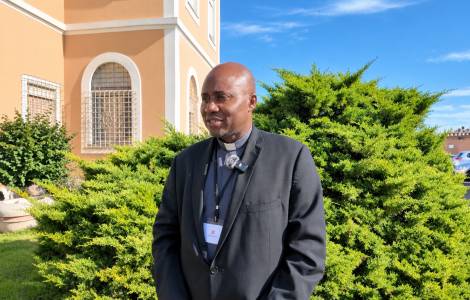
Photo Fides
by Marie-Lucile Kubacki
Rome (Fides News Agency) – Diverse Churches, many stories, and an exchange of gifts that runs in every direction. On the sidelines of the first international conference of "The Church of the Sheaves", held at the Pontifical Urbaniana University from 22 to 24 October 2026, Fides spoke with Fr. Stan Chu Ilo. A priest of the Diocese of Awgu, Nigeria, and Senior Research Professor at the Center for World Catholicism and Intercultural Theology of DePaul University in Chicago, Fr. Ilo is co-director, with Fr. Jaeho Chung, of "The Church of the Sheaves: Equipping the Saints for Mission as Gift Exchange", an initiative of the Dicastery for Evangelization.
What has the project achieved so far, and what are your impressions of these first exchanges?
First of all, you can see the beauty of the Catholic Church. It is such a beautiful Church: full of diversity, full of stories, full of enthusiasm and full of joy. This is the work of the Holy Spirit. When the project began, we were not entirely sure how it would work out. Most of the collaborators did not know each other; they came from all over the world. Yet you can see their enthusiasm as they work together, find harmony, and build a compelling narrative of what God is doing in different parts of the world. Whenever I have the privilege of being in this kind of assembly, what always moves my heart is how people from so many places, led by the Holy Spirit and driven by missionary joy and vocation, find convergence. Together they bring to the worldwide Church some of the great narratives we are now hearing. I think of the video of a Filipina woman working in Scandinavia. She talked about the weather and about how she manages to hold all these things together. That is the message: wherever you come from, you find a home. That is not always the case, but it is where we want to be: a synodal Church, a truly Catholic Church, where everyone finds a home.
The Church of the Sheaves is about the exchange of gifts. How can we change our practices and our mindsets so that this exchange becomes truly mutual enrichment?
The first thing is conversion, which I think is central to discipleship. If you look at the Gospels, one of the first things Jesus says is that the acceptable time of God is here: repent and believe the good news. Gift exchange requires conversion, because the eyes, the mind and the heart need to be purified in order to see God. We human beings are often driven by pride and self-sufficiency; we think we know it all. The Church God wants helps us see through the eyes of Jesus, think through the mind of Jesus and feel through the heart of Jesus. That requires purification: less of me, more of God.
This applies not only to individuals but also to cultures, because cultures are individuals writ large. As Pope John Paul II said, social sin develops out of personal behaviours, patterns and practices. Nobody holds a synod to decide, "Let us be mean to others." It happens through copying and imitation.
That brings me to the second point: modelling. That is why, in this project, we are looking at good practices and best practices. This is really what the Church is about: the faith once delivered to the saints, and the boldness of the early Church. They had no money, no power and no influence. They were ordinary people, but they were bold, and their witness of faith, preserved in the biblical narratives, inspires us. Today we are living the Acts of the Apostles, not as a text of Scripture but as the continuing deeds of God in the everyday experiences of our world. We want to show what gift exchange looks like. That is why we are bringing these stories together, so that people can say: "What you think is impossible in Europe is happening in North America." That is the gift: showing the many things that are happening.
The third point is leadership. If we have converted Christians, we will have converted systems and institutions, and practices that model the life of the Trinity: the perichoresis, the exchange of gifts between the Father, the Son and the Holy Spirit, whose inner dynamism generates the diversity and beauty of the world. But we also need converted leaders, because everything in the Catholic Church happens in the parish. Lumen Gentium speaks of the local Churches; the Church is fully present when it gathers to worship and celebrate the Eucharist. So what kind of pastors do we have in our parishes? What kind of bishops do we have in our dioceses? It does not all depend on Rome. Pope Leo is leading by example when he says he wants a Church that builds bridges, but he will not go to Nigeria to build those bridges himself. That is the task of priests, sisters and small Christian communities. This is what it will look like when small Christian communities, in every nook and cranny, begin to weave webs of relationships that reflect this communion.
There is one more point: the incompleteness of life. Life is incomplete; it is cracked. But God fills us through grace and through the presence of the other. The Synod on synodality and its Instrumentum laboris emphasized this mutual need rather than any sense of superiority. It is not "I don't need you", but "We need each other". As the popular song says, we can lean on each other.
How is mission being reshaped? We once thought of mission as going from the North and the West to the Global South. Today sometimes we hear that the South sends missionaries to a secularised West that lacks vocations. Is that really the picture, or is it rather a circular "economy of mission", a whole landscape rather than a matter of West and South?
Yes, it is true. The ancients gave us the image of perichoresis: the three divine Persons dancing together. The point is to become more Trinitarian. It is not one person giving and another receiving; everyone gives and everyone receives. You cannot say it is only the Father, or only the Son, or only the Holy Spirit. Many people, including, I think, Pope Benedict, have said that the crisis we face is an anthropological crisis. I would say that the crisis we always have in the Church is Trinitarian in nature. The more we become like God, the more the Church becomes credible, faithful, fruitful and, if you like, life-giving. So, a new vision of mission: I agree. But I would rather speak of recovering the authentic foundation of mission, its Trinitarian foundation. In the Church of the Sheaves project we have brought these two together: the Church of the Sheaves, the Global South, and the Church of the Seeds, the Global North. As I said yesterday, the sheaves have become seeds, and the seeds will become sheaves. This is how the life of God works for us.
( Fides News Agency 23/10/2026)



 COLOMBIA - "Mission remains urgent": the Colombian Church renews its missionary commitment on the centenary of DOMUND
 100 YEARS SINCE THE ORDINATIONS OF THE FIRST SIX CHINESE BISHOPS - Bishop Joseph Hu Ruoshan and the Diocese of Taizhou
 Fulton J. Sheen proclaimed Blessed. Cardinal Tagle: “Blessed is the earthen vessel that draws power from Jesus”
 The new catechumens and the first Christians. Archbishop of Reims: "The Pope will encounter a Church in France undergoing profound transformation"
 VATICAN - Cardinal Luis Antonio Tagle is the new Dean of the Sacred College of Cardinals
 VATICAN - Sister Mary Teresa Barron appointed adjunct secretary of the Dicastery for Evangelization and president of the Pontifical Mission Societies