
Information service of the Pontifical Mission Societies since 1927
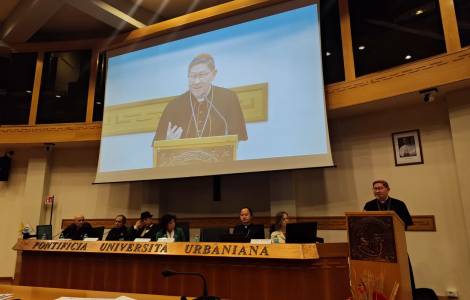
foto Fides-Laura Gomez Ruiz
Rome (Fides News Agency) – We publish the address delivered by Cardinal Luis Antonio Gokim Tagle, Pro-Prefect of the Dicastery for Evangelization (Section for First Evangelization and New Particular Churches), at the international conference entitled “The Face of the Universal Church in China: 100 Years Since the Consecration of the First Chinese Bishops” (Pontifical Urbaniana University, 5 November 2026).
§§§
I have been asked to share some concluding reflections at the end of this day, a day in which presentations and speeches have examined, from various perspectives, the ordinations of the six Chinese bishops consecrated in Rome by Pope Pius XI. They were the first Chinese Bishops to be consecrated in modern times.
I do not intend to provide a summary of the content of the individual contributions. Nor do I intend to offer a final assessment of this historical research and analysis—work that remains open to further study, as the distinguished scholars and academics who have spoken so far have clearly demonstrated.
Instead, I would like to offer a few simple reflections, presented in the form of five “Thank you”
I will touch upon five aspects and insights that we can now better recognize and appreciate—both today and in the future, having participated in this event—by following the thread that connects our own time to that event of a century ago.
1. A “Thank You” for the communion that “springs from the faith of the Apostles”
The ordination of the six Chinese Bishops in 1926 reveals, in a particularly luminous way, the very nature and mission of the episcopal ministry within the great mystery of the Church and her pilgrimage through history.
Pope Leo XIV suggested this in a few essential words in his video message, when he recalled that the six Bishops had travelled across the world to receive episcopal ordination from the hands of the Successor of Peter, thereby bearing witness – and I quote – to “the communion that springs from the faith of the Apostles, whose indispensable sign is the unity of each individual Bishop with the Bishop of Rome”.
The Pope reminds us that THE SOURCE of unity and communion in the Church is the faith of the Apostles, not our agreements, intentions or human adjustments. It is an ever-living source.
Quoting Saint Paul VI's Credo of the People of God, Pope Leo described this communion as “a manifestation of the mystery of the Mystical Body of Christ, which ‘has no other life than that of grace’”.
The journey undertaken by the six Chinese Bishops, who travelled all the way to Rome over the course of a month to receive episcopal ordination from Pius XI, offers a luminous and moving illustration of what Bishops – all Bishops – truly are, with their abilities and limitations, their gifts and their human frailties. They are not “officials of God”, local representatives of a “political-spiritual power”. They are shepherds of souls. They are not “managers” or “influencers of the sacred”. They are Successors of the Apostles.
Those six men who came to Rome in October one hundred years ago were the first Chinese to become Successors of the Apostles in modern times.
The apostolic succession they received from the hands of the Bishop of Rome is like a thread running through history, linking every Bishop to the first Apostles, to those eyewitnesses who lived with Jesus and saw Him after His resurrection.
Through apostolic succession, Bishops thus guarantee continuity in the celebration of the valid and efficacious Sacraments: the acts of salvation and healing that Christ Himself accomplishes through His ministers, from one generation to the next.
The source of communion among Bishops, and with the Bishop of Rome, lies in their walking together in the faith of the Apostles.
From that same source comes their missionary mandate to proclaim the Gospel everywhere, just as the first Apostles did. Succession in the faith and mission of the Apostles.
As Pro-Prefect of the missionary Dicastery, called to serve and work within the great stream of Christian life that has animated the network of Propaganda Fide for centuries, I myself witness every day how this apostolic dynamism is manifested in every part of the world and shines forth also in the lives of our Chinese brothers and sisters.
2. A “Thank You” for the “universal face of the Church” as manifested also in China
Numerous contributions to the conference (notably those by figures such as Grignani and Giunipero Arrieta) have emphasized that the ordinations of the Chinese Bishops in 1926 represented an important milestone in the “missionary turning point” experienced by the Catholic Church during the first decades of the twentieth century, particularly under the pontificates of Benedict XV and Pius XI.
The Holy See had long recognized that the intertwining of missionary activity with the colonial strategies of Western powers was detrimental to the mission.
Several speakers today have emphasized that the new guidelines, and the very decision to foster the growth of indigenous clergy and entrust the leadership of dioceses also to Bishops from the local population, should not be regarded ONLY as a change in “ecclesiastical policy” in response to changing times and the decline of the colonial powers of that era.
In his video message today, Pope Leo XIV reiterated that, rather, the intention was to “remain faithful to the very nature of the Church, whose unity is not uniformity, but communion in diversity”.
In the video message he addressed in 2024 to the international conference marking the centenary of the Council of Shanghai – a conference also hosted by this University – Pope Francis had stressed that the participants in that first General Synod of the Church in China had recognized that “Christ's proclamation of salvation can reach every human community and every individual person only if it speaks in their mother tongue”.
We are now called to discern how all this remains relevant today, albeit in different forms and contexts.
In various settings, we can see that every adaptation, every process of “localization” or “indigenization”, may entail changes in the forms and practices of ecclesial life.
In different historical circumstances, unexpected and distinctive paths may emerge, enabling us to continue walking together in the faith of the Apostles, in unity and communion, following Jesus.
In this way, the universality of the Church can shine forth in new forms and circumstances, while always bearing in mind the teaching contained in an ancient maxim attributed to various authors and also recalled by Saint John XXIII in his encyclical Ad Petri Cathedram: “Unity in necessary things, freedom in doubtful things, and charity in all things” (In necessariis unitas, in dubiis libertas, in omnibus caritas).
Any potential change or adaptation can be embraced, provided that one continues to draw together from the source of communion and to journey together in the faith of the Apostles, in a shared belonging to the Body of Christ, and in communion with the Successor of Peter—becoming “all things to all people” in order to proclaim the Risen Christ and bear witness to Him, as the Apostle Paul taught.
This gives rise to a Christian paradox, through which the Catholic Church, even in China, can reveal the universal face of Catholicism in its full richness, precisely while fully expressing its own Chinese identity. The universal Church exists in and through the various particular Churches.
Within this paradox, communion with the Bishop of Rome and with the universal Church frees us from the danger of turning our different cultural, social, ethnic and religious affiliations into “identity” banners. Apart from this universal openness, persistent appeals to one's own particularities and distinctive characteristics almost invariably lead to self-enclosure. They express forms of self-referential withdrawal that fuel conflict.
3. A “Thank You” for the pain of sins and for the patience that springs from gratitude and forgiveness
We have seen that the journey of the Chinese Bishops from Shanghai to Rome to receive episcopal ordination from Pius XI was greeted with joy and enthusiasm. But we have also seen that reaching that day had not been easy.
Before that moment, and for many decades, there had been resistance, hostility and even acts of sabotage, including within the Church itself, on the part of those who, for various reasons, opposed the episcopal ordination of Chinese Bishops or regarded it as “premature”.
In everyday life, there were those who continued to treat Chinese priests as “second-class clergy”, in some cases subjecting them to outright discrimination.
Such attitudes, even when not motivated by personal malice, failed to recognize the universal nature of the Church and confined Catholicism to an exclusive bond with a single culture and a single civilization.
In the face of all this, we have reason to give thanks because the Catholic community in China continued to journey forward and grow amid so many trials – those of that period, and those that followed in the decades thereafter.
The Lord preserved the faith of so many amid accusations, divisions among brothers and sisters, and apostolic suffering – what Saint Paul called “Thlipsis”.
For this, we should give thanks.
The Church's journey through history is like this. It is not a journey for the perfect, for those who consider themselves pure and believe they can save themselves by independently building their own moral integrity.
The Church's journey is marked by human frailty, external pressures, mistakes and old and new forms of clericalism. It is marked by compromises and falls. Yet there is always the possibility of a new beginning, of receiving forgiveness, and, through merciful forgiveness, of experiencing the pain for our own sins and betrayals.
From the merciful gaze of Jesus come Peter's tears of sorrow, as his heart is broken by the realization that he has just denied Him.
“While we were still sinners, Christ died for the ungodly at the appointed time”, Saint Paul writes in his Letter to the Romans.
During the Great Jubilee of the Year 2000, when then-Cardinal Joseph Ratzinger was asked why the Church asks forgiveness for the sins of the past, he replied: “Only forgiveness, the very fact of being forgiven, makes it possible to acknowledge sin with frankness.”
This experience of freely giving and receiving forgiveness can heal wounds even today. It can strengthen hearts and bring them joy amid the hardships and obstacles encountered along the way.
4. A “Thank You” for the wonderful sight of Churches “exchanging gifts”
As we saw in the short documentary screened this morning, the six Chinese Bishops who travelled from Shanghai to Rome brought gifts to the Bishop of Rome.
Today, too, in this new missionary era in which we are living, shaped by the missionary teaching of Pope Francis and Pope Leo XIV, the horizon before us – one that we can explore and embrace with gratitude – is that of the “exchange of gifts” among the Churches.
This horizon of the “exchange of gifts” was also suggested by the recent conference on the “Church of the Sheaves”, promoted by our Dicastery and hosted by this University.
As Archbishop Fortunatus Nwachukwu often explains, the image of the sheaves comes from Psalm 126, the psalm of those who sow in tears and return home with songs of joy, carrying their sheaves of wheat.
In past centuries, countless missionaries sowed the Gospel far from their homes. Today, the fruits of that sowing are visible. Throughout the world, there are communities alive in the faith, new vocations and gifts which, as Archbishop Fortunatus says, can “enrich the entire Body of Christ”.
For this reason, we can move beyond a “one-way” understanding of missionary relationships, in which there are “Churches that give” on one side and “Churches that receive” on the other. Every local Church has gifts to offer and gifts to receive, for the benefit of the entire ecclesial community.
The Church in China has many gifts and treasures to share with all the Churches throughout the world, and is already doing so. This exchange is also fostered by the increasingly frequent encounters made possible with Chinese Bishops.
What until a few years ago could not take place is now becoming increasingly common: Chinese Bishops are participating in Synods, in meetings convened by the Pope, and also in conferences organized by our Dicastery.
Allow me to say that it is a great joy for me to experience this closeness, including physical proximity, which fosters familiarity, trust among brothers, and the possibility of mutual support.
I am approaching the twenty-fifth anniversary of my episcopal ministry. My brother, Bishop Joseph Li Shan, has been Bishop of Beijing for almost twenty years. We have so many gifts to share…
And the greatest joy comes when we realize that all the gifts we exchange with one another are gifts from Jesus.
All the gifts we can share with one another – the genuine gifts, those that bring joy to the heart – come from Him, not from us.
We play with His gifts; we trade in the gifts we have received from Him, like children playing with the presents they have received from their mother and father and exchanging them with one another.
In this way, we Bishops can discover that even our fidelity is a gift, not the result of our abilities, perseverance or performance. This is something experienced by those who live in situations of persecution because of the name of Christ.
5. A “Thank You” for the prayers of our Chinese brothers at the tomb of the Apostle Peter
I have left my most intimate and personal “thank you” until last, because I would like to share a great joy with all of you.
As has been emphasized several times during this conference, one hundred years ago the six Chinese Bishops travelled all the way to Rome to be consecrated and become Successors of the Apostles at the tomb of the Apostle Peter.
Tomorrow morning, before their departure, Bishop Li Shan, Bishop Ding Zuyao and others will be able to go and pray together at Peter's tomb.
This is the most beautiful and comforting gesture we can make. It is a gesture that embraces and gives meaning to our speeches and conferences, which might otherwise risk becoming occasions of self-celebration.
Let us pray for one another, give thanks, and entrust the journey of the Catholic Church in China to the intercession of Saint Peter the Apostle.
Let us pray for Pope Leo XIV, for our brothers and sisters in the Church in China, and for the entire great Chinese people.
Thank you.
(Fides News Agency, 5/11/2026)



 Cardinal Chow at the Conference on the first Chinese bishops: an “intercultural” approach can support the journey of Catholics in today’s China
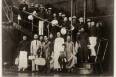 100 YEARS SINCE THE ORDINATIONS OF THE FIRST SIX CHINESE BISHOPS - The Role and Significance of the First Six Dioceses Entrusted to Chinese Bishops
 Cardinal Tagle celebrates his father’s funeral Mass in Imus: “Eternal Life is to remain close to Jesus”
 In Dar es Salaam, African Liturgists call for an end to the “folklorization” and “theatricalization” of inculturation