
Information service of the Pontifical Mission Societies since 1927
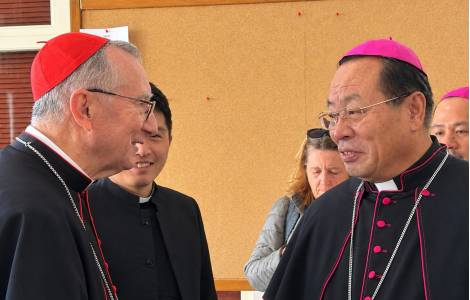
foto Fides (Marie-Lucile Kubacki)
Rome (Fides News Agency) – We publish the address delivered by Joseph Li Shan, Bishop of Beijing, at the international Conference entitled “The Face of the Universal Church in China: 100 Years Since the Consecration of the First Chinese Bishops” (Pontifical Urbaniana University, November 5, 2026).
§§§
Your Excellencies,
dear brothers and sisters in the Lord,
distinguished experts and scholars,
good morning to you all!
As a Chinese Bishop, it is a great honor for me to take part in this conference commemorating the centenary of the episcopal consecration of the first six Chinese Bishops. I sincerely thank the organizers for their kind invitation. On this occasion, on behalf of the Church in China and the Chinese Bishops, I extend my warmest wishes to this conference, praying that, under the guidance of the Holy Spirit and through our common commitment, it may bear abundant fruit. I also wish all the distinguished participants every blessing in body and soul.
I am the Bishop of the Diocese of Beijing, and I myself was born in Beijing. Beijing was the first diocese in China. In 1294, the Franciscan friar John of Montecorvino, sent by Pope Nicholas IV, arrived in Beijing to proclaim the Gospel. Thus, the Chinese people were able to hear the Good News of salvation. In 1307, the Archdiocese of Khanbaliq, that is, Beijing, was established. However, with the end of the Yuan Dynasty, the Church, whose activities had been directed primarily towards princes and nobles, also declined, eventually disappearing altogether.
In 1601, the Jesuit Matteo Ricci, having set out from Rome and overcome countless difficulties, finally succeeded in settling in Beijing, near Xuanwumen (the Xuanwu Gate), where he built the city's first church. Matteo Ricci understood profoundly that the proclamation of the Gospel of Christ cannot bypass or disregard the society and culture of the place in which it is proclaimed. On the contrary, only when the seed of the Gospel is sown with respect for local cultural traditions can it take root, sprout, blossom and bear fruit. It is clear that Matteo Ricci followed the missionary spirit of the Apostle Saint Paul, who became “all things to all people” (1 Cor 9:22).
This method of evangelization adopted by Matteo Ricci, which adapted itself to Chinese society and culture, came to be known as “the Matteo Ricci rule”. It was precisely through this approach that the seed of Christ's salvation was able to take root in the land of Beijing and bear fruit. My ancestors in the faith, and I myself, are the continuation of those fruits.
Two years ago, another conference on the Church in China was held here, marking the centenary of the Concilium Sinense celebrated in Shanghai. The Council of Shanghai of 1924, convened by Archbishop Celso Costantini, engaged in a serious reflection on the methods adopted by Western missionaries in China following the Opium Wars. It rejected the misguided practice of a Church relying on the political power of Western nations and, with regard to the Church in China and its relationship with Chinese politics, culture and people, formulated numerous ideas and proposals that remain valid today. In this way, it reopened the process of the Sinicisation of Catholicism.
It was precisely at the Concilium Sinense of 1924 that the formation and appointment of local clergy were incorporated into the final documents:
“The Catholic Church of God is neither alien nor foreign to any people or nation. Therefore, it must be recognized that every people should have its own ministers to administer the Sacraments, so that they may instruct and guide their own people in embracing the divine law and precepts.”
“In order to provide for the missions in a manner suited to the needs of the times and to establish the Church in China more fully, particular care must be taken to promote and foster Chinese religious vocations, both to the diocesan clergy and to the religious clergy.”
The primary purpose of convening the first Concilium Sinense was to implement the spirit of the Apostolic Letter Maximum illud, promulgated by Pope Benedict XV on November 30, 1919. This document urged mission territories to form and employ local clergy, so as to build local Churches genuinely faithful to the missionary spirit of the Apostles. At the same time, Archbishop Celso Costantini, Father Vincent Lebbe, Ma Xiangbo and others, who felt deep anguish over the ills afflicting the Church in China at the time, raised their voices forcefully to proclaim the urgent need to establish a local Church and form a Chinese clergy: “The Church in China for the Chinese!” These appeals were entirely consistent with the missionary spirit of the Apostle Paul.
Western missionaries who arrived in China between the end of the Ming Dynasty and the beginning of the Qing Dynasty had also recognized the importance of the local clergy for the development of the Church. Father Jean Basset, of the Paris Foreign Missions Society, for example, having witnessed the many crises then affecting the Church in China, put forward several proposals, including the Sinicisation of the clergy. He believed that the Church in China had failed to develop its own theological thought and capacity for governance, and had been unable to become self-reliant because it was entirely controlled by foreign missionaries. For this reason, Basset considered the translation of Sacred Scripture into Chinese, the Sinicisation of the liturgy and the formation of a clergy of Chinese nationality both necessary and urgent. Father Basset therefore undertook the translation of the Bible into Chinese, completing a substantial portion of the New Testament.
Unfortunately, alongside this movement towards the Sinicisation of the Church, there were also opposing currents. The troubled history surrounding the elevation to the episcopate of Luo Wenzao, the first Chinese Bishop, is a case in point. As early as 1669, in recognition of his outstanding work of evangelization, Luo Wenzao was proposed for the episcopate. Portugal, however, invoking its right of patronage, opposed the appointment, and his consecration was suspended. In 1674, Luo Wenzao was again appointed Apostolic Vicar of Nanjing, but strong opposition persisted, and his episcopal consecration was postponed until 1685. From that time until 1926, for more than two hundred years, the Church in China had no Chinese Bishops at all.
In the twentieth century, with the promulgation of Maximum illud and the outstanding work of Archbishop Celso Costantini and Father Vincent Lebbe, the path towards entrusting the leadership of the Church in China to Chinese Bishops was once again brought to the fore. On December 12, 1923, Puqi, in Hubei, was established as an Apostolic Prefecture entrusted to the Chinese clergy. Subsequently, the Apostolic Vicariates of Anguo and Xuanhua in Hebei, Taizhou in Zhejiang, Fenyang in Shanxi, and Haimen in Jiangsu were established. Despite strong resistance, and under the powerful impetus of the Chinese people's aspiration for national independence, Chinese Bishops were finally able to travel to Rome and receive episcopal consecration in St Peter's Basilica.
These six Bishops – Zhao Huaiyi of Xuanhua, Chen Guodi of Fenyang, Hu Ruoshan of Taizhou, Zhu Kaimin of Haimen, Cheng Hede of Puqi and Sun Dezhen of Anguo – subsequently made an enduring contribution to the development of their respective dioceses and of the Church in China, as well as to the inculturation of the Church. In doing so, they definitively refuted the unfounded claim that Chinese clergy were incapable of shepherding the flock of their own country.
Nevertheless, the situation of a Church in China led and administered by foreign missionaries did not fundamentally change with the consecration of the six Chinese Bishops. Western political powers had not entirely withdrawn from China, and resistance to the inculturation of the Church remained strong. Before the founding of the People's Republic of China, only 28 of the 137 ecclesiastical circumscriptions in China had a Chinese Bishop, and only three of the twenty Archbishops were Chinese. Chinese Catholicism had not truly freed itself from external governance, had not yet become a work directed by Chinese Christians themselves, and had still not managed to shed the label of a “foreign religion”.
The founding of New China radically changed the situation of a Church in China that had relied on Western political powers. Remaining faithful to the essence of the faith and preserving unchanged the fundamental doctrines and canonical norms, all Christians found themselves facing the question of how the Church could best adapt, within the framework of the Chinese government's policies and laws on freedom of religious belief, to a new form of Church-State relations with Chinese characteristics. It was precisely in this context that Chinese Catholics, together with the entire Chinese people, supported the new socialist China and embarked on the path of patriotism and love for the Church, independence, autonomy and self-management.
In keeping with the spirit of synodality proposed by the most recent Assembly of the Synod of Bishops, the affairs of the Church in China are now managed collectively by the Chinese clergy, religious sisters and the faithful, and the various holy works of the Church are flourishing. Today, the more than eighty Bishops of the Church in China have taken up the pastoral ministry entrusted to them by Jesus Christ and are tending the Lord's flock in the ancient land of China.
Today, as we commemorate the centenary of the episcopal consecration of the first six Chinese Bishops, we intend both to celebrate the Church in China's journey towards the Sinicisation of Catholicism, made possible by the emergence of a Chinese episcopate, and to remember the arduous and complex path of the Sinicisation of the Church in China, whose fruits have come at a great price.
We must not forget history; without the light that history provides, we cannot fully grasp the orientation of the Sinicisation currently being promoted by the Church in China.
As a Pastor of the Church in China, I believe that several points are particularly important for its future.
First of all, the Catholic Church, founded by Jesus Christ and not directed towards the pursuit of any earthly interests, must and can achieve a genuine encounter and authentic integration with the society and culture in which it lives. This is both the missionary spirit of the Apostle Paul and the vision of the Second Vatican Council concerning the relationship between faith and culture, and between the Church and the world. The Church in China, having once been constrained by colonial structures, has an especially indelible experience of this reality. This is precisely where the significance of the Sinicisation of the Church that we are advocating today lies.
In my view, the implementation of the Sinicisation of Catholicism belongs to the very essence of the Church. The Sinicisation of Catholicism does not seek to construct a different form of Catholicism, one that departs from Tradition, but rather to build a genuinely Catholic Church. It is not an external addition to the Catholic Church, as though it were optional, something that may or may not be undertaken. Rather, it is an intrinsic requirement of the Church's catholicity.
The Sinicisation of Catholicism is the process through which the catholicity of the Church moves from the abstract to the concrete, from emptiness to abundance, from immaturity to maturity. We should understand it in this way: Sinicisation offers the Church an opportunity to reflect upon herself and to adapt to China's present-day social and cultural context. Such adaptation not only does not undermine the catholicity of the Christian faith; it is actually required by it and provides an appropriate starting point for its authentic realization within the particular Church in China.
Secondly, “where there is the Bishop, there is the Church.” The Bishop is both the one to whom Jesus Christ entrusts His mission and His companion on the journey. For the Church to be perfect, the Bishop must first set an example, continually striving for his own perfection.
Today, the Church in China places particular emphasis on ecclesiastical discipline and implements rigorous and comprehensive governance of the Church, so that all Chinese clergy may be conformed to Christ and, before the world, work for the glory of God and the good of humanity.
Our faith, which comes from Jesus Christ, is always closely connected with the assumption of responsibility towards the society in which we live. Both the biblical tradition and the teaching of the Popes call upon us to “be subject to the legitimate authorities, for they have been established by God”.
The Constitution and the laws of the State, as expressions of the general will, constitute the fundamental guarantee of social order and citizens' rights. As a Catholic Bishop, I believe that compliance with the laws of the State should not be regarded as an external constraint, but as a natural expression of inner faith and a faithful implementation of the Gospel command: “Render unto Caesar the things that are Caesar's, and unto God the things that are God's.”
The laws of the State and the norms of the Church are not in opposition to one another; rather, they complement each other on the path towards the perfection of the human person. The laws of the State establish the legitimate boundaries of religious activities and fully guarantee the normal evangelizing and pastoral activities of the Church, as well as the legitimate rights of the faithful. As for canon law, it guides the faithful towards elevating their moral lives and developing, in the spirit of faith, a habit of respect for the law.
From Jesus Christ, we ministers have received not a job, but a holy calling. As the Pope often reminds us, this requires us to offer every day of our lives to God, living each day as a journey of sanctification.
“Be holy, for I am holy” (Lev 11:44). God's call asks us to preserve holiness in the world, to keep ourselves far from every sin and temptation, to bear witness to the teaching of the Gospel, and to serve everyone with a pure heart and upright conduct.
Looking at the present situation, the corruption of the human spirit brought about by modern individualism and hedonism has indeed given rise within the Church to signs of weakened ideals of faith and laxity in discipline, seriously damaging the image that the Church ought to present to society.
Today, the Church in China has made the renewal of ecclesiastical conduct one of its priority commitments, in order to restore a positive image of the Church in society. In this regard, Saint Francis, who died eight hundred years ago, and the authentically evangelical way of life he proposed, retain great significance for our own time.
Finally, in matters of faith, the Church in China differs in no way from all the other Churches throughout the world.
Over the past two years, Chinese Bishops have participated in the Synod of Bishops and in two important conferences held in Rome, as well as, naturally, in other international exchange initiatives. All this has undoubtedly deepened our mutual understanding and strengthened the fraternal bonds among us Bishops in the Lord Jesus Christ.
A fuller communion among the Churches of the world will certainly contribute to building a community with a shared future for humanity.
Today, the great changes taking place throughout the world, unprecedented in a century, are unfolding at an accelerating pace, and the challenges affect every sphere: from the traditional international security order to humanity's shared traditional ethical values, including the question of the relationship between artificial intelligence and the human person, which is of particular concern to Pope Leo XIV.
Today, no unilateral power in the world is capable of confronting and resolving these serious challenges. Only through an awareness of our shared human destiny and by adopting the approach of “walking together” can we move forward along the right path.
China, which is promoting the great rejuvenation of the Chinese nation in every sphere through Chinese modernization, is a China undergoing transformation, a China that loves peace, a China that wishes to establish friendships with all.
The same is true of the Church in China. We wish to “walk together” with all our sister Churches throughout the world, members of the one Body, in an attitude of respect, dialogue and communion, so that together we may bear witness to the beautiful Gospel entrusted to us by Jesus Christ.
Your Excellencies, dear brothers and sisters in the Lord, distinguished experts and scholars, the episcopal consecration of the first six Chinese Bishops represented a right step for the Church in China in terms of ecclesiastical governance, and a right step in the Sinicisation of the Church!
In the spirit of the Second Vatican Council, the Church in China will continue to seek ways of bringing the Christian faith into harmony with Chinese society and culture, further deepening both the thought and practice of the Sinicisation of the Church, so that the catholicity of the Gospel of Christ may be manifested ever more fully in a Church in China that is constantly changing, developing and growing in maturity.
Thank you all!
(Fides News Agency, 5/11/2026)



 Cardinal Chow at the Conference on the first Chinese bishops: an “intercultural” approach can support the journey of Catholics in today’s China
 100 YEARS SINCE THE ORDINATIONS OF THE FIRST SIX CHINESE BISHOPS - The Role and Significance of the First Six Dioceses Entrusted to Chinese Bishops
 Leo XIV to the John Paul I Vatican Foundation Conference: peace is a daily Mission
 In Malawi, a whole stadium celebrates 100 years of World Mission Sunday: “United in Christ, united in mission”