
Information service of the Pontifical Mission Societies since 1927
pontificalmissions.org
by Marie-Lucile Kubacki
Rochester (Fides News Agency) – “All around us there are people who never stop hating someone or something, shouting: 'Down with capitalism! Down with labor unions! Down with religion! Down with government! Down with economic royalists! Down with property! Down with this class! Down with that class!' But I say 'Up from class hate! Up from all hate! Let us stop downing things, and start looking up, up, up, up to God!’”
Fulton J. Sheen delivered these famous words in Los Angeles during the Second World War, in an appeal for peace among Jews, Protestants and Catholics to counter the impulse towards collective hostility. They also offer a glimpse into a less explored aspect of this American prelate’s public witness: his longstanding opposition to racial discrimination, expressed well before the civil rights legislation of the 1960s.
A maternity hospital for Black mothers
In 1938, the Catholic priest received an inheritance from Duchess Brady, a benefactor whom he had met in Lourdes. Thomas C. Reeves writes in *America’s Bishop: The Life and Times of Fulton J. Sheen* that Sheen allocated a substantial portion of this sum to the Diocese of Mobile, in Alabama, to help the Sisters of Mercy to use the funds to build a small maternity ward for Black mothers. In Mobile, where segregation prevailed, Black mothers were excluded from hospitals reserved for white patients. The program supported by these funds was later associated with Martin de Porres Hospital. The initiative expanded over time. In 1950, a larger hospital facility opened following a major fundraising campaign in which Sheen continued to take part. Reeves also reports that Sheen’s interest in the project was connected to Fanny Washington, his African-American cook and housekeeper.
Over the following years, Sheen donated the royalties from his books and the fees he received for public appearances to Catholic initiatives and institutions in Alabama. These included his support for the Mission of the Immaculate Heart of Mary in Hillview, Alabama, as well as contributions to chapels and itinerant missionary projects in North Carolina and Texas.
In 1942, after receiving an invitation from a Black woman, he travelled to a small town in North Carolina, where he preached a mission on the steps of the local public school. A year later, he crossed Alabama with a priest in a trailer, speaking “on street corners and in cornfields to anyone who would listen,” Reeves writes.
These episodes took place at a time when Black Catholics often lived on the margins of American ecclesial and civic life. They showed Sheen’s determination to place his influence, the money he raised and his public visibility at the service of communities that had very limited access to such resources.
From Mobile to Rochester
The concrete help Sheen offered Black Catholic communities was rooted in a broader moral and theological conviction. Human rights, as he argued in *A Declaration of Dependence* (1941), did not originate from the government and could not be subordinated to the preferences of a majority. Their foundation was the dignity of the human person before God. Public authorities, in this regard, could recognize and protect rights; they could not, by any elementary standard of justice, assign less value to one group of people than to another.
Rooted in the Christian tradition, this vision led Sheen to regard racial prejudice as a refusal, first and foremost, to recognize the other as a child of God.
When Sheen became Bishop of Rochester in 1966, he arrived in a city marked by the consequences of racial inequality in the North. The riots of July 1964 had brought to the surface anger unleashed by police practices, housing conditions, employment and exclusion from the economic benefits of an industrial city. Catholic organizations in Rochester had already begun to respond: the Catholic Interracial Council had been established in 1960, while diocesan initiatives provided assistance to Black children and Puerto Rican families. During his episcopate, Sheen gave visible support to many of these causes. The Catholic press in Rochester reported that, between 1967 and 1968, he himself founded an organization that later gave rise to the Bishop Sheen Ecumenical Housing Foundation, an affordable housing agency that remains active in the region and seeks to address the shortage of decent housing for low-income residents.
Housing discrimination was not confined to the South. In Northern cities, it could persist through unequal access to rental accommodation, home sales, mortgages and credit, as well as through informal practices that restricted where families could live.
In Rochester, Sheen also became involved in the public debate over employment and racial exclusion at Eastman Kodak, the city’s largest private employer. An article published in *America* magazine lists him amongst those who were putting pressure on Kodak to improve access to training and employment for Black workers (‘Fulton Sheen, God’s Love and the Civil Rights Movement’, 26 August 2026).
A missionary vision embracing all humanity
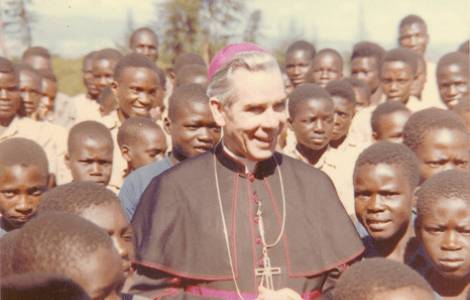
The international dimension of Sheen’s ministry reinforced this perspective. From 1950 to 1966, he served as national director of the Society for the Propagation of the Faith in the United States. This role led him to speak to American Catholics about a Church that transcended cultures, languages and nations.
During his travels in 1960, he visited Argentina and Brazil, spending time in particular in Buenos Aires and Rio de Janeiro. In Rio, he noted the striking proximity between extreme wealth and extreme poverty: the contrast between the city’s prestigious coastal neighborhoods and the deprivation just a short distance away challenged any simplistic identification of economic and social success with moral virtue. He later travelled to Kenya, where he visited mission stations and communities afflicted by disease, isolation and profound insecurity. He celebrated Mass in a modest mission church with a clay-and-manure floor, and later recalled meeting a woman, the mother of ten children, who had been abandoned by her husband. His journey also took him to Johannesburg, where he witnessed apartheid at first hand. Accounts of the visit describe his determination, despite resistance from the authorities, to go and meet a Black catechist in an area subject to segregation.
At a missionary conference in St. Louis in 1953, Sheen explicitly linked the universal scope of the Catholic mission to the rejection of any hierarchy based on race. According to a retrospective account of the gathering published by the *National Catholic Register*, he told missionaries: “Pay no attention to race or skin color, for there are no inferior people in the world when they are children of grace through the sacraments.” (“When Venerable Fulton Sheen addressed 270,000 people in St. Louis,” April 14, 2026.) In the same address, Sheen referred to Muslims’ belief in one God and their veneration of Jesus and Mary. He also spoke of China as a country that remained open to a renewal of faith, despite going through a difficult period.
Charity toward our “neighbor” whom we do not choose as neighbor
Fulton Sheen does not fit neatly into contemporary political categories. He was neither a civil-rights activist nor a theorist of structural racism, according to the terminology that emerged later within the movement. His commitment took the form of homilies, philanthropic initiatives, pastoral journeys and appeals to conscience. Yet these forms of action had significant repercussions in their historical context: supporting maternity care where segregation restricted Black women’s access to medical treatment; assisting missionary communities neglected by public institutions; and advocating for housing and employment in Rochester.
The career of Jerome Gary Cooper illustrates Sheen’s approach well. Raised in Mobile, Alabama—a city marked by segregation—Cooper entered the University of Notre Dame in 1954 thanks to a scholarship and graduated with a degree in finance four years later. He then enlisted in the United States Marine Corps, becoming, during the Vietnam War, the first African-American Marine officer to lead an infantry company in combat. He later rose to the rank of major general and was appointed United States Ambassador to Jamaica, where he served from 1994 to 1997.
The magazine *America* and the biographical database *BlackPast* report that a recommendation from Fulton Sheen helped Cooper obtain his scholarship to Notre Dame.
For Sheen, that person was ‘the neighbor’. Not the ‘neighbor’ we choose because he thinks like us or resembles us — according to the logic of algorithms that create false communities — but the person placed before us, often in an inconvenient way, often at the edge of the road. It is in this person, Sheen believed, that Christians can encounter the image of God by bearing witness to their faith in Christ
(Fides News Agency, 22/9/2026)



 BEATIFICATION OF FULTON SHEEN/III - An American at the Second Vatican Council: Archbishop Sheen’s contribution to the Decree “Ad gentes” on the Church’s missionary activity
 ASIA/LEBANON - The beatification of Patriarch Hoyek in Lebanon's new time of trial
 Mission beyond the illusions of efficiency: following in the footsteps of Venerable Little Sister Magdeleine of Jesus
 Leo XIV: in the lives of new martyrs and witnesses, the reflection of Christ’s victory over death
 Rome, Sassari, the world: The birth of World Mission Sunday in five stages
 VATICAN - Tribalism and the Church, Archbishop Nwachukwu to new bishops: “A bishop is not bishop of one group or another; he is bishop of all”
 AMERICA/BRAZIL - Justice for the murder of Moïse Kabagambe: "barbarism becomes normal when it involves the poor"