
Information service of the Pontifical Mission Societies since 1927
Courtesy of Apostolic Vicariate of Southern Arabia
Thessaloniki (Fides News Agency) – The global migration flows that characterize the present age intersect, in surprising and mysterious ways, with the paths of apostolic ministry.
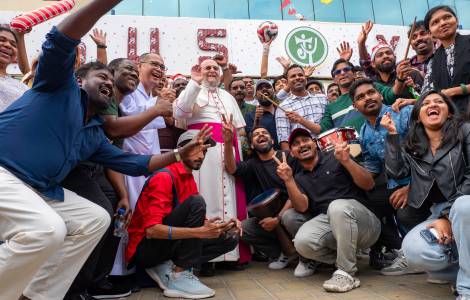
In recent decades, the large numbers of migrant workers who have arrived in the Arabian Peninsula have turned that part of the world into a kind of “laboratory” where a plural and “intercultural” Church is flourishing, becoming also a space of encounter between peoples and cultures. This was documented by Bishop Paolo Martinelli, Apostolic Vicar of Southern Arabia, in a detailed address dedicated to the transformations brought about by the mobility of peoples.
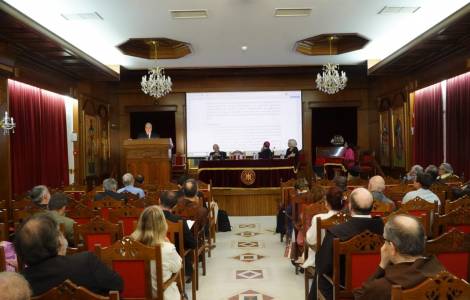
Bishop Martinelli’s address served as the opening lecture of the 18th Inter-Christian Symposium in Thessaloniki, a significant ecumenical initiative promoted by the Institute of Franciscan Spirituality of the Pontifical University Antonianum and the Department of Theology of the Orthodox Faculty of Theology at the Aristotle University of Thessaloniki. This year’s edition, dedicated to “Christian Faith in a Multicultural Context”, examined the transformations taking place in a society marked by migration.
Pope Leo XIV, in a message sent to the participants in the Symposium, observed that “in contemporary society, the Christian faith no longer constitutes the sole cultural reference point”, and that this “requires the Churches and believers to rethink how they express and bear witness to the Gospel”.
Bartholomew I, Ecumenical Patriarch of Constantinople, also sent a message to the conference, recalling that “multiculturalism creates new opportunities for communication and cooperation, but at the same time confronts Christians with the question of how they can bear witness to the faith in such circumstances”.
Processes that happen “without asking our permission”
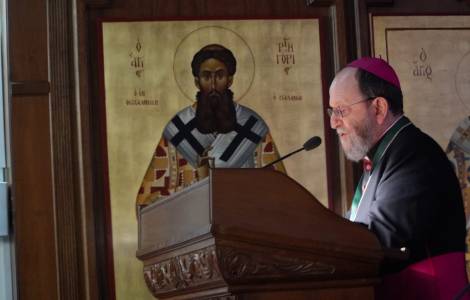
In his presentation, entitled “Christian Faith in a Multicultural Context: Mapping the Issues at Stake”, Bishop Martinelli recalled that mobility has always been part of the history of humanity, salvation and the Church. Today, however, the movement and intermingling of peoples are taking place “on a scale never reached before”. The Arabian Peninsula, he noted, offers a privileged vantage point from which to observe some of the unpredictable effects of this epochal phenomenon.
In the United Arab Emirates, the Bishop recalled, more than 90 per cent of the population consists of migrants, representing more than 200 ethnic groups and nationalities. Even the baptized who attend the Catholic churches come from more than 100 countries and form a “multicultural, multi-ethnic and multispiritual” community.
Martinelli describes it as “a laboratory of intercultural Church”. This experience raises a fundamental question: how can differences be lived out without either erasing them or turning them into separation?
The Apostolic Vicar observes that the process of cultural intermingling cannot in any way be halted: “This is not a political choice […] but a process that happens without asking our permission. This process needs to be governed with wisdom and foresight.”
Neither assimilation nor a “melting pot”
Bishop Martinelli’s report, who is a member of the Order of Friars Minor Capuchin, then examined the different concepts of “assimilation”, “multiculturalism” and “melting pot”. For Martinelli, all these models prove insufficient.
The path to be taken instead is that of “interculturality”, understood as openness and a willingness to “bring differences into interaction rather than overcome them”.
The paradigmatic reference point, from a perspective of faith, is what takes place at Pentecost: “At Pentecost, languages are not overcome; rather, unity is manifested in the diversity of languages and cultures.”
This dynamic unfolds in three dimensions: the inculturation of the Gospel, the evangelization of cultures and the interculturality of faith.
The “Paradigm” of Pentecost
Inculturation, the Vicar of Southern Arabia explained, is the process through which faith in Christ can encounter and take on the culture of peoples. The evangelization of culture recalls that the Gospel challenges and transforms every culture. Interculturality brings different cultures — with their distinctive characteristics — into encounter around the same faith.
The decisive point, therefore, is reciprocity.
“The Church,” the Franciscan Bishop acknowledged, “does not live from the autonomy of the individual cultures in which she is present, but from the fruitful reciprocity of cultural differences.”
Along this path, migration itself is shaping and reshaping the face of Christian communities, and interculturality is becoming a concrete dimension of ecclesial life.
Thus, the question raised by Leo XIV and Bartholomew — how to express and bear witness to the Gospel in a multicultural society — finds in Martinelli’s reflection a possible perspective: fostering “the interaction of cultural differences around the one Christian faith”, while offering the Church community’s specific contribution to peaceful coexistence and peace.
(EG) (Fides News Agency, 29/9/2026)
Courtesy of Apostolic Vicariate of Southern Arabia
Courtesy of Apostolic Vicariate of Southern Arabia



 100 YEARS SINCE THE ORDINATIONS OF THE FIRST SIX CHINESE BISHOPS - Bishop Joseph Hu Ruoshan and the Diocese of Taizhou
 New episcopal ordination in China: Ignatius Ding Zuyao ordained Bishop of Haimen
 Bible and cultures: Christian identity as encounter
 Here's how Sweden is quietly rediscovering itself as a "land of mission"
 The Centenary of the consecration of Six Chinese Bishops and the Provisional Agreement between the Holy See and the People’s Republic of China
 EUROPE/HUNGARY - Message of the annual gathering of the Pontifical Society of the Holy Childhood: Different yet united in the love of Christ
 EUROPE/POLAND - Mission seeks new paths: the message that emerged from the autumn meeting of the Pontifical Mission Societies