
Information service of the Pontifical Mission Societies since 1927
avosa.org
by Gianni Valente
Abu Dhabi (Agenzia Fides) - In the territories of the Apostolic Vicariate of Southern Arabia—which includes the United Arab Emirates, Oman, and Yemen—those who share the Catholic faith, starting with the Bishop, are all immigrants. This is how the ecclesial communities now scattered across the Arabian Peninsula were born. Not by calculation or planning, but by following the pressing needs of real life: finding a job to live and provide for their loved ones. Now, the shadow of war is cast upon them and their condition. The United Arab Emirates are also the target of Iranian drones and missiles following the Israeli-American attack on Iran. And the future of Christians employed in the metropolises, on construction sites, and in factories becomes even more uncertain.
Can a community of expatriates, far from their homes, persist if the conflict also eliminates their jobs? Or can it eventually dissipate like wind in the wind, if the economic and productive flows from which workers draw their often meager wages are blocked?
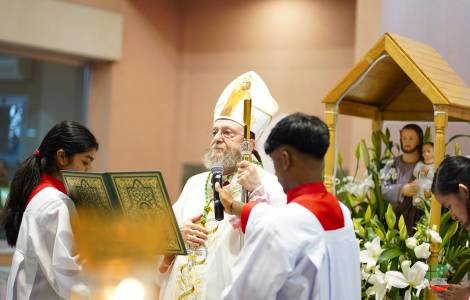
Bishop Paolo Martinelli, Apostolic Vicar, visits communities and parishes during Lent. He sees and listens. He tells Agenzia Fides that he finds comfort "in children's prayers for peace." He experiences that even in the temporary situation that risks becoming precarious, "the people of God are a faithful people." And he repeats the words of the Apostle whose name he bears: "nothing can separate us from the love of Christ."
The Catholics of the Apostolic Vicariate are immigrant workers. What impact does the war have on their status as workers? Are businesses closing?
MARTINELLI: Our faithful share the working conditions of all other foreign workers. In the United Arab Emirates, 90 percent of the population is migrant, in Oman about 50 percent. The Gulf countries have foreign workers as an essential resource. In the UAE, in the face of attacks from Iran, the government is currently promoting smart working, especially in the private sector, to reduce traffic and avoid long commutes. Schools have also been moved online.
The tourism sector is currently suffering the most. We know that a number of employees in the sector are not working, temporarily for now, while they wait to see how the situation develops. Local authorities have expressed their support for all residents and workers. They hope that life continues as normal despite the difficulties. Much will depend on the medium-and long-term outlook. Has anyone started thinking about returning home?
MARTINELLI: I don't think any drastic decisions have been made so far; some have left the country temporarily, taking advantage of the two-week school holidays. Everyone is trying to understand how the situation will develop and then assess it. Everyone's hope is to return soon, hoping for an end to hostilities. We also have a strong partnership with the civil authorities to help those without families and living in labor camps, so that no one feels alone and can learn to face this uncertain situation with serenity. Here, religion is considered a resource to humanize life, to support the journey, and to foster solidarity among people. The "temporary" nature of the Vicariate's Christian communities was a fruitful and comforting sign for all: a sign of communities born not through effort or design, but through generosity. Has the war further increased the perception that their "temporary" nature can become "precarious"?
MARTINELLI: The Christian sense of this temporariness leads us to experience life as a great pilgrimage. Our faithful live these circumstances intensely, as they are given by Providence. It's enough to see how they participate in celebrations, how they help one another, their passion for communicating the faith to their children, the seriousness with which they commit themselves to their work. Yet we know that our ultimate destiny lies elsewhere: the purpose of life is the Kingdom of God, eternal life. And the path we travel is important precisely because it leads elsewhere; every step is precious because it brings us closer to the goal and is sustained by the virtue of hope. "All things work together for good for those who love God," St. Paul reminds us in his Letter to the Romans.
It seems to me that this attitude allows our faithful to navigate even a moment like this, a time of further uncertainty, with the strength of Christian hope. The Lord does not abandon us and walks with us, even in the transitory nature of these days. We are together and we walk together; together we also face these new problems.
War is a shock; it surprises, it tends to destabilize, andto challenge our certainties. However, from the perspective of faith, this circumstance also makes it even more evident that we do not possess life and that hope should never be placed in circumstances, which are always changing, but in Christ, who is present even in the impermanence of life. What are the effects on the ordinary life of communities (Masses, sacraments, catechism), which is always very lively?
MARTINELLI: At first there was fear, and in the first few days there was a certain decrease in the number of faithful attending Holy Mass. But in the following days, the number of faithful returned substantially to normal. Indeed, in some cases we saw an increase in the number of faithful, eager to pray more. The civil authorities encourage continuity with normal life. They simply asked us to avoid excessively large gatherings. For this reason, for example, catechism has been moved online. Otherwise, all the sacraments can be accessed in the parish.
These days I continue to make pastoral visits to our parishes, meeting children, young people, and groups, and celebrating Mass. I always find the liveliness and participation that characterizes these people. We also talk about the war and share our concerns for the future, but we remain certain that nothing can separate us from the love of Christ.
Has there been an event, a gesture, or a word spoken by a baptized person that has comforted you as a Bishop during these difficult days, when we are gripped by fear?
MARTINELLI: I would like to recall two events. The first concerns the very first day, when the war broke out. I was in a parish on the border with Oman. We celebrated the children's Mass. I wasn't sure what to say; I too was struck by this new situation. I thought I'd teach them a song about peace: "Peace comes from above, enters the heart, is seen on the face." I was moved by how quickly they learnt it and how they sang it, enunciating the words clearly and shouting them out loud.
It truly seemed like a great prayer from children to God asking for peace.
On March 4, we celebrated the tenth anniversary of the murder of four Missionaries of Charity nuns in Aden, Yemen, in 2016. With this conflict having only just begun, I was afraid that people would find it difficult to attend, but to my great surprise, at 7 p.m., and despite several alerts during the day, the church was packed with people, as on special occasions, even though it was a weekday. The people of God are faithful. (Agenzia Fides, 16/3/2026)



 100 YEARS SINCE THE ORDINATIONS OF THE FIRST SIX CHINESE BISHOPS - Bishop Joseph Hu Ruoshan and the Diocese of Taizhou
 New episcopal ordination in China: Ignatius Ding Zuyao ordained Bishop of Haimen
 Egypt, Sudan, Eritrea and Somalia meet to discuss tensions and unresolved issues in the Horn of Africa
 United States lifts sanctions on Eritrea
 EUROPE/ITALY - Chinese priests and nuns "on mission" in the neighborhoods of Naples
 AFRICA/UGANDA - Uganda's immigrant integration model confronts US administration plans
 ASIA/TAIWAN - 8,000 people at the first Gathering of Migrant Workers organized by the Taiwanese Catholic community
 ASIA/PHILIPPINES - Bishops address social issues and call for a shared commitment to fair wages and human dignity
 To use AI wisely, first know what you want to preserve, G20 Interfaith forum highlights
 AMERICA/UNITED STATES - At the "G20 Interfaith Forum" Apostolic Nuncio Caccia points out that technologies and innovations "do not tell us what the good is”