
Information service of the Pontifical Mission Societies since 1927
VaticanMedia
by Laura Gómez Ruiz
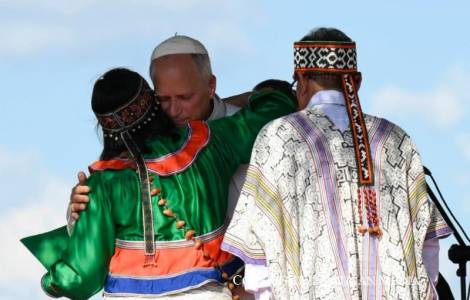
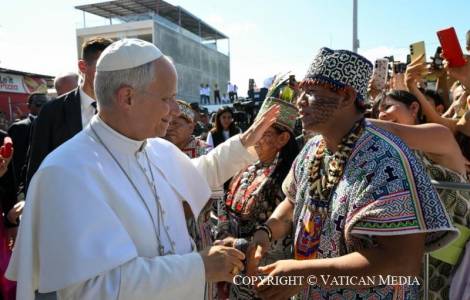
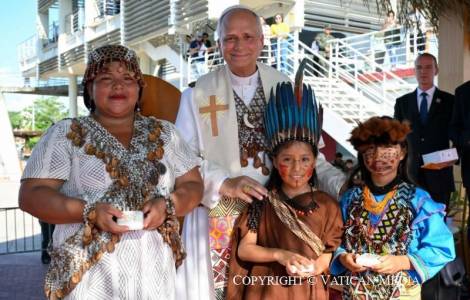
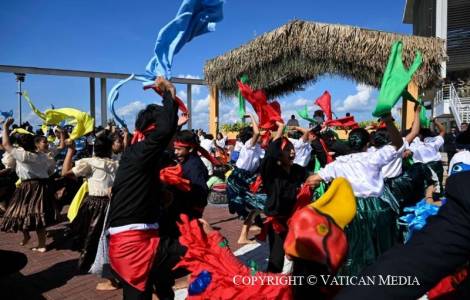
Pucallpa (Fides News Agency) – “Today, to defend our homes can cost our lives.” Representatives of Amazonian indigenous peoples made this appeal to Pope Leo XIV during his meeting with missionaries and local communities on the afternoon of November 15, at Malecón Puerto Callao in Pucallpa, the penultimate stop of his visit to Peru.
Eight years after Pope Francis’ meeting in Puerto Maldonado, many of the concerns raised at that time remain unresolved. According to indigenous representatives, some have even worsened.
Continuing the path begun by his predecessor, Leo XIV recalled the dream expressed by Pope Francis in his Apostolic Exhortation Querida Amazonia: “I dream of an Amazon region that fights for the rights of the poor, the original peoples and the least of our brothers and sisters, where their voices can be heard and their dignity advanced.”
At the beginning of his address, Leo XIV explained the purpose of his visit: “I come as a shepherd to listen to your stories and to walk alongside you. I wish to strengthen you in faith and hope, supporting you in your search for the justice and peace that this land so greatly needs.”
The Pope also recalled that “the Church must walk alongside humanity in order to serve the Lord faithfully. This is essential if we are to become like Jesus Christ and follow him here and now, as we await his return.”
“We continue to go unheard, and discrimination against indigenous peoples persists,” community representatives said. They described a situation marked by land invasions, titles to their lands are challenged and the expansion of activities that threaten their lives and safety. These include oil spills, illegal and indiscriminate logging and extractive mining, and drug trafficking.
All these activities pollute rivers and lakes, destroy forests and undermine the very sources of life on which communities depend. “For us, nature and our territory are not simply land: they are our common home, our history, our identity, our culture and our spirituality,” they explained.
Since the meeting with Pope Francis in Puerto Maldonado in 2018, 37 indigenous leaders have been killed, while many others continue to face threats because they seek to protect their territories and communities.
“Protecting the Amazon must never mean facing death or criminalization for those who defend it,” the indigenous representatives said, calling for protection for those working to defend their communities and justice for those who have lost their lives.
Violence that comes from afar
In 2014, four Ashéninka leaders from Saweto, in the Ucayali region, where Pucallpa is located, were killed after denouncing threats from illegal loggers and fighting to protect their ancestral lands (see Fides, 19/9/2014). Since then, other leaders from the Kichwa, Kakataibo and Harakbut communities have also become victims of violence.
River pollution is another major threat facing Amazonian communities. In August 2026, the Apostolic Vicariate of Iquitos issued an urgent appeal to stop the expansion of illegal mining in the Nanay River basin, the main source of drinking water for more than half a million people in Iquitos and numerous indigenous communities (see Fides, 17/8/2026).
The Pan-Amazonian Ecclesial Network (REPAM) has helped bring this issue to international attention, contributing to a report on Amazonian aquatic ecosystems presented by United Nations Special Rapporteur Pedro Arrojo. The report highlighted river pollution and its consequences for indigenous communities (see Fides, 08/11/2026).
Alongside the threats to their territories, indigenous communities also face limited access to basic rights. In many areas, reaching a health centre means travelling long distances along the river. Children and young people also struggle to access quality education that respects their languages, cultures and traditional knowledge.
The situation of indigenous women and girls is particularly painful. They “suffer violence, including sexual violence, and often cannot obtain either protection or justice,” the representatives said.
“We want communities where a girl can grow up safely and without fear, and where no perpetrator goes unpunished.”
Wounds that remain unhealed
The Pope listened to these appeals, acknowledging that “the voice that rises today from these places speaks to us of wounds that remain unhealed and have, in some cases, grown worse.”
Leo XIV directly linked the situation of Amazonian peoples to environmental destruction: “the cry of the earth and the cry of the poor are inseparable, exposing patterns of exploitation and economic activity that threaten the balance of creation.”
For this reason, he stressed that “the Amazon rainforest cannot be separated from concern for the people who live there. Indeed, integral ecology, social justice, and the spiritual life go hand in hand.”
Caring for Creation and the mission of the Church
Leo XIV also linked the protection of creation and human dignity to the Church’s evangelizing mission.
Recalling that “defending one’s home can cost one’s life” and that “the blood of these brothers cries out to God and demands justice”, he denounced the damage caused by corruption and arbitrary power.
“In every sphere, corruption and arbitrariness undermine the fundamental trust in human goodness. Yet this makes the Gospel an even stronger call to personal and community conversion, offering renewed hope for healing, consolation and reparation,” he said.
The indigenous representatives did not limit themselves to describing their suffering. They also shared their dreams, hopes and efforts to build a different future.
“These are not just dreams: every day we work to turn them into reality, so that our peoples may remain alive. So that our cultures may remain alive. So that our knowledge may remain alive,” they said, affirming their determination to build a dignified future for the next generations.
The Pope recognized their strength and ability to persevere and begin again, seeing in the Amazonian peoples witnesses to Christ, “who does not come down from the Cross, but gives His life for His people.”
In this context, Leo XIV warned against treating the Amazon as “a reserve of resources to be extracted”. Instead, he called for a different model, rooted in the Gospel and respectful of the wisdom of peoples, who recognize, in different languages, that everything in the world is deeply interconnected.
He specifically referred to the damage caused by “indiscriminate deforestation and the pollution of rivers and other waters through illegal mining and oil spills”. These are not isolated accidents, he said, but “the consequences of the irresponsible exploitation of natural resources, which undermines the very existence of communities”.
The Pope also warned about the scourge of drug trafficking, which preys on the poverty of young people, luring them with false promises of profit and uprooting them from their own culture.
The Pope also called for quality education that uses the languages of Amazonian peoples and values their ancestral knowledge, while preparing younger generations to face major global challenges.
The Social Doctrine of the Church, he explained, is constantly developing and helps us read the signs of the times under the guidance of the Holy Spirit.
“Within it, your ancestral knowledge can encounter the rich heritage of the Church's wisdom, in order to ensure that your rights, acquired over generations, may be protected,” he said.
Amazonian peoples express gratitude to missionaries
The indigenous representatives also expressed their heartfelt gratitude to the missionaries who have accompanied, and continue to accompany, Amazonian peoples in their daily lives and struggles.
Among them, they remembered Sister María Agustina Rivas López, known as Aguchita, a member of the Congregation of Our Lady of Charity of the Good Shepherd. She was murdered by the Shining Path guerrilla group on September 27, 1990 in La Florida, in the Junín region, together with eight other local residents.
They also recalled Father José Álvarez, known as Apaktone, among the Harakbut; missionary Luis Bolla, known as Yankuam Jintian, among the Achuar; and Father Gaston Villanueva, known as Korin Bima, among the Shipibo-Konibo.
Leo XIV expressed his gratitude to the men and women religious, as well as to lay pastoral workers, who “with heroic fidelity keep the faith alive in the most remote villages”.
The Apostolic Vicariate of Pucallpa, he noted, has only 25 priests serving a territory as vast as entire countries.
“We must support their formation and recognize their ministerial service,” he said. He also expressed his support for the efforts of the Ecclesial Conference of the Amazon (CEAMA) and the Pan-Amazonian Ecclesial Network (REPAM) to shape a Church with an Amazonian face, bringing together the proclamation of the Gospel and the promotion of integral ecology.
“Christ never abandons us. Christ is with you. The Church is with you, and you are her members. We are the Body of Christ!” the Pope exclaimed.
He concluded by encouraging everyone to move forward “with courage and hope”, entrusting the peoples of the Amazon, their families and their communities to the protection of Mary Most Holy, Mother of the Amazon.
(Fides News Agency, 16/11/2026)
Vatican Media
Vatican Media
Vatican Media



 POPE LEO XIV IN PERU/IV - “Jesus, I trust in you”: The Pope embraces Peru’s young people
 LEO XIV IN PERU: Mission, Augustinian fraternity and the bond with his people, as recounted by Father Lam
 AMAZONIA - UN Special Rapporteur Arrojo denounces river pollution and its devastating impact on indigenous communities: “Water cannot be a business”
 AMERICA/PERU - Apostolic Vicariate of Iquitos issues urgent appeal to curb spread of illegal mining in the Amazon
 LEO XIV IN PERU/III - Pope to Bishops: Along the Inca Trail, following in the footsteps of the Saints
 ASIA/MONGOLIA - COP17: The gift of faith in Jesus and care for creation in the witness of a young Mongolian woman
 Defending land means defending life: Latin American Churches Stand alongside communities in mining conflicts
 Leo XIV: in the lives of new martyrs and witnesses, the reflection of Christ’s victory over death
 ASIA/SOUTH KOREA - Official hymn for Seoul WYD 2027 unveiled: "Take courage; I have overcome the world"
 700 participants enrolled in new online course in missiology and missionary spirituality in English, promoted by the Pontifical Missionary Union