Information service of the Pontifical Mission Societies since 1927
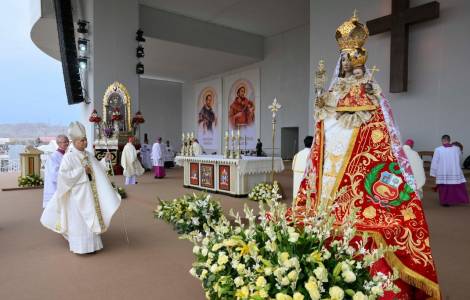
Lima (Fides News Agency) – “My journey is coming to an end, but the mission continues!” This was the message that Pope Leo XIV addressed to the faithful gathered on November 16 at Las Palmas Air Base in Lima for the Mass celebrated at the end of his visit to Peru.
The Pope’s reflection centred on St Turibius de Mogrovejo, the second Archbishop of Lima, on the 300th anniversary of his canonization. In a world “wounded by arrogance”, his life points to a path far removed from worldly power and grounded solely in the strength of “the power of crucified love”.
Born in Mayorga, Spain, in 1538, Turibius seemed destined for a career in law. But his calling to become a shepherd of the Church in Lima changed the course of his life. He became a priest and then a bishop, devoting himself to reaching communities scattered across a vast territory. He died in 1606 while on a pastoral visit, still travelling to meet his people. Pope Benedict XIII canonized him on December 10, 1726, and in 1983 Pope John Paul II proclaimed him patron of the Latin American episcopate.
Pope Leo XIV recalled his life as that of a disciple who was surprised by Jesus’ call. Turibius “crossed this country on foot, covering hundreds and hundreds of kilometers,” conscious that he was following Jesus himself as he set out to meet the Indigenous peoples. He learned their language and sought to understand their beliefs, recognizing “the quiet work of the Holy Spirit”.
Closeness to the people became essential to proclaiming the Gospel, with the conviction that “gentleness” is the only way to proclaim the Risen Christ.
The Pope recalled Turibius’ efforts to ensure that priests learned Quechua and fought for the ordination of Indigenous people and mestizos, who were still despised by many members of the clergy. Turibius wanted them to choose to lay aside their ancestral beliefs freely, without coercion,” the Pope explained.
Through his pastoral visits, Turibius was able to know and help his faithful and, when necessary, to correct them, instructing them in the divine word and administering the sacraments. He refused gifts and continued his ministry despite opposition and slander.
“The only ones who cannot wait are the poor,” Pope Leo XIV said. Turibius gave special attention to those most in need, without excluding anyone. He gave almost everything he received to the poor and supported the establishment of hospitals for indigenous people.
After each pastoral visit, he also brought back observations, complaints and appeals from indigenous communities to the king, seeking to put an end to injustices. His pastoral care therefore included the concrete defence of the people entrusted to him.
The Pope also pointed to Turibius’ work as an early example of the synodal approach. Through councils and synods, the saint knew how to “listen, engage in dialogue, welcome the inspirations of the Spirit and put communal discernment into practice, even including the poor in the search for truth”.
The Pontiff highlighted the lasting impact of the guidelines established in the 16th century, which remained in force until the end of the 19th century. This was a missionary communion that “values differences, sensitivities, and diverse perspectives within the unity of the faith” and finds its centre in the Eucharist.
Turibius, he added, “was an architect of the civilization of love”, alongside contemporary saints such as Saint Rose of Lima, Saint Martin de Porres and Saint Francis Solano.
“Yes, the Peruvian people are also my people!” Pope Leo XIV reaffirmed, assuring the faithful: “I will always carry you with me.”
In his closing words of thanks, he added: “I have felt at home, and you have reminded me that the Church truly is a family.”
He continued: “It was here that you taught me how to be a bishop, and this time I learned a little more about serving as the Successor of Peter.”
Finally, he said: “I came to proclaim Christ to you, and I leave with the witness of the faith and devotion that I always admired in you.”
(MLK) (Fides News Agency, 17/11/2026)