
Information service of the Pontifical Mission Societies since 1927
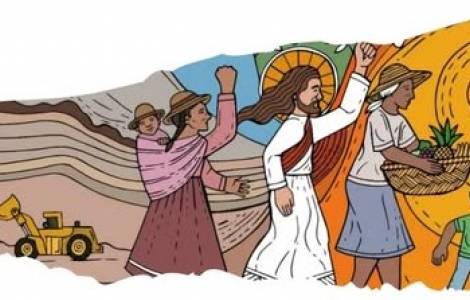
Iglesias y Mineria (Facebook)
by Laura Gómez Ruiz
Chitré (Fides News Agency) – "Our only concern is to safeguard the life of every human being." With these words, Bishop Rafael Valdivieso of Chitré recently summed up the concern of the Catholic Church in Panama amid the ongoing debate over the possible reopening of mining projects in the country. According to the Bishop, any activity that may endanger the health and lives of local communities must be evaluated with the utmost responsibility.
Across Latin America and the Caribbean, local Churches accompany communities affected by the social and environmental consequences of mining, defending human dignity, the rights of peoples and the care of Creation. This is not a rejection of all mining activity, but rather an invitation to discernment in the light of the Social Doctrine of the Church: economic development cannot be separated from respect for life, the common good and the protection of our Common Home.
In July 2025, the Conferences of the Latin American Episcopal Council (CELAM), together with the Churches and Mining Network and with the support of the Dicastery for Promoting Integral Human Development, presented the “Pastoral guidelines in response to the impacts of mining activity in Latin America and the Caribbean.” The document, the fruit of a process of discernment involving around twenty bishops engaged in accompanying communities affected by mining, offers pastoral criteria for addressing socio-environmental conflicts through the defense of life, human rights and care for creation.
One year after the presentation of the Guidelines, this journey continues through formation initiatives promoted by CEBITEPAL, the Churches and Mining Network, and CLAR. The online course, Pastoral guidelines for the Churches in the face of the mining reality, from June 19 to September 4, seeks to provide pastoral workers with tools for discernment and pastoral action in accompanying communities affected by these conflicts.
"Today, mining is reaching every corner of our territories in Latin America, especially rural communities and Indigenous peoples. In many cases, it causes the displacement of communities, fuels social conflict and is accompanied by activities that are profoundly destructive to nature and the environment," says Pedro Sánchez, a member of the Churches and Mining Network and one of the organizers.
The course addresses topics related to the Social Doctrine of the Church, ecological spirituality, the defense of socio-environmental rights, accompaniment of vulnerable communities, and the development of pastoral alternatives that promote justice, participation and care for Creation.
Development that respects life
In Panama, the debate over the possible reactivation of mining projects has once again prompted the Church to voice concern about the consequences extractive activities may have for both communities and the environment.
Bishop Rafael Valdivieso of Chitré recalled that the country's bishops have listened both to experts and representatives of mining companies, while remaining concerned about the effects such projects could have on the people living in the affected areas. "Anything that endangers human health and life represents a serious risk," the Bishop said, referring to the dangers associated with mining. He also stressed that the bishops' position is motivated neither by political nor economic interests, but by the defense of the human person and the pursuit of the common good.
The position expressed by the Bishop follows the Pastoral Letter "Querida Panamá," published by the Panamanian Bishops' Conference in 2024, in which the bishops called for listening to "the cry of the earth and of the peoples," promoting an integral ecology in which the common good becomes the guiding criterion for decisions concerning the country's development.
Defending those who defend the land
Honduras illustrates one of the most painful dimensions of conflicts related to the defense of the land: the violence suffered by those who defend the common good and accompany vulnerable communities.
The death of Juan Antonio López, a delegate of the Word of God, pastoral worker and defender of the Common Home, deeply affected the Honduran Church and was reported by Fides (see Fides, 14/10/2024). López became a point of reference for a pastoral ministry that regards care for Creation as a concrete expression of the gaze on reality illuminated by the Christian faith. For many ecclesial communities throughout Latin America, integral ecology is not an agenda external to the Church's mission but an integral part of the proclamation of the Gospel and the preferential option for the most vulnerable.
Violence against environmental defenders continues to raise serious concern. Following the killing of several farmers in May 2026 in Rigores, in the department of Colón, the Honduran Bishops' Conference expressed its "deep sorrow and indignation," reminding the faithful that "every victim is a person created in the image and likeness of God." The bishops condemned the violence and called for renewed efforts to build "justice, truth and peace."
The Churches and Mining Network likewise recalled that the Bajo Aguán region, "the land of the Minister of the Word Juan Antonio López," has become an area where those defending their territories face grave threats. According to the organization, the killings reveal "a structural problem that generates poverty, inequality, violence, impunity and the absence of the State." For the Church, defending our Common Home necessarily includes protecting those who dedicate themselves to its care, especially those who accompany their communities in the light of faith and commitment to human dignity.
Water as a common good
In Ecuador, the ecclesial community has joined efforts to defend water resources, community lands and the rights of populations living in areas affected by extractive projects.
One of the most significant cases concerns Intag, in Imbabura Province, where farming communities have long opposed mining projects because of their potential impact on an area renowned for its ecological richness. After months of community mobilization, mining company Semperterra withdrew its machinery from the area in June 2026.
In this context, Bishop Geovanni Paz of Latacunga expressed his solidarity with the local communities, saying: "I am very happy to see how the people of Intag have organized themselves to defend their territory. We must continue defending both human rights and the rights of nature."
The defense of these territories forms part of the Christian commitment to care for Creation and protect the most vulnerable communities. Economic development cannot be separated from safeguarding ecosystems, ensuring access to water, and guaranteeing that local populations participate in decisions affecting their territories.
The Churches and Mining Network has also stressed that mining-related conflicts in Ecuador reveal broader problems linked to environmental pollution, water contamination and the social tensions generated by extractive projects. For the Church, these conflicts ultimately raise a deeper question: what model of development can truly guarantee a dignified life for present and future generations?
When the territory challenges the Church's pastoral care
In the Dominican Republic, too, the defense of water has become one of the principal concerns in response to expanding mining projects.
Through its Commission for Ecology and the Environment and the Dominican Bishops' Conference, the local Church has expressed its support for communities seeking to protect both the Central and Northern Cordilleras, emphasizing that access to water is a fundamental human right and an essential criterion in evaluating the sustainability of any mining project.
This concern became particularly evident in May 2026, when several priests joined thousands of demonstrators marching to Santiago de los Caballeros to defend the Northern Cordillera, an impoprtant water reserve for many rural communities. Among them were Fathers Ramón Ramos and Rogelio Cruz, who firmly declared that "life is not negotiable" and called for local communities to be fully involved in decisions concerning their territories.
The presence of priests alongside the faithful reflects a pastoral approach repeated throughout the continent: listening, accompanying and discerning together with local communities how best to respond to the social and environmental consequences of economic decisions that directly affect their daily lives.
Care for creation and the preferential option for the poor
From Central America to the Andes and the Caribbean, these experiences reveal a shared pastoral concern. Mining-related conflicts are not merely disputes over natural resources; they concern real people, communities, cultures and territories. Throughout this journey, the Churches of Latin America continue to affirm that care for Creation is an integral part of proclaiming the Gospel. The preferential option for the most vulnerable and the protection of our Common Home are inseparable dimensions.
Presenting the pastoral guidelines on mining in July 2025, Cardinal Michael Czerny, Prefect of the Dicastery for Promoting Integral Human Development, declared: "The time has come to move from words to action," stressing the need to translate ecclesial reflection into concrete initiatives.
Pope Leo XIV has repeatedly emphasized that environmental concerns cannot be separated from social justice and the defense of the most vulnerable. In his Message for the 2025 World Day of Prayer for the Care of Creation, he recalled that "the destruction of nature does not affect everyone equally" and that its consequences fall above all upon "the poor, the marginalized and the excluded."
In his encyclical Magnifica Humanitas (May 15, 2026), the Pope returned to the theme, affirming that "the quality of development is measured by its ability to unite (...) justice for people and care for our Common Home."
In a continent rich in natural resources yet marked by profound inequalities, the central question guiding the Church's pastoral commitment remains how to promote a model of development that does not leave the most vulnerable behind and protects life as a gift from God. (Fides News Agency, 9/7/2026)



 “Gifts to give and gifts to receive”: The Church of the Sheaves opens its first international conference in Rome
 COLOMBIA - "Mission remains urgent": the Colombian Church renews its missionary commitment on the centenary of DOMUND
 ASIA/MONGOLIA - COP17: The gift of faith in Jesus and care for creation in the witness of a young Mongolian woman
 AMERICA/COLOMBIA - Pope Leo XIV: May Jesus Christ be announced with clarity and immense charity among the inhabitants of the Amazon
 ASIA/SOUTH KOREA - The journey toward WYD 2027 crosses paths with the Church’s social doctrine
 AMERICA/COLOMBIA - Bishops promote initiatives for "responsible voting" ahead of elections