
Information service of the Pontifical Mission Societies since 1927
VaticanMedia
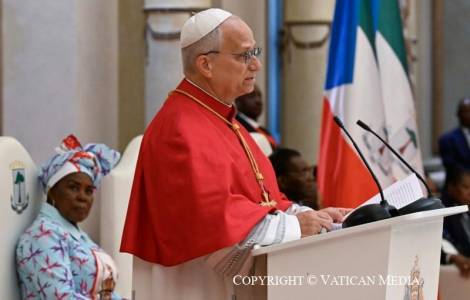
Malabo (Fides News Agency) – “It is always a joy to see places around the world where the Church is growing,” said Pope Leo XIV at a press conference on the flight from Luanda to Malabo in Equatorial Guinea, the last country on his first trip to Africa as Pope, where he was greeted with exuberant joy by numerous faithful from the moment of his arrival. In his first address at the Presidential Palace to representatives of the government, the diplomatic corps, and civil society, he declared that he was happy “to be here and to visit the beloved people of Equatorial Guinea.”
He was welcomed by President Teodoro Obiang Nguema Mbasogo, who had also welcomed Pope John Paul II 44 years ago. He stands as a symbol for those political leaders and rulers who, in many African states, have secured their power for unusually long periods. Forty-four years ago, in his address to President Obiang Nguema Mbasogo—who had come to power through a coup against the dictatorial regime of his uncle, Francisco Macías Nguema—Pope John Paul II described the city as “the symbolic center to which the living aspirations of a people converge for the establishment of a social climate of authentic liberty, justice, respect and promotion of the rights of every person or group, and better living conditions, which allow everyone to realize themselves as human beings and as children of God.” Pope Leo XIV echoed these words in his address, emphasizing: “These are words that remain timely and that challenge anyone entrusted with public responsibility,” and in his address he also recalled the criteria that guide Christians on the path of history and in dealing with world affairs.
The Pope repeatedly quoted Saint Augustine, who, in his work "De Civitate Dei," interpreted events and history according to the model of two cities: the City of God, the eternal city, characterized by unconditional love for God (amor Dei), along with love for one's neighbor, especially the poor; and the earthly city, which is a temporary dwelling place, where men and women live until death. "From this perspective," the Bishop of Rome stated, "the two cities coexist until the end of time." And Christians are called "by God to dwell in the earthly city while keeping their hearts and minds turned toward the heavenly city, their true homeland." "Every human being," Pope Leo XIV continued, "can benefit from the ancient realization of living on earth as a pilgrim." And it is essential "to discern the difference between that which lasts and that which passes, remaining free from the pursuit of unjust wealth and the illusion of dominion.”
For this reason, Pope Leo affirms, “the Church’s social teaching offers guidance to all who seek to address the “new things” that destabilize our planet and human coexistence, while prioritizing, above all else, the Kingdom of God and his justice.” This is “a fundamental dimension of the Church’s mission: to contribute to the formation of consciences through the proclamation of the Gospel, the provision of moral criteria and authentic ethical principles — all while respecting individual freedom and the autonomy of nations and their governments.”
With regard to Equatorial Guinea and other African countries, Leo XIV affirms that “exclusion is the new face of social injustice.” He recalls that Tthe gap between a ‘small minority’ — 1% of the population — and the overwhelming majority has widened dramatically. He emphasizes that “the rapid technological evolution we are witnessing has accelerated speculation” that seemingly overshadows fundamental imperatives such as the safeguarding of creation, the rights of local communities, the dignity of labor and the protection of public health.” In this context, he quotes Pope Francis in his apostolic exhortation “Evangelii Gaudium” about “such an economy kills.” He notes that the current “proliferation of armed conflict is often driven by the exploitation of oil and mineral deposits, occurring with no regard for international law or the self-determination of peoples.” And the new technologies themselves “appear to be conceived and utilized primarily for warlike purposes.”
But—the successor of Peter continued—“God does not want this.” And “his holy Name must not be profaned by the will to dominate, by arrogance or by discrimination; above all, it must never be invoked to justify choices and actions of death.” The concluding words of Pope Leo’s first address in Equatorial Guinea are encouraging: “Your country,” the Pope said, “is a young country! I am certain, therefore, that within the Church you will find help for the formation of free and responsible consciences, enabling you to advance together toward the future.” The Pope recalled that “in a world wounded by arrogance, people hunger and thirst for justice” and that “it is necessary to encourage those who believe in peace and to dare to engage in “countercurrent” politics — those which place the common good at their very center.” He concluded by emphasizing that “The city of God — the city of peace — is indeed received as a gift from on high, the horizon toward which our every noble aspiration turns. It is both a promise and a task.” “Let us, walk together, with wisdom and hope, towards the city of God, which is the city of peace,” the Bishop of Rome concluded. (GV) (Fides News Agency, 21/4/2026)



 ANGELUS - Pope Leo XIV: When we are with Christ, “our needs are abundantly met”
 The Manual of Latin American Ecclesial Communities to address the addiction crisis: A story of Communion
 Defending land means defending life: Latin American Churches Stand alongside communities in mining conflicts
 AMERICA/COLOMBIA - Bishops promote initiatives for "responsible voting" ahead of elections
 Tomáš Halík at the FABC Assembly: «The future of Christianity will depend upon whether our communities become places where people truly learn to see»
 AFRICA/ALGERIA - Record of abstention in Algeria's legislative elections
 AMERICA/CHILE - Chilean Church celebrates Our Lady of Carmel, Queen and Mother of Chile, on the centenary of her coronation
 LEO XIV IN AFRICA - Archbishop Nwachukwu: If Jesus finds refuge again in Africa
 ASIA/PHILIPPINES - Impeachment proceedings against Vice President Sara Duterte: Catholics are guided by the spirit of the "Oratio imperata"
 ASIA/PHILIPPINES - Election campaign between dynasties and polarizations: Bishops' appeal to consider "the well-being of others"