Information service of the Pontifical Mission Societies since 1927
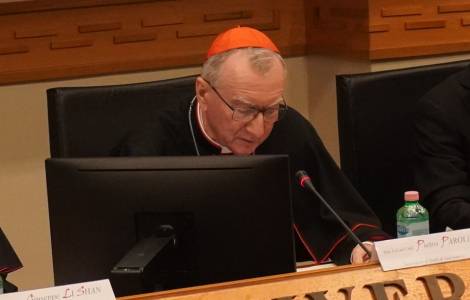
foto Fides (Samuele Massimi)
Rome (Fides News Agency) – We publish the text of the address delivered by Cardinal Pietro Parolin, Secretary of State of His Holiness, at the international conference entitled “The Face of the Universal Church in China: 100 Years Since the Consecration of the First Chinese Bishops” (Pontifical Urbaniana University, November 5, 2026).
§§§
Your Eminences,
Dear brothers in the Episcopate,
Dear priests, men and women religious, and seminarians,
Distinguished speakers,
Ladies and Gentlemen,
It is with great joy that I join you today in commemorating the centenary of the consecration of the first six Chinese Bishops. Strictly speaking, they were the first of the modern era, following the isolated case of Gregory Luo Wenzhao in 1685.
Today’s occasion is made all the more joyful by the presence among us of two brother Bishops from the People’s Republic of China: His Excellency Monsignor Joseph Li Shan, Archbishop of Beijing, and His Excellency Monsignor Ignatius Ding Zuyao, who was recently ordained Bishop of Haimen, one of the sees entrusted to the pastoral care of the prelates ordained in 1926.
I would like to take this opportunity to mention their names: Joseph Hu Ruoshan, Apostolic Vicar of Taizhou; Simon Zhu Kaimin, Apostolic Vicar of Haimen; Philip Zhao Huaiyi, Apostolic Vicar of Xuanhua; Melchior Sun Dezhen, Apostolic Prefect of Lixian; Odoric Chen Hede, Apostolic Prefect of Puqi; and Louis Chen Guodi, Apostolic Vicar of Fenyang.
Their consecration undoubtedly marked a decisive turning point in the history of the Catholic mission in China. It was also a moment of particular significance in expressing the bond between the universal Church and the local Church: having embraced the faith in their respective places of origin, the six newly appointed Pastors, after a long journey, received the fullness of the priesthood directly from the hands of the Successor of Peter, only to be sent back to their homeland with the mission of tending Christ’s flock and further proclaiming the Gospel.
To fully appreciate the significance of this event and the ecclesiological meaning it embodies, it is worth briefly considering the decisions and vision of the man who was the driving force behind its realization.
Indeed, it was the resolute intervention of Pope Pius XI, at the beginning of 1926, that gave decisive impetus to the preparations for the ordination of the first Chinese Bishops in Rome. By resolving certain concerns that had arisen during consultations with the missionaries and in the deliberations of the Roman Curia, Pope Ratti personally made clear his decision to entrust six circumscriptions in the country, some of which had been established specifically for the occasion, to local bishops. “His Holiness decided that we must move forward without hesitation, because otherwise, we will never achieve anything good or solid.” These words, expressed by Cardinal van Rossum, then Prefect of the Congregation for the Propagation of the Faith (Propaganda Fide), describe the firm position expressed by Pius XI during the audience granted to him on the matter on 4 February of that year.
Indeed, even a brief historical examination reveals the central role played by the Pope’s decisions and by the Pontiff himself in the events that led to the consecration, in the Vatican, of the first Chinese prelates.
Several factors helped shape Pius XI’s vision of the future of missionary activity and deepen his affection for the Asian continent and for what was then commonly referred to as the Far East.
First and foremost, the awareness of the universal character of the Catholic Church was being challenged, during the 1920s, by the profound changes brought about by the experience of the First World War. The memory of that immense tragedy had left deep marks on civil society, international relations and, above all, intellectual thought, both secular and religious.
As early as 1919, in his Apostolic Letter Maximum illud, regarded as the Magna Carta of contemporary Catholic missionary activity, Benedict XV had given a renewed impetus to the Church’s mission in the aftermath of the war.
The document highlighted three key points: the rejection of colonialism, including criticism of the connection that had, to some extent, developed between foreign missions and the national interests of Western powers; the promotion of the local indigenous clergy, so that the Church would not be perceived as foreign anywhere; and the neessary evangelical dimension of the mission, with the mandate not to “spread the kingdom of men, but that of Christ”.
On this basis, during the subsequent pontificate of Pius XI, the pax christiana – which, since the nineteenth century, the Church had championed in Europe as a corrective to the growing violence of class conflict – was given a broader meaning. It was no longer confined to a social and Eurocentric perspective but was extended to the wider context of the international community, thereby embracing the question of peaceful coexistence among different nations and cultures.
In Pius XI’s vision, the gradual crisis of the Old Continent, of which the Great War had been a striking manifestation, called for a response grounded in universal openness towards other peoples, who, too, were destined to become part of the Kingdom of Christ and the peace that would flow from it.
As a result, the renewed missionary impetus that had been gathering strength since the beginning of the century was reorganised under the pontificate of Pope Ratti, in accordance with new sensibilities and new guiding principles.
One of the most significant features of this development was the changing appreciation of non-European peoples, particularly those of Asia.
Indeed, in the homily he delivered on October 28, 1926, on the occasion of the ordination of the six Chinese Bishops, the Pontiff expressed genuine esteem” for China, describing it as "boundless regions where, since the remotest antiquity, literature and the arts have flourished”.
This represented a radically different outlook from that conveyed by the expression “populi in tenebris et in umbra mortis sedentes” (“peoples sitting in darkness and in the shadow of death”), which until then had also shaped, within Catholic circles, the prevailing perception of non-Christian civilizations.
While keeping missionary activity firmly focused on the proclamation of the faith and the name of Christ, this renewed perspective paved the way for a transition from a concept based on the assumption that there was only one truly developed civilization – which therefore had to be exported and transmitted – to one recognizing a plurality of civilizations, each possessing its own intrinsic, albeit imperfect, validity and therefore calling for a more complex effort of mutual encounter and dialogue.
This innovative missionary model was adopted and authoritatively set forth in the Encyclical Rerum Ecclesiae, promulgated by Pius XI on February 28, 1926, just a few months before the six Chinese Bishops arrived in Rome for their consecration. The document clearly sets out several fundamental principles of the Catholic mission which, although they may seem self-evident today, were genuinely innovative at the time: the local clergy were no longer regarded as merely an auxiliary element, but were entrusted with full responsibility for ecclesiastical governance; the formation of indigenous Bishops became a structural objective and a necessary condition for the future stability of the Church; local religious congregations were called upon to become an integral part of this project, ensuring a widespread missionary organization; finally, greater awareness emerged of the importance of understanding local ways of thinking and valuing local culture in order to transmit the faith effectively.
In this respect, the mission in China became a driving force and a pioneering example for other regions, both in Asia and on other continents, which soon adopted the same missionary model. The response in China to the decisions taken by Pius XI was indeed enthusiastic, as evidenced by a report sent to Propaganda Fide on August 18, 1926 by Monsignor Celso Costantini, then Apostolic Delegate in Beijing: “The Encyclical Rerum Ecclesiae, […] the appointment of the six Chinese Bishops and their consecration in Rome have made a profound impression: it is as though an electric shock had passed through the missions, awakening hearts and setting them on a new path. […] With the appointment of the six Chinese Bishops, the Pope has definitively brought one historical period to a close and inaugurated another.”
The Pope’s missionary foresight and pastoral determination thus played a decisive role in the successful outcome of the events surrounding the first six Chinese Bishops of the modern era. However, a reading of the brief homily he delivered on October 28, 1926 also reveals, beyond any doubt, the personal and deeply spiritual bond he sought to establish with these first sons of the Chinese nation to be raised to the dignity of the episcopate.
First of all, the Pope explained that he had chosen to hold the celebration on the very same day on which, seven years earlier, he himself had received episcopal consecration. He described this coincidence as “a most precious favour”, for which he would always remain grateful to God.
He then placed particular emphasis on the symbolic significance of the setting he had chosen for the rite: “We summoned you, in fact, to this city, the centre of the Christian religion, so that you, whom we consecrate in the august majesty of this temple dedicated to Peter, as the first fruits and budding shoots of the Chinese episcopate, […] might return from here to your own regions; from here, we say, from where the source of all apostolic ministry flows.”
Finally, he expressed in deeply affectionate terms the bond of faith forged by that occasion: “You have come, venerable Brothers, to see Peter. […] And Peter has welcomed you with such great affection.”
It is clear that, in the Pontiff’s intention, this moment of such great significance was not merely an expression of a wise strategy for missionary organization. Rather, it was conceived as a means of expressing a deeper and more fundamental reality: the bond between the Successor of Peter and the Successors of the Apostles, in China as in every corner of the world. This bond is a constitutive element of the life of the Church, indispensable to the proclamation of Christ and a defining criterion for recognizing the apostolic character of the Church’s Gospel witness.
From the very first centuries of the ecclesial community’s life, the pope and the bishops have been joined by a bond rooted in Christ’s mandate and nurtured in the communion of the Spirit. Just as Peter was called to strengthen his brothers, so too is the successor of Peter a visible sign of unity for the pastors of the Church. The Bishops, dispersed throughout the various lands of the world, remain united with one another and with the Pope in the same faith, the same mission and the same charity.
There are many Churches, and many are the voices and faces of the peoples of the world; yet there is only one Body of Christ, which all are called to serve.
Within this wondrous divine design, the Petrine primacy and the mission of the Bishops are certainly not opposing realities: they belong to one and the same ecclesial communion. As members of the College of Bishops, the Bishops share responsibility not only for the pastoral care of their own dioceses but also for the entire Church – the sollicitudo omnium Ecclesiarum (concern for all the Churches).
In the Bishop of Rome, moreover, this universal solicitude takes on a particular intensity, since it is united to the supreme, full, universal and immediate pastoral power over the whole Church, conferred by Christ.
The ministry of the Successor of Peter, therefore, is not exercised in relation to the individual particular Churches as an external authority intervening from outside; rather, it belongs intimately to their very ecclesial life.
Far from being a form of political hegemony, this inherent presence of the Petrine ministry within every portion of the People of God manifests a wonderful, reciprocal interiority between the universal Church and the particular Churches. They are not separate or merely juxtaposed realities, but intimately interconnected dimensions of the one Church of Christ. As the Dogmatic Constitution Lumen gentium states: “In virtue of this catholicity each individual part contributes through its special gifts to the good of the other parts and of the whole Church. Through the common sharing of gifts and through the common effort to attain fullness in unity, the whole and each of the parts receive increase.”
On the basis of these theological principles, the bond established so visibly and symbolically between Pius XI and the first six Chinese Bishops also offers an eloquent reminder for our own times.
In this regard, I believe that at least two points for reflection can be identified.
What took place a hundred years ago first and foremost brings into sharp focus the question of communion between the Pope and the Catholic Bishops in China. The Holy See has always regarded this as a fundamental guiding principle – perhaps the decisive criterion above all others – in directing its work.
From those luminous beginnings on October 28, 1926 to the present day, throughout the complex events that have repeatedly shaped the course of world history, every step taken by the Apostolic See towards China has been intended to offer and safeguard this relationship of communion and effective communication.
This is based on certain essential criteria: the necessity that individuals truly desire such communion, and that the external conditions exist for it to be expressed; the awareness that communication between the Bishops and the Pope “must not take up the political struggle in its own hands in order to bring about a more just society; it cannot and must not take the place of the State; but neither can it nor must it remain on the sidelines in the struggle for justice”; and, finally, the conviction that, in the eyes of the Pope, all the baptized are equally his children, whatever choices they may feel called upon in conscience to make within their concrete historical and political circumstances. In this regard, the words of Pope Francis, written in 2018 following the signing of the Provisional Agreement on the appointment of Bishops, are particularly significant. They bear witness to the joy and pastoral concern with which the Pontiff nurtured his bond with his brothers and sisters living in China: “I would like you to know that, ever since I was entrusted with the Petrine ministry, I have found great consolation in seeing the sincere desire of Chinese Catholics to live their faith in full communion with the universal Church and with the Successor of Peter.”
It is from this conviction, I believe, that our hope for the future also stems: that the communion which today undoubtedly exists in its essential form between the Pope and all the Bishops in the People’s Republic of China may, through a gradual and shared journey, find ever more concrete ways of expressing itself, being nurtured and growing stronger.
A second point for reflection concerns the effects produced by this bond of communion.
On the day of the consecration of the six Bishops, Pius XI concluded his homily with a mandate expressed in particularly forceful terms: “The words of Christ the Lord may rightly be addressed to you also, at this solemn hour, by the Vicar of Christ: ‘Lift up your eyes and look upon the regions – those vast regions of yours – which are already white for the harvest’; and again: ‘Go, also into my vineyard’; and furthermore: ‘Go forth, preach, teach, baptize, bless. For I have chosen you so that you may go and bear fruit, and that your fruit may endure.’”
This was a mandate which, in a sense, transcended the immediate circumstances to mark the beginning of a broader transition: although the work of Western missionaries continued for a long time to make an invaluable contribution to the growth of the Church in China, a new era of responsibility for local Catholics began at that moment.
Exactly one hundred years after that day, sharing the same joy as Pius XI, we too can affirm that today the Chinese Catholics themselves, and their Bishops in particular, are called to be the principal agents of the mission in China.
It is their privilege and responsibility to take up the legacy of this historical journey, becoming protagonists in the life of the Church and promoting, with ever-renewed zeal, the evangelization of their homeland. This is why the Holy See regards them and the people entrusted to their pastoral care with such deep affection, and remains wholeheartedly willing to accompany and support them along this path.
Communion and mission are therefore inseparable dimensions of ecclesial life, today as in the past, in China as throughout the rest of the world. Without the impetus of mission, communion remains static and may even risk fading away; without the vital bonds of communion, on the other hand, mission becomes dispersed into a thousand sterile streams.
As I draw this brief historical overview to a close, I wish to repeat the words with which Pope Leo, a few days ago, marked the centenary of World Mission Sunday, established by Pius XI himself. I make these words my particular wish for the future of the Church in China:
“At the heart of mission lies the mystery of union with Christ. Before his Passion, Jesus prayed to the Father: ‘so that they may all be one, as you, Father, are in me and I in you, that they also may be in us’ (Jn 17:21). These words reveal the deepest desire of the Lord Jesus and, at the same time, the very identity of the Church, the community of his disciples: to be a communion that springs from the Trinity and lives from and within the Trinity, at the service of fraternity among all human beings and harmony with all creatures. […]
The unity of the disciples is not an end in itself: it is directed towards mission. Jesus states this clearly: ‘So that the world may believe that you sent me’ (Jn 17:21). It is through the witness of a reconciled, fraternal and supportive community that the proclamation of the Gospel finds its full communicative power.”
(Fides News Agency, 5/11/2026)