
Information service of the Pontifical Mission Societies since 1927
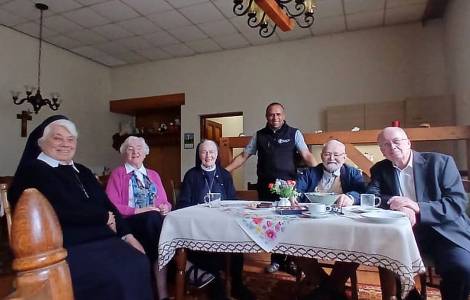
photo:Christian Sieland
by Marie-Lucile Kubacki
Port Moresby (Fides News Agency) - Father Christian Sieland, director of PMS Papua New Guinea, is the son of a German lay missionary who lived his apostolic vocation for more than two decades alongside priests and religious. Gratefully recognizing the great value of his experience as a young volunteer in Papua New Guinea and his close contact with missionaries from different nations, Father Christian today participates in the adventure of a local Church in transition from ‘missionary dependency’ to full local responsibility, encouraging a renewed inculturation of the Gospel. In this context, his recent journey to visit elderly missionaries, who served in his homeland and now live in retirement homes in several European countries, becomes both an act of gratitude and a living lesson: by honoring those who first bore witness to the faith, he invites a new generation to remember its roots, to cherish its cultural heritage, and to let the Gospel take ever deeper root in the soil of their people’s lives.
You have recently spent time visiting elderly missionaries who served for many years in Papua New Guinea. What struck you most in the way they look back on their mission today?
Yes, following the PMS General Assembly, I traveled to the Netherlands and Germany to visit some of our retired Dutch and German missionaries in their retirement homes. I visited Teteringen in the Netherlands for the Dutch missionaries, and Steyl, also in the Netherlands, for the German missionaries. These missionaries belong to the Society of the Divine Word (SVD) and the Missionary Sisters Servant of the Holy Spirit (SSpS). Both congregations were founded by St. Arnold Janssen and sent out into the world. Their pioneers reached New Guinea in 1896, beginning their missionary work along the coastal areas before venturing inland into the central Highlands. Most of the missionaries I visited are now in their late 80s or early 90s. My Bishop Emeritus, the Most Rev. Henk Te Maarssen, SVD, was in Teteringen when I visited; he will turn 93 this September. He spent almost 60 years in Papua New Guinea—more than 50 years as a priest and 8 years as a bishop.
Generally, these missionaries would have loved to stay in their mission countries and be buried in the soil of the land they served. However, due to failing health and the availability of specialized medical services in their home countries, they had to return. Yet, although they are physically present in Europe, their hearts and thoughts remain entirely in Papua New Guinea. Listening to their stories, it was clear that they have absolutely no regrets about choosing a missionary life; given the chance, they would make the exact same choice over and over again. What they often don't fully realize is that by evangelizing our people, they also laid the foundations for the modern nation of Papua New Guinea, which is now 90% Christian. What struck me most about them was their profound humility. In many cases, they did pioneering missionary work—preaching, baptizing, and building a vast network of infrastructure, including parishes, schools, and hospitals to serve our people. Yet, they never boast about their achievements; they did everything simply for the glory of God.
When these senior missionaries speak about the people and communities they accompanied, what words or images do they use most often, and what does that tell you about their understanding of mission?
The first thing you notice when listening to them is that they identify 100% with the people and communities of Papua New Guinea, whom they served for over half a century in some cases. In their reflections and shared memories, there is very little negativity. Instead, their words reflect deep respect and, I would even say, reverence for the people, their traditions, and their culture. Their missionary experiences completely grounded them in reality, simplicity, and humility. Many of them arrived in the 1950s and 1960s. Back then, they had to learn the local vernacular languages from scratch, which gave them a profound understanding of our country's diverse cultures and traditions. I feel that this early missionary spirit is sometimes missing among many of the newer missionaries arriving today, largely because most of the groundwork has already been laid. Modern missionaries continue to build upon the foundations established by these early pioneers, but the raw zeal and energy of those first trailblazers was something entirely unique.
From their experience on the ground—often in very remote and difficult areas—what lessons about patience, perseverance and humility have particularly struck you?
When I talk about expatriate missionaries coming to PNG and spending anywhere from a few years to five decades here, I often say that they have been infected with the "New Guinea virus." This deep exposure to the country permanently changes a person. As pioneers, they entered the most remote areas where there were no roads, schools, or health centers. They lived directly with the people, slept in their villages, and ate whatever food was offered to them. Through this, they learned that the Western dictionary definition of "poverty" has no real meaning in a country like Papua New Guinea. Even though the people had no money—and needed no money for their daily survival—they actually had everything. God blessed them with a land that provided for all their needs. Even today, 90% of the land belongs traditionally to the people and their tribes; land is the greatest asset any Papua New Guinean possesses. While working alongside the people, the missionaries naturally adapted to a simple, humble lifestyle. This way of life was intrinsically connected to the traditional social systems of PNG, which already contained many of the Gospel values the missionaries came to preach. God had prepared our people over many centuries for this encounter with the Word. This is why they embraced the Gospel so readily and rapidly—they recognized their own values reflected in the Christian message, but could now understand and appreciate them through the light of faith.
In which way?
Patience, perseverance, and humility are truly the three virtues shaped over decades of evangelization. To leave a so-called "civilized world" and enter a tribal society with a complex social structure requires these three elements; without them, you can never truly reach the hearts of the people. With patience and humility comes a deep openness, allowing a missionary to truly appreciate what is right in front of them. It is not a "primitive, stone-age culture," as many early Westerners dismissively described it, but a highly sophisticated society made up of a thousand distinct tribes and cultures. The missionaries understood this. In my own journey with our people, the most important lesson they have taught me is that true happiness is found in simplicity. From that simplicity, you naturally learn humility and patience—the ultimate keys to unlocking human hearts.
These missionaries arrived in a cultural context very different from their own. How did they learn to respect and value local traditions, and what aspects of their approach to inculturation would you like to pass on to younger missionaries and priests?
The very first prerequisite is open-mindedness. You cannot be an effective missionary if you do not appreciate the hidden beauty and complexity of other cultures. No single culture is superior to another; rather, every culture has a purpose in enriching others. You cannot arrive in a foreign land and condemn local traditions, customs, and cultures, whether before or during the proclamation of the Gospel. Our early missionaries must be highly commended for taking an open-minded approach. They took the time to study local cultures and languages, even compiling dictionaries and grammar guides for languages that, up until then, had been entirely oral. They highlighted the beautiful values already present in the culture, while also finding the courage to gently tell the people when certain tribal practices were incompatible with the Gospel. This process of inculturation unfolded over many decades. I believe it bore its finest fruit when locally trained catechists emerged. These catechists were well-educated, highly trained in theology, and intimately understood the depth of their own traditions. Consequently, they were able to preach the Gospel effectively to their own people in their own languages. They were often sent ahead by foreign missionaries into untouched territories to do the foundational groundwork, and they served as the best translators and cultural interpreters for the church. (Fides News Agency, 8/7/2026)



 The Heaven opened, the Bishop’s Mission, and the Grace of being a little flock
 The Gospel bears fruit among mountainous ethnic minorities in Northern Vietnam
 ASIA/KYRGYZSTAN - “The fate of the flock is my fate”: Bishop Anthony Corcoran’s missionary road
 The Church of the Sheaves: a missionary perspective presented to Newly Ordained Bishops
 EUROPE/HUNGARY - Message of the annual gathering of the Pontifical Society of the Holy Childhood: Different yet united in the love of Christ
 EUROPE/POLAND - Mission seeks new paths: the message that emerged from the autumn meeting of the Pontifical Mission Societies
 Bishop Martinelli at the Inter-Christian Symposium in Thessaloniki: Migrants have made the Arabian Peninsula a “Laboratory of an Intercultural Church”
 The Centenary of the consecration of Six Chinese Bishops and the Provisional Agreement between the Holy See and the People’s Republic of China