
Information service of the Pontifical Mission Societies since 1927
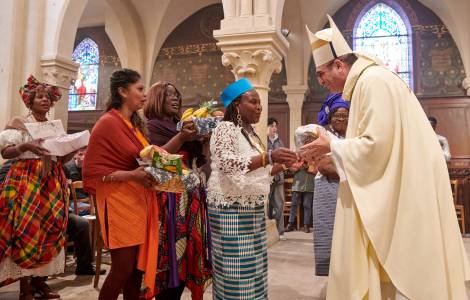
photo Manuel Lagos Cid
by Marie-Lucile Kubacki
Saint-Denis (Fides news Agency) – As the Diocese of Saint-Denis prepares to welcome Pope Leo XIV during his visit to France (September 25–28) for a prayer vigil with youth and catechumens at the Stade de France, enthusiasm is so high that the registration portal was overwhelmed as soon as it opened.
Rich with centuries of history, the Church of Saint-Denis is also a place of ecclesial renewal—shaped by its working-class, often impoverished, multi-ethnic, and multi-faith environment.
Speaking to Fides, local bishop Étienne Guillet offers a portrait of his small yet "vibrant" Church, which could very well serve as a living laboratory for the universal Church.
Registrations for Pope Leo XIV’s vigil at the Stade de France filled up almost instantly. What does this level of enthusiasm tell us?
The first round of spots actually filled up in an hour and a half! The registration platform was overwhelmed, and young people are still searching for tickets—there is clearly a huge sense of anticipation. It is a wonderful sign for the Church in France.
The Stade de France is located right here in Saint-Denis, and we are thrilled the Pope is coming to our diocese. We have a story to tell, and we are certainly not just a "Parisian suburb"! He will be welcomed into a dynamic territory with its own distinct history, diverse population, and a vibrant local Church known for its unique creativity and renewal.
In fact, right from inside the stadium, you have a direct view of the Basilica of Saint-Denis and its nave.
What do the adults currently seeking baptism in Seine-Saint-Denis look like?
Reading the letters sent to the bishop before Easter is an incredible gift. Some write half a page,while others share ten pages of their life story. The largest group is between 18 and 25 years old, but there is not a single “sociological profile.” Some catechumens grew up around Christianity without ever being baptized. Parents, or often grandparents, passed down prayers, the Gospel, or the habit of going to church. For families who came from Cape Verde—often via Portugal—settling down, language barriers, and day-to-day survival meant sacraments were pushed into the background for a while, because other matters were more urgent. Once established, however, these young people want to complete that journey.
Others had almost no prior contact with the Gospel. Yet, there is always a point of contact, a mediator: the witness of a friend, a coworker, a sister-in-law, or a neighbor; an invitation to Mass; or something they found online.
Social media is not everything, but it is where people ask their initial questions today. We need to offer solid answers there, but how do we ensure they find meaningful, nourishing content?
Sometimes, simply stepping into an open church—with its silence and beauty—is enough to create space for an encounter with God.
Can you give a concrete example of this?
One man shared how, after a very hard day, he saw a bell tower from his commuter train. He stepped inside and found a spark of peace that completely changed his life. This really challenges us as a Church: our doors need to stay open and welcoming. Yet, more and more, due to security or lack of staff, many church doors remain locked, even in major tourist areas.
Does the religious reality typical of the department emerge in these journeys?
Overall, about 15% of the letters come from people who grew up in or close to a Muslim environment—either attending a mosque themselves or having a Muslim parent.
Their path often involves personal connections and online searching, but very frequently, they mention a dream or a profound spiritual experience. That might surprise our Western rationality, but afterall, dreams run all through the Bible!
The letters also feature working- and middle-class people of French background whom the Church has struggled to reach in recent years: civil servants, office workers, tradespeople.
Their presence challenges the idea that these baptisms are about identity politics or a reaction against another religious group. What these stories describe is not an ideological struggle; it is primarily the joy of encountering Christ. Many pinpoint the awakening of their faith to a time of trial—grief, illness, unemployment, or despair. That is when they come to understand existentially what it means for Jesus to be theSavior: not an abstract concept, but someone who reaches down to rescue you when you are drowning inside, giving you the desire to move forward and love again.
Has the strong Muslim presence impacted how Christians express their faith?
In Seine-Saint-Denis, Muslims have actually made it easier for people to talk openly about God and profess their faith. Young Christians, though a minority, feel free to say they are Christian and be happy about it. They get asked questions, sometimes challenged, but it does not create a hostile environment—even if outsiders often assume otherwise.
In highly diverse, working-class neighborhoods, believing in God is generally recognized and respected. As the First Epistle of Peter puts it, we are called to "give an account for the hope that is in us.
"This sense of pride belongs to a local Catholicism that may be a minority, but is vibrant and non-aggressive. The March for Jesus—originally started by Evangelicals—really highlighted this reality for us. Even before the institutional Church formally decided to participate, local youth were already showing up. Our parish choirs joined in with real joy. Witnessing one's faith does not mean engaging in a power struggle; it means peacefully living out who you are.
You mention new catechumens, dreams, and the joy of being part of a community—is the Book of Acts coming alive in Seine-Saint-Denis?
It really is. Whenever the Church undergoes a rebirth, you see the same themes: dreams, callings, new communities forming, and stories of grace. The Book of Acts is a faithful reflection on the birth of the Church that became the standard for a growing community.
Today's catechumens remind us of those same truths: faith is born through encounters, prayer, Scripture, community, and sharing and missionary joy. These are stories of salvation and grace.
How are these newly baptized adults transforming parishes and reshaping the approach to mission?
The main challenge is genuinely integrating them. In parish life, two phrases can instantly discourage a newcomer: "we have always done it this way" and "we do not need any more help."
Instead, we need to get to know each person, make them feel seen, and trust them with responsibilities quickly. Why wait two years before asking someone to read, sing, welcome people, serve, or get involved in charity work? Evangelical communities set a great example here by giving people real responsibilities right away.
Integration is a two-way street. Long-time parishioners need to make room for the newly baptized, while newcomers are joining a community with its own history, wisdom, rhythm, and traditions. But this is a top priority, because without strong community ties, some people get discouraged after having such an attentive catechumenate. Sacramental grace is always at work, but we know a Christian on their own is a Christian in danger. Because of this, we are looking across the Île-de-France region at ways to build mentorship programs for the newly baptized, small groups that continue after baptism, and earlier integration into parish life. Sunday Mass is essential, but it is not always enough—you can walk in and out completely anonymous. Everyone needs a small group where they are known, where their absence is noticed, and where someone reaches out to check on them. We have to help people identify their gifts right from the start: "You are welcome here, and we need what you bring with you."
There are fifty different ways to get people involved. Serving on a security team, a catechism group, joining the choir, or helping clean the church can all become places of friendship, prayer, and shared commitment. The Christian life links our vertical relationship with God—liturgy, prayer, popular devotion—with our horizontal relationship with one another. Those two axes form the cross.
The Church in Saint-Denis has over 1,700 years of history. Does that history resonate with these newcomers?
Our diocesan history is multifaceted: Saint Denis—our first bishop around 250 AD—and his companions; the medieval basilica; the royal necropolis holding the remains of 70 monarchs;
monastic history; Gothic architecture and stained glass; as well as the more recent history of migration, poverty, and worker-priests. However, the aspect that resonates most with catechumens is Saint Denis as a missionary, baptizer, and martyr. According to tradition, he came to ancient Lutetia with the priest Rusticus and the deacon Eleutherius to preach the Gospel and celebrate the first baptisms there! People are most drawn to that authentic, deeply missionary spirit of martyrdom. Ending a liturgy in the basilica’s choir near their relics connects the Church today back to its roots: receiving salvation and being missionaries in a complex, sometimes risky world. It is a journey greatly appreciated by the faithful.
The spire of the basilica is currently being rebuilt, and we have offered to fund four new bells. It sounds like a wild project given how financially poor we are, but behind it is a desire to give visible form to that continuity. Architecturally, a spire acts like a pointing finger, inviting us to look toward heaven—even as Gothic design anchors it to the ground, where we are called to build the Kingdom here and now. We hope to cast these bells right in the church plaza as was done in ancient times; they will ring out for joy, prayer, baptisms, weddings, funerals, and peace. At the same time, the medieval pilgrimage to Saint Denis' tomb is making a real come back. More and more parish groups, schools, and youth clubs have been visiting in recent years. We need to offer them a true spiritual journey that goes beyond Gothic architecture and leads them into prayer.
What are your hopes for Pope Leo XIV’s visit?
First and foremost, great joy and pride. Public officials, including non-Christians, received the news with real enthusiasm; they see it as a blessing not just for local Christians, but for the entire region. Many are eager to hear a message that reaches beyond the Catholic community. They already respect the Pope’s geopolitical courage and recognize that his words offer a vision that can lift us all up. The Muslim community in Seine-Saint-Denis was deeply moved by his trip to Algeria—particularly his stop in Annaba in the footsteps of St. Augustine, a key historic figure for many of Algerian descent. Deep down, our local Church resembles the Church in Algeria: small, operating in a complex environment, yet remarkably vibrant.
In Seine-Saint-Denis, a region marked by poverty, cultural diversity, and religious pluralism—Muslims, Jews, Sikhs, Buddhists, and Christians—this event can serve as a powerful symbol of peace. In our thirteen Catholic high schools, we plan to form small teams of "Papal Ambassadors": two Catholic students inviting eight non-Catholic classmates. They will prepare for the papal vigil together, attend as a group, and bring what they experienced back to their schools. This simple initiative reflects a core conviction: religions are not destined to fuel conflict; their primary mission is to build peace. Even as a minority, the Church can remain joyful, courageous, and a builder of bridges. (Fides News Agency, 13/8/2026)
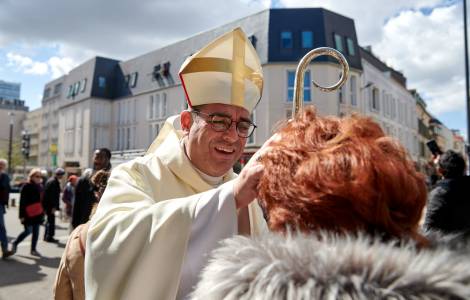
Photo Manuel Lagos Cid



 The seed of the Gospel and mission: Archbishop Sangalli concludes the formation Course for bishops in Nemi with a meditation on St Charles de Foucauld
 AFRICA/MALAWI - Archbishop Nwachukwu at the Jubilee marking 125 years of the Gospel in Malawi. Two new priests for a Church called to set out anew on mission
 "You will see greater things": FABC opens its 12th Plenary Assembly in Jakarta
 The new catechumens and the first Christians. Archbishop of Reims: "The Pope will encounter a Church in France undergoing profound transformation"
 BEATIFICATION OF FULTON SHEEN/IV - Sons and Daughters of the same Father. Fulton Sheen and racial segregation
 Leo XIV: in the lives of new martyrs and witnesses, the reflection of Christ’s victory over death
 Leo XIV to the new Bishops: Remain with Jesus, the “Good Shepherd,” to keep a missionary heart
 Pope to Latin Catholic Bishops in the Arab Regions: “Do not be afraid of your smallness”
 Cardinal Vesco: in Algeria, Augustine is also a “universal brother”
 Three Churches pray for peace on the border between the Czech Republic, Slovakia, and Poland
 ASIA/THAILAND - National Director of the Pontifical Mission Societies: "Let us disarm hearts and build bridges of reconciliation with Cambodia"