
Information service of the Pontifical Mission Societies since 1927
SJM
by Paolo Affatato
Astana (Fides News Agency) – The Catholic Church in Kazakhstan is experiencing a phase of profound transformation: it is no longer simply the Church of former Polish, German or Ukrainian deportees, but it is increasingly becoming a community that looks to the Kazakh people and their language. As a commission of bishops works on translating the Missal and other liturgical texts into Kazakh, a growing number of ethnic Kazakhs are asking to learn about the Gospel and receive Baptism. This is what Father Gabriel Jocher, a 37-year-old Austrian priest of the Congregation of the Servants of Jesus and Mary (SJM) and National Director of the Pontifical Mission Societies (PMS) in Kazakhstan, told Fides.
The Catholic community in Kazakhstan is a minority in a country of around 20 million inhabitants, where Islam is the religion of the majority and the Orthodox Church constitutes the second-largest Christian community. Catholics number an estimated 120,000 faithful, organized in the Metropolitan Archdiocese of the Most Holy Virgin Mary in Astana, the dioceses of Karaganda and Almaty, and the Apostolic Administration of Atyrau.
The Catholic presence is rooted above all in the deportations of Poles, Germans, Ukrainians and Lithuanians during the Soviet era, when thousands of believers were sent to labor camps and settlements across Kazakhstan. Following the country's independence and the restoration of Church structures in the 1990s, the Catholic Church gradually developed a missionary dimension. Today, while the historic communities of former deportees continue to shrink as many families have returned to their countries of origin, pastoral attention is increasingly focused on the Kazakh population. More and more local people, coming from Muslim families or non-religious backgrounds, are spontaneously embracing the Gospel and asking to begin the catechumenate.
"Twenty years ago, missionaries were here mainly to accompany the former Catholic settlers. Today the future of the Church is different: pastoral ministry is increasingly focused on the Kazakh community," Fr. Jocher says.
"Russian is still the language most commonly used in our liturgy, catechesis and pastoral care," he explains. "The problem is that there is still no official Catholic translation of the Bible or liturgical books. Protestant communities already have their own version, while we are still working on it."
For this reason, the local Church considers the translation of liturgical texts a missionary priority: "For the Kazakh people it would be extremely important to be able to celebrate Mass and pray in their own language," Fr. Gabriel observes. "This is a process of inculturation that takes time. A special commission is working on it. We must find the right words and the most appropriate theological terminology. But once this work is completed, I believe many more people will feel involved and happy to participate in the life of the Church."
The first steps have already been taken. "Every day in our cathedral we pray the Rosary in both Russian and Kazakh," he says. "During Mass we sing several hymns in Kazakh. At the Major Seminary in Karaganda, we also celebrate an experimental liturgy in Kazakh once a week: all the readings, prayers and the homily are in Kazakh, while the words of consecration remain in Latin."
The formation of future priests also reflects this perspective: "We are teaching seminarians in Kazakh," explains the National Director of the PMS. "We are convinced that this is the path for the future of the Church in this country."
The change also affects the very face of Catholic communities. "In rural areas, Christians are still largely descendants of those deported during Stalin's era," Father Jocher recalls. "They were Germans, Poles, Ukrainians and other peoples forcibly sent to Kazakhstan's gulags. After the collapse of the Soviet Union, many returned to Germany, Poland and other countries. As a result, many rural parishes have gradually become smaller."
At the same time, however, a new phenomenon has emerged. "In the major cities," he notes, "we see Kazakh people every day, with no Christian background, often from Muslim families or from atheist backgrounds, spontaneously entering our churches."
"They simply ask: 'What is this place? What do you do here?' That opens the door for us to introduce them to the Gospel and to the Church."
According to the missionary, these are people engaged in a genuine spiritual search: "We now have a significant number of Kazakhs from Muslim backgrounds who have converted to Catholicism," he says. "We cannot always explain what draws them. Perhaps they are searching for the meaning of life. The Gospel speaks to their hearts."
Their journey is not without challenges: "In some families there is mistrust and dissent," he explains. "Many believe that Kazakh identity and Islam are inseparable. They think changing religion means abandoning one's culture. We explain instead that it is entirely possible to be fully Kazakh and fully Christian."
Many catechumens firmly defend this freedom: "They tell their family members: 'This is my personal choice. I want to follow this path.' They then begin a preparation for the sacraments that lasts about one year."
Each Easter brings new fruits. "In the parish where I currently serve in Astana, we celebrated four adult baptisms this year; last year there were twelve. At present another ten people are following the catechumenate."
Sometimes the first encounter with Christ begins simply from the silence of a church. "Sometimes a person comes asking for information," Father Gabriel recounts. "We simply tell them: 'Go to the Chapel of the Ascension, sit down and pray to God.' Then the Holy Spirit does the rest. After that experience, many express an interest in the Christian faith."
Mission also means creating places of encounter in a society where direct evangelization is subject to legal restrictions. "As missionaries," he explains, "we are allowed to work only within the areas where we are registered."
"For this reason, building relationships is essential. We organize concerts in churches that also include Muslims, as well, cultural events and social initiatives. The nuns care for sick and disabled children. Our school has become a privileged place for meeting with the local population."
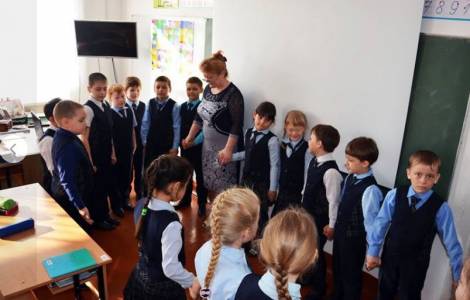
Father Gabriel has been living in Kazakhstan for about two and a half years. His congregation has managed a school in Korneevka, in northern Kazakhstan, for the past twenty-five years. The "Sankt Lorenz" School in Korneevka is a well-established educational project run by the missionaries of the SJM congregation together with the Austrian Franciscan Sisters of Vöcklabruck.
The main school building originally served as the local headquarters of the Communist Party during the Soviet period. The Servants of Jesus and Mary and the Austrian Franciscan Sisters assumed responsibility for the complex in 2000. "It is a public school administered by us," he explains. "It includes kindergarten, primary and secondary education, with around 200 students. All of them study German and can earn a language certificate that enables them to continue their studies in Germany or Austria. In a rural area affected by unemployment and alcoholism, the school offers children a concrete opportunity to build a different future."
Kazakhstan's vast territory, however, presents enormous pastoral challenges.
"The distances are immense," he says. "To reach one of our mission stations, I travel 250 kilometers. The nearest parish to our school is about 600 kilometers away. Much of our ministry is carried out in the car."
Despite these challenges, the missionaries strive to ensure that even the most isolated communities do not feel abandoned.
"At least once a month," he says, "we visit families living in the most remote areas, celebrate Mass, hear confessions and share life with them. One of the strengths of the Church in Kazakhstan is precisely this sense of family and mutual support."
As National Director of the Pontifical Mission Societies, Father Gabriel travels throughout the country every year. "Together with two religious sisters, we organize periods of missionary animation in the most remote parishes. We spend two or three days with adults and children. Every year we undertake three or four major missionary journeys, and we are trying to appoint PMS representatives in every diocese because the distances are so vast."
Among the projects supported by the Pontifical Mission Societies are this year's summer camps dedicated to Fulton Sheen, former National Director of the Pontifical Mission Societies in the United States, assistance for an orphanage in the Diocese of Almaty, and the construction of a chapel in Burabay, known as the "Switzerland of Kazakhstan," a tourist destination in the north of the country. "We want to be present even in places where people go on holiday," Father Gabriel concludes. "A small chapel, a guesthouse such as the one we hope to build in Burabay, a place of prayer, these can all become opportunities to meet many people. Today, this too is evangelization for us."
(Fides News Agency, 21/7/2026)



 PAPUA NEW GUINEA - Cardinal Tagle at Bougainville Jubilee: “Faith arrived here through the celebration of the Eucharist”
 ASIA/MALAYSIA - Radio Veritas Asia Mandarin Service marks 50 Years with Malaysian concert tour celebrating Chinese sacred music
 ASIA/MONGOLIA - Farewell to Father Robert Goessens, pioneer of the Catholic mission in Mongolia
 In Dar es Salaam, African Liturgists call for an end to the “folklorization” and “theatricalization” of inculturation