
Information service of the Pontifical Mission Societies since 1927
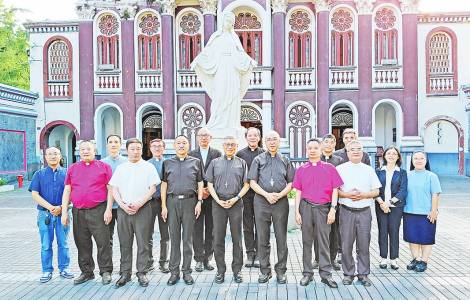
KungKaoPo
by Marta Zhao
Chengdu (Fides News Agency) – Reflection based on an understanding of the “Sinicization of religions” is far more constructive than rejection based on ignorance. This is how Cardinal Stephen Chow Sau-yan, Bishop of Hong Kong, described the key criteria for addressing the issue of “Sinicization,” which is also relevant to ecclesiastical developments in the People’s Republic of China. He made this statement during a visit to Sichuan Province, in mainland China, before traveling to Rome to participate in the “Ad Limina Apostulorum” visit with the bishops of Hong Kong and Macau. The bishops of Hong Kong, along with the bishops of Macau, were received in audience by Pope Leo XIV on Thursday, June 18.
Peter Choy Wai-man, Vicar General of the Diocese of Hong Kong, visited Sichuan Province with Cardinal Chow and later shared his impressions in the diocesan weekly newspaper KungKaoPo. “I was able to gain a deeper understanding,” said Bishop Choy, “of how the Church in Sichuan is practicing ‘Sinicization’… It should therefore be seen not as a threat, but rather as an opportunity to proclaim the Gospel and bear witness to the faith in contemporary China.”
Cardinal Choy led an eleven-member delegation on his trip to Sichuan, which spent a week in the province in early June. The participants met with five of the province’s bishops (Bishop Tang Yuange of Chengdu, Bishop Luo Xuegang of Yibin, Bishop Lei Shiyin of Leshan, Bishop Chen Gong’ao of Nanchong, and Bishop Lei Jiapei of Xichang) and concelebrated Mass with them. The trip also included a visit to the Sichuan Provincial Catholic Philosophical-Theological Seminary, meetings with priests, nuns, seminarians, and lay people, and provided a valuable opportunity to deepen their understanding of the situation of the local Church.
All members of the delegation affirmed that young seminarians, priests, and nuns represent a source of hope for the local Church. Cardinal Chow, after his visit to the seminary, affirmed: “Young people are truly the hope of the Church and the country; we must care for them and form them carefully.” This trip, he added, “offered us numerous opportunities to better understand the ‘Sinicization of religions’ in the Church. A reflection based on knowledge is far more constructive than a rejection based on ignorance. These experiences provide a valuable foundation for continued dialogue and exchange. This is also an essential prerequisite for achieving unity in diversity.” Auxiliary Bishop Joseph Ha Chi-shing also stated that the trip allowed him to gain firsthand insight into the situation in Sichuan’s five dioceses and the implementation of the national religious policy. “We have established friendships with five bishops, which will foster future exchange between the churches… What impressed me most was meeting so many young priests, nuns, and seminarians. They all approach their vocation with enthusiasm. In them, one can see the grace of God and the hope of the Church.”
Vicar Peter Choy emphasizes in this context: “On the one hand, I had the opportunity to speak with the five bishops of Sichuan, who belong to the first generation of theologically trained clergy after the reform and opening-up policies. They grew up in difficult years marked by scarcity of resources, and their unwavering faith inspires great admiration. On the other hand, I was able to better understand how the Church in Sichuan is implementing the ‘Sinicization of religions.’ Although it reflects a political orientation of the entire Chinese society, its application has many points of contact with the inculturation process that the Church has always pursued. It should therefore not be seen as a threat, but rather as an opportunity to proclaim the Gospel and bear witness to the faith in contemporary China.”
Tam Chi-man, president of the Lay Association, Father Franco Bellati, regional superior of PIME for Hong Kong, Sister Teresa Chong Chun-yi of the Sisters of the Most Precious Blood, Vicar General Dominic Kam Po-wai, Father Leo Liu Ya-lun, assistant to the diocesan treasurer, Wong Chin-to, permanent deacon, and Vicar Chan Wing-chiu also expressed their joy at the opportunities for shared prayer, exchange, and dialogue that arose during the trip. All described the journey as an experience of strong communion, “which allowed us to see God’s work in the Church in China.” (Fides News Agency, 19/6/2026)



 ASIA/PHILIPPINES - "A truly missionary Church does not impose political choices, but it helps the faithful discern wisely"
 ASIA/MONGOLIA - Farewell to Father Robert Goessens, pioneer of the Catholic mission in Mongolia
 Leone XIV at the Rimini Meeting: Jesus keeps his treasure in earthen vessels
 In Dar es Salaam, African Liturgists call for an end to the “folklorization” and “theatricalization” of inculturation