
Information service of the Pontifical Mission Societies since 1927
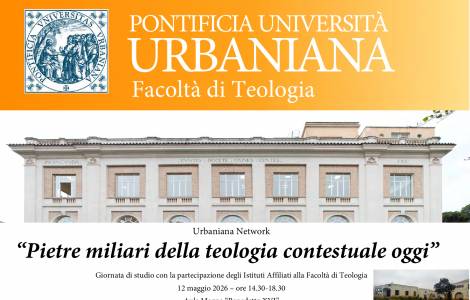
Rome (Fides News Agency) – On Tuesday, May 12, 2026, a study day entitled “Milestones of Contextual Theology Today” will be held in the Aula Magna “Benedict XVI” at the Pontifical Urbaniana University. The event is part of an ongoing reflection on current developments in the theological engagement with cultural contexts and their intersections with inculturation processes. During the study day, renowned guests and representatives of the worldwide network of theological institutes affiliated with the University of Urbaniana will speak.
The Conference thus offers a valuable opportunity to learn about the diversity of theological institutes—associated with seminaries, institutes, and local study centers on every continent—that are affiliated to the Pontifical Urbaniana University. The affiliation process of over 90 institutes began after the Second Vatican Council at the initiative of Pope Paul VI, in a context characterized by the presence of numerous students from African countries at the Urbaniana, who at that time were grappling with the often difficult processes of decolonization.
Under the pontificate of Pope Francis, a significant milestone was reached with the publication of the Apostolic Constitution "Veritatis Gaudium" on ecclesiastical universities and faculties. It was signed on December 8, 2017, and entered into force in 2018. The Pope stated that it was time for the rich heritage of knowledge—tested and enriched, so to speak, ‘in practice’ through the persistent commitment to the cultural and social communication of the Gospel, as it is implemented by the People of God on different continents and in dialogue with different cultures—to come together in order to give Church studies the courageous renewal that the missionary transformation of a Church that 'goes forth' requires.
The network of affiliated institutes embodies the dynamism that arises from the fruitful tension between the universality of the Christian message and the diversity of its expressions. “This Study Day is part of a shared journey with the affiliated institutes,” Father Étienne-Noël Bassoumboul, a Cameroonian priest and biblical scholar, as well as a professor at the Faculty of Theology of the Urbaniana University, told Fides. “We recognized—and this desire also arose from the network of institutes—that cooperation with the university needed to be intensified in order to establish a genuine network that goes beyond a purely formal or bureaucratic connection. In the numerous preparatory meetings we were able to hold, the desire grew to further promote theological and academic reflection at these institutions.” “Today, we support these institutes in drafting their statutes, as well as in academic and scholarly matters,” Bassoumboul continued. “The programs must be approved by the university and subsequently by the Dicastery for Evangelization and the Dicastery for Culture and Education. After that, however, the institutes enjoy the greatest possible autonomy.”
Thus, in addition to courses on ancient, medieval, modern, and contemporary Church history, the individual institutes generally also offer courses on Church history in various countries. Particular importance is placed on knowledge of other religions, inculturation, and traditional religions within an interreligious context. “It is important and meaningful to continue speaking of ‘contextual theology,’” explains Étienne-Noël Bassoumboul, “because no theology is detached from reality or the context in which we live: our history, our individual circumstances, our social situation. Contextual theology, in accordance with the Council and recent Magisterium, emphasizes that the cultural context becomes a true theological point of reference, in dialogue with Sacred Scripture and Church tradition. For example, in discussions with various institutes and in examining the curricula and statutes available to us, we have discovered philosophy courses that focus on important thinkers within the context of their respective countries. This is a considerable gain.” As part of the study day, Cardinal Víctor Manuel Fernández, Prefect of the Dicastery for the Doctrine of the Faith, will deliver the opening address following greetings from Professor Vincenzo Buonomo, Papal Delegate and Rector of the Urbaniana University, and Professor Pietro Angelo Muroni, Dean of the Faculty of Theology.
Following the address by the Prefect of the Dicastery for the Doctrine of the Faith, Professor Steve Bevans, Professor Emeritus of the Catholic Theological Union of Chicago, will give a lecture entitled “Milestones of Contextual Theology Today: Where We Have Come From, Where We Are Going.” Bevans, a leading figure in Contextual Theology, will outline the key stages in the development of this approach, from its beginnings to its future prospects. Following a panel discussion, the event, moderated by Professor Aldo Skoda, will continue with a lecture by Professor Kokou Mawuena Ambroise Atakpa (Faculty of Theology, Urbaniana University) on “Contextual Theology and Cultural Pluralism in the Academic Field.” This lecture will explore the challenges that cultural pluralism poses for theological production. In the second part of the Study Day, representatives from the associated institutes will have the opportunity to provide a comprehensive overview of the practices of Contextual Theology worldwide under the common theme of “Theology in Dialogue with the Social, Cultural, and Ecclesiastical Context.” Speakers include Bishop Peter Paul Saldanha of India, from the St. Joseph Institute of Theology in Mangalore; Professor Tutoe Tupouniua Toutaiolepo, from the Pacific Regional Seminary in Suva, Fiji; Professor Giuseppe Busani, Director of the Missionary Theological Institute of the Pontifical Institute for Foreign Missions (PIME) in Monza; Professor Michael Wenceslas Tiendrebeogo from the Saint Pierre Claver Theological Institute in Burkina Faso; and Professor Juan Antonio Nureña Prado (ISET-Juan XXIII, Lima). The day concludes with a lecture by Professor Maurizio Gronchi (Theological Faculty of the Urbaniana) entitled “How to Speak of Christ in Different Cultures,” a reflection on the possibilities of proclaiming Christ in pluralistic cultural contexts.
Meanwhile, Cardinals from around the world are preparing for the upcoming consistory in June, which they will attend at the invitation of Pope Leo XIV. In a letter dated April 12, he reaffirmed the need to “relaunch Evangelii Gaudium to honestly assess what, after so many years, has actually been received and what remains unknown and unimplemented,” while paying particular attention must be made to “the necessary reform of the paths of Christian initiation.” Pope Leo XIV emphasized the importance of inculturation in his message to the participants of the Theological-Pastoral Congress on Our Lady of Guadalupe on February 5, 2026. The Study Day scheduled at the Pontifical Urbaniana University is a sign that these issues are being seriously discussed. The network of theological institutes associated with the university holds a vibrant treasure waiting to be discovered and made known. (ML) (Fides News Agency, 8/5/2026)



 Urbaniana University hosts study day of the “Velasio de Paolis Chair” on Law in the life and mission of the Ecclesial Community
 Missionaries in friendship with Christ. Cardinal Tagle celebrates a Mass of Thanksgiving for Saint Newman, Patron of Urbaniana University
 Archbishop Nwachukwu’s “compass” for Catholic communicators: “You are disciples before being influencers”
 VATICAN - Pope Leo XIV appoints Members and Consultors of the Dicastery for Evangelization's Section for First Evangelization and New Particular Churches
 Between political neo-messianisms and Augustinian realism: scholars and analysts revisit Leo XIV’s teaching on international politics and Global scenarios
 Theologian Bevans: "Contextual Theology" and new paths of mission
 ASIA/PHILIPPINES - "A truly missionary Church does not impose political choices, but it helps the faithful discern wisely"
 ASIA/MONGOLIA - Farewell to Father Robert Goessens, pioneer of the Catholic mission in Mongolia
 In Dar es Salaam, African Liturgists call for an end to the “folklorization” and “theatricalization” of inculturation