
Information service of the Pontifical Mission Societies since 1927
VaticanMedia
by Gianni Valente
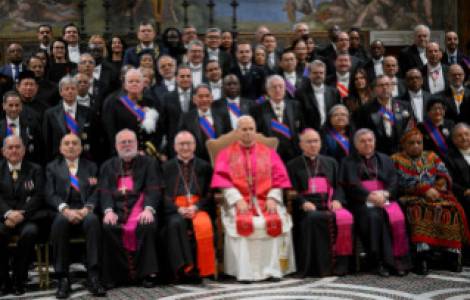
Vatican City (Agenzia Fides) – In his traditional New Year's address to the members of the Diplomatic Corps accredited to the Holy See, Pope Leo XIV today observed the current state of the world through the powerful lens of "The City of God", the work that Saint Augustine wrote "inspired by the tragic events of the Sack of Rome in 410 AD." It was a fascinating and effective experiment, because it is fruitful and thought-provoking to contemplate the geopolitical upheavals of the present and the current relations between the Church and the powers of the world through the eyes of the "Doctor Gratiae," a Father of the Church.
The Holy Bishop of Hippo—Leo XIV reminded the Ambassadors gathered in the Hall of Benediction, that he followed his priestly vocation within the Order of Saint Augustine—"interprets events and history itself according to the model of two cities: there is the city of God, which is eternal and characterized by God’s unconditional love (amor Dei), as well as love for one’s neighbor, especially the poor. Then there is the earthly city, which is a temporary dwelling place where human beings live until death." The City of God has no other task in this world than to place its hope in invoking the name of the Lord. If the city of man lives by possessing the things of this world, the other City lives by hope in God. It is born, lives, and journeys through history by the attraction of grace, while "the earthly city is centered on pride and self-love (amor sui), on the thirst for worldly power and glory that leads to destruction."
For Augustine, there are two cities, but they cannot be identified. However, along the path of history, they are "perplexae," that is, intertwined until the end of time. The citizens of both cities coexist in this world. For Augustine, the City of God is not a fortified city facing the world or standing against it. There is a continuous transition between the two Cities: whoever is a citizen of one can always become a citizen of the other. And it is precisely the experience of belonging to "the other City" that can help Christians realistically recognize the goods and positive aspects of the "City of Man" along with the violence and corruption potentially linked to all power, especially those powers that most try to cloak themselves in masks of spiritual and ethical idealism.
In this way, the Christian realism of the great Father of the Western Church has resonated today in various passages of the speech of the Bishop of Rome, his son in faith.
A Realistic Perspective
Leo XIV realistically acknowledged the worrying weakness of “multilateralism” at the international level, given that “a diplomacy that promotes dialogue and seeks consensus among all parties is being replaced by a diplomacy based on force, by either individuals or groups of allies. War is back in vogue and a zeal for war is spreading.” Furthermore, the Pope also observed that “especially in the West, the space for genuine freedom of expression is rapidly shrinking. At the same time, a new Orwellian-style language is developing which, in an attempt to be increasingly inclusive, ends up excluding those who do not conform to the ideologies that are fueling it.”
Introducing the topic of conscientious objection, the Bishop of Rome acknowledged that “freedom of conscience seems increasingly to be questioned by States, even those that claim to be based on democracy and human rights.”
The Successor of Peter stated that “persecution of Christians remains one of the most widespread human rights crises today.” He spoke of a “subtle form of religious discrimination against Christians, which is spreading even in countries where they are in the majority, such as in Europe or the Americas,” especially “when they defend the dignity of the weakest, the unborn, refugees and migrants, or promote the family.” He also reiterated the Holy See’s desire that campaigns and measures against human trafficking “will not become a pretext for undermining the dignity of migrants and refugees,” and the same considerations apply to prisoners, “who can never be reduced to the crimes they have committed.”
Pope Prevost named the “projects aimed at financing cross-border mobility for the purpose of accessing the so-called ‘right to safe abortion’.” and the practice of ‘surrogacy,’ which, “by transforming gestation into a negotiable service, this violates the dignity both of the child, who is reduced to a “product,” and of the mother, exploiting her body and the generative process, and distorting the original relational calling of the family.” He also pointed out that an actual “short circuit” of human rights is occurring, whereby “the right to freedom of expression, freedom of conscience, religious freedom and even the right to life are being restricted in the name of other so-called new rights, with the result that the very framework of human rights is losing its vitality and creating space for force and oppression.”
Citing again “The City of God,” Leo XIV echoed as Augustine notes “great is the folly of pride in those individuals who think that the supreme good can be found in this life, and that they can become happy by their own resources.” He added that “it is no coincidence that pride is always at the root of every conflict.” He then turned his attention to the conflicts and situations of crisis and violence that cause suffering to peoples and nations throughout the world: Ukraine, the Holy Land (recalling the realistic solution of “two peoples, two states”), Venezuela (with the appeal to “respect the will of the Venezuelan people”), Haiti, the African Great Lakes region, and Myanmar. He also mentioned the trend toward “producing ever more sophisticated new weapons, also by means of artificial intelligence.” Recognizing that “peace remains a difficult yet realistic good,” the Pope recalled, as Augustine reminds us, peace is “the aim of our good,” because “it is the very aim of the city of God, to which we aspire, even unconsciously, and of which we can enjoy a foretaste even in the earthly city.”
Among the signs of hope, the Bishop of Rome mentioned the Dayton Accords, which “thirty years ago put an end to the bloodstained war in Bosnia and Herzegovina. Despite difficulties and tensions, they opened up the possibility of a more prosperous and harmonious future,” he said, alluding to the Joint Declaration of Peace between Armenia and Azerbaijan, signed last August. He also explicitly referred to “the efforts made in recent years by the Vietnamese Authorities to improve relations with the Holy See and the conditions in which the Church functions in the country.” “These are all seeds of peace,” Pope Leo XIV emphasized, “that need to be cultivated.” (Agenzia Fides, 9/1/2026)



 The Manual of Latin American Ecclesial Communities to address the addiction crisis: A story of Communion
 ASIA/CHINA - Francis Xavier Duan Yongkun ordained Coadjutor Bishop of Bameng
 The Pontificate of Leo XIV and Global Politics: A lecture by Massimo Faggioli at the Gregorian University
 ASIA/MALAYSIA - Malaysian Ambassador Assan: "Respect for international law, and the protection of human dignity is the path to peace in the Middle East and Southeast Asia"
 US House bill calls to halt aid to Nigeria over anti-Christian violence
 Tomáš Halík at the FABC Assembly: «The future of Christianity will depend upon whether our communities become places where people truly learn to see»
 "As one Body in Christ": Churches in the Emirates pray together for peace in Dubai
 LEO XIV IN AFRICA - The Pope to the Angolans: The Risen Jesus can also heal the wounds of your people
 Between political neo-messianisms and Augustinian realism: scholars and analysts revisit Leo XIV’s teaching on international politics and Global scenarios
 Theologian Bevans: "Contextual Theology" and new paths of mission
 EUROPE/RUSSIA - Moscow hosts a conference on relations between the Holy See and Italy between the 19th and 21st centuries
 12 theatre Companies at the XXXIV Slovak Christian Theatre Festival inspired by Saint Francis
 “Saints have a past and sinners have a future.” Chinese Catholics celebrate Saints Peter and Paul, Patrons of the Church of Rome