
Information service of the Pontifical Mission Societies since 1927
VaticanMedia
Vatican City (Fides News Agency) — By dating his first encyclical, Magnifica Humanitas, on May 15, Pope Leo XIV deliberately places himself within a well-defined tradition: that of the great social encyclicals, and in particular Pope Leo XIII’s Rerum Novarum, published on May 15, 1891.
The “industrial revolution” to which his concern refers is that of artificial intelligence (AI). However, Magnifica Humanitas is not intended to be an encyclical “about” artificial intelligence (although the topic is central), but rather an encyclical about our “magnificent humanity,” shaken by the ongoing revolution.
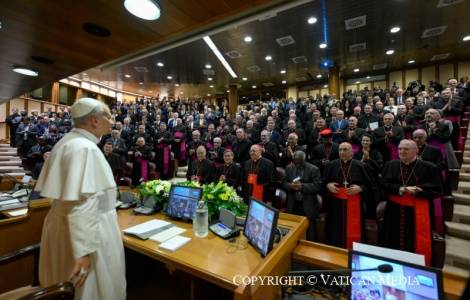
From the very first words of the text — presented today in the Vatican, in the Synod Hall in the presence of the Pontiff himself — the framework of the reflection is set out clearly: “Humanity, created by God in all its grandeur, is today facing a pivotal choice: either to construct a new Tower of Babel or to build the city in which God and humanity dwell together.” [n. 1]
The reflection that follows seeks to challenge humanity and decision-makers to a genuine examination of conscience. It is not necessarily a frontal condemnation. “Technology,” the Pope writes, “should not be considered, in itself, as a force antagonistic to humanity. On the contrary, it has formed part of our history since the beginning as ‘a profoundly human reality, linked to the autonomy and freedom of man.’” [n. 4]
Rather, the goal is to establish an ethical and moral framework prior to the use of AI, using the pursuit of the “common good” as its epistemological criterion.
In the current context, Leo XIV shows how the principles of Social Doctrine are of great help for discernment. “In a world where data, computational resources and regulatory influence remain in the hands of a few, to speak of the common good means exposing this new form of epistemic, economic and political asymmetry and naming the new monopolies of AI.” [n. 109]
What is at stake, he says, is the need to “disarm AI” “means freeing it from the mentality of “armed” competition, which today is not limited simply to the military context, but is also an economic and cognitive phenomenon. This entails a race for ever more powerful algorithms and larger datasets, driven by the desire to secure geopolitical or commercial dominance.” [n. 110]
“To disarm,” he adds, “means discrediting the assumption that technical power automatically confers the right to govern. To disarm does not mean rejecting technology, but preventing it from dominating humanity.” [n. 110]
AI is not “neutral”
One of the most relevant points of discernment is that AI is not “neutral,” because “it takes on the characteristics of those who devise, finance, regulate and use it.” [n. 9]
The heart of the reflection appears in paragraph 104: “We cannot consider AI to be morally neutral,” the Holy Father insists. “In reality, every technical tool embodies choices and priorities through what it measures, ignores and optimizes, and how it classifies people and situations. If a system is designed or used in a way that treats some lives as less worthy, or excludes them without the possibility of appeal, then it is not merely a tool “to be used well,” since it has already introduced criteria that contradict the inalienable dignity of the human person. For this reason, ethical discernment cannot be limited to asking whether we are using a system for good or bad purposes; it must also examine how that system is designed and what vision of the human person and society is embedded in the data and models that guide it.” Therefore, Leo XIV explains, “the primary choice is not between a “yes” or “no” to technology, but rather between constructing Babel or rebuilding Jerusalem; between a power that claims to dominate the heavens and a people who work together in the presence of God to rebuild the walls of fraternal coexistence.” [n. 9]
Digital Neocolonialism
The text denounces a contemporary “colonialism” that “assumes new forms,” and “no longer dominates only bodies, but appropriates data, transforming personal lives into exploitable information.” “Entire regions, especially those marked by structural fragility and limited geopolitical relevance, are currently subjected to a new mindset of extraction: that of health data, epidemiological profiles, genetic maps and demographic information. These have become the new “rare earths” of power: vital data which, once aggregated and analyzed, can be used to train predictive models, guide investment strategies, anticipate crises and, above all, determine who and what is deemed to matter.” [n.178]
The evident risk is that of new forms of domination and worsening inequalities, because “those who control the health data of entire peoples — often collected under the pretext of aid, research or innovation — possess a structural leverage over the future, for they can shape needs and markets.” Likewise “they can also decide, before others, to whom medicines, investments and protections will be allocated.” For the Pope, here lies “one of the most urgent moral challenges of our time: to ensure that shared knowledge becomes a true common good rather than an instrument of dominance. This requires restoring to individuals not only the data that describes them, but also the ability to decide how it is used, by whom and for whose benefit. Otherwise, the digital age will not be post-colonial, but colonial in another form.” [n. 178]
Immense power in the hands of a few
The Pope stresses that “in many cases within the digital context, control over platforms, infrastructure, data and computing power does not rest with States, but with major economic and technological actors. These entities effectively set the conditions for access, determine the rules of visibility and shape the very possibilities for participation.”
This problem is immense because “when such power is concentrated in the hands of a few, it tends to become opaque and evade public oversight, increasing the risk of distorted forms of development that give rise to new dependencies, exclusions, manipulations and inequalities.” [nn. 95–96]
The New Gnosis of transhumanism
If Magnifica Humanitas appears more as a warning than as a condemnation of AI, its tone becomes much harsher regarding transhumanism and posthumanism currents “that interpret progress as surpassing the human condition.”
Leo XIV compares them to “an archipelago of different conceptual islands, distinct yet connected by a common “sea” of assumptions, namely the central role of technology and the aspiration to transcend the limits of the human condition.” [n. 116]
He explains that transhumanism “envisions the enhancement of human beings through technologies — such as biomedicine, body engineering, devices and algorithms — with the aim of increasing performance and capabilities. Posthumanism, especially in its more radical forms, goes further: it challenges anthropocentrism and envisions a hybridization of human beings, machines and the environment, even anticipating a threshold where humanity surpasses itself in a new evolutionary stage.”
Although the Pope acknowledges that “such ideas remain largely speculative,” he nonetheless sounds the alarm because “they gain relevance by altering the collective imagination and thereby influence social, economic and political choices.” [n. 116]
Faced with these ideological tendencies, all the more dangerous because, like wolves in sheep’s clothing, they can disguise themselves as good intentions and already constitute for some an almost mystical horizon, a new gnosis that despises the human body in its limited form and dreams of rejecting its limits, Christianity possesses a precious experience. “Our relationship with life seems to be in crisis today. Everything that appears as a “limit” — incapacity, illness, old age, suffering, vulnerability — tends to be seen primarily as a defect to be corrected, rather than as a reality through which our humanity matures and opens itself to relationship. And yet we must remember that humanity flourishes not despite limitations, but often through them.” [n. 118]
“In the promises of transhumanism and some posthumanist currents of thought, which seek an enhanced and almost disembodied humanity, we recognize a yearning that is of concern to us, namely the need for a fuller life, less exposed to limitations and suffering. Yet the Incarnation opens a different pathway. On the one hand, old and new ideologies alike urge humanity to overcome limitations through technology, and to rise above others by asserting dominance. Contrary to this, the mystery of the Son of God entering into our human condition promises something quite different. The living God descends into our history in order to free us from all forms of slavery. He takes upon himself our weakness and transforms it into a setting for salvation. There is no moment or human situation that is not worthy of Go.” [232]
The wounds through which grace can enter
Leo XIV here develops a magnificent reflection on the human condition, in which limitation becomes the breach through which the light of grace can enter. “It is precisely within our limitations that the following find a place: compassion, as well as a sincere concern for the needs of others; a generosity that can emerge even in the midst of darkness and failure; spiritual experience and the worship of God. We see this at many moments when our limits become tangible: when we face rejection, when we suffer the illness or loss of a loved one, when we encounter our own weakness or failure. Mysteriously, it is precisely in such moments that we can discover a new wisdom, tangibly experience the closeness of others and encounter the presence of the Lord.” [n. 119]
“Even when limitations are experienced as inner suffering, human wisdom teaches us not to deny or suppress it, but to integrate it. To eliminate suffering entirely would mean, in the end, extinguishing love and desire as well. Those who love and desire cannot avoid passing through trial and suffering; and over the years, we carry within us lessons that leave their mark like scars, the memories of a journey shaped by freedom and failure, dreams and disappointments.” [120]. He continues, “the moral corruption of our limitations as created beings — namely the evil that clearly agitates the human heart — ruins society and life, at times reaching extreme forms of inhumanity. Yet even these painful expressions of our limitations leave openings for the good. Even when persons dehumanize themselves and bring about tragedy, a small light continues to shine within humanity, one that can be rekindled, with God’s grace, along paths of conversion and reconciliation.” [n. 121]
For all these reasons, Magnifica Humanitas ultimately becomes a hymn to critical thinking, freedom, and the beauty of the human being, to humanity’s infinite capacity to rise again, with its wrinkles and scars, carrying the inestimable treasure of a flesh promised not to an “enhanced” body, but to a glorified one. (ML) (Fides News Agency, 25/5/2026)



 Pope in France/III - Metz, at the roots of European peace in the “city of three borders”
 ASIA/CHINA - Chinese edition of Pope Leo XIV’s doctoral thesis published
 What lies behind the diplomatic clash between Argentina and Brazil
 Archbishop Nwachukwu’s “compass” for Catholic communicators: “You are disciples before being influencers”