
Information service of the Pontifical Mission Societies since 1927
RVA
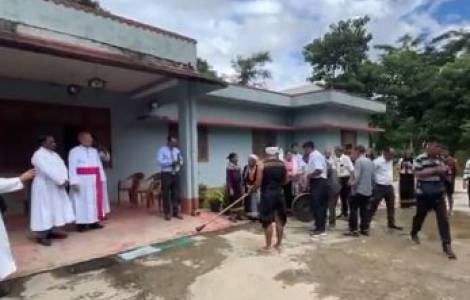
Imphal (Agenzia Fides) - "Prime Minister Narendra Modi came to Manipur and promised a solution to the conflict that has plagued us for over two years. He spoke of peace, prosperity, and development. He brought a package of economic aid. He spoke of the integrity of the state of Manipur and the unity of the nation. However, his visit failed to address the sore point and the crucial problem: the population of Manipur is divided by the conflict and has been living in separate areas for two years. Over 50,000 people from the Kuki and Meitei ethnic groups are suffering in refugee camps. The solution can only come from a process of healing and reconciliation and must be considered in the medium to long term," said Linus Neli, Archbishop of Imphal, the capital of the state in northeastern India, in an interview with Fides on the day of the visit of Indian Prime Minister Narendra Modi to the state. "Modi spoke to the two groups separately, primarily promising economic prosperity and bringing a package of economic aid," the Archbishop notes, "but he did not address the relationship between the warring groups, the hatred, the urgency of restoring internal and communal peace."
"Currently," explains Archbishop Neli, "the management of the crisis in Manipur is in the hands of the military. The army keeps the warring communities apart, controls the territory, and provides security. This is intended to prevent further unrest and violence, but it is not a solution. The situation on the ground is entrenched. And the wounds will remain if no one does anything to heal them."
According to Archbishop Neli, "political will is required to advance a serious reconciliation process and restore peaceful coexistence between the two groups. This requires the goodwill of both sides and also mediation by the political, state, and federal authorities," he notes. "Reconciliation is possible if the issues at hand are addressed openly and according to criteria of fairness and justice, overcoming barriers and polarization: this is the task of good politics," he adds.
"As the Catholic Church," the Archbishop concludes, "we are present with believers in both communities, among the Kuki and the Meitei. We continue to provide humanitarian assistance to the refugees and promote intercultural and interreligious encounters to foster peace and coexistence. We try to act as a bridge and initiate a process of healing and reconciliation." "For our pastoral life," he concludes, "we have to rebuild three churches that were completely destroyed by violence two years ago, while two monasteries are currently occupied by the army, and we temporarily do not have access to their facilities. But given the situation, there is nothing we can do; we have to wait and see." (PA) (Agenzia Fides, 15/9/2025)



 EUROPE/ITALY: Sister Inês Paulo Albino: "The presence of children, wherever they are, should guide us to a change of perspective"
 ASIA/SOUTH KOREA - Civil and religious organizations: No to the construction of two new nuclear power plants
 AMERICA/COLOMBIA - Bishops promote initiatives for "responsible voting" ahead of elections
 AMERICA/BOLIVIA - The economic crisis fuels social tensions: Bishops call for dialogue and reconciliation
 AFRICA/SOUTH AFRICA - Catholic bishops denounce the increase in violence against migrants
 The hidden tragedy of suicides in refugee camps
 "As one Body in Christ": Churches in the Emirates pray together for peace in Dubai
 ASIA/UZBEKISTAN - The Bishops of Central Asia express “firm support” for Pope Leo XIV and elect Cardinal Marengo as President of the Bishops' conference