
Information service of the Pontifical Mission Societies since 1927
Cbcpnews
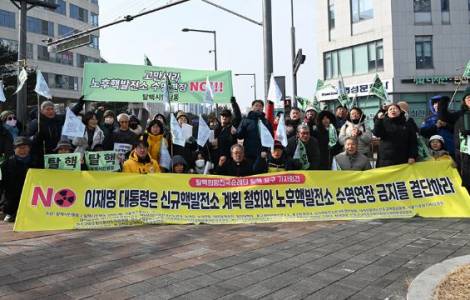
Seoul (Agenzia Fides) – Social organizations, NGOs, and groups from various religious communities (including Christian associations) in South Korea are rejecting the Korean government's plan to build two new nuclear power plants. They are protesting and demanding its immediate abolition. The government in Seoul has announced that it will build two nuclear power plants by 2038, as Climate Minister Kim Sung-whan stated, to expand the national electricity supply. The state-owned company Korea Hydro & Nuclear Power (KHNP) will issue a tender to select the sites for the new reactors, followed by an evaluation and selection process expected to last approximately six months. The company aims to complete the reactors by 2037 and 2038. Originally, the new Korean President, Lee Jae-myung, who took office in 2025, had promised investments in renewable energy, a move contrary to his predecessor, Yoon Suk Yeol, who had planned to expand nuclear power production. Now, Lee's administration has given the green light to resume investments in nuclear power plants.
This move has sparked outrage and protests from the Citizens' Action for Nuclear Disarmament network, comprised of 43 civil and religious groups. In a joint appeal, the network called on President Lee Jae-myung to personally explain the decision to the public. The network also demanded the resignation of Minister Kim, who, they said, "neglected his responsibility for national security and environmental protection and pushed for nuclear power production." Furthermore, the network pointed out that the government had promised to phase out nuclear power but has now reversed course "based on rushed opinion polls and without adequate public debate." This decision, it is said, “represents a betrayal of the citizens who have longed for denuclearization.”
In addition to questions about the construction of the reactors, the civil society network asks: “How will the problem of the increase in high-level radioactive waste resulting from the expansion of nuclear power plants be solved?” Since more than 26 power plants are concentrated on the east coast alone, there are also concerns about evacuation procedures in the event of a simultaneous accident involving multiple reactors.
According to the International Atomic Energy Agency, South Korea has 26 commercially operated nuclear power plants, with two more, Saeul-3 and Saeul-4, under construction. In 2024, these 26 plants supplied a total of 31.7% of the country's electricity generation. (PA) (Agenzia Fides, 27/1/2026)



 LEO XIV IN SPAIN - The Pope in the port of Arguineguín: “Every individual that arrives asks us what remains of our humanity”
 EUROPE/ITALY: Sister Inês Paulo Albino: "The presence of children, wherever they are, should guide us to a change of perspective"