
Information service of the Pontifical Mission Societies since 1927
Wikipedia
Rome (Fides News Agency) – “No one explained to us that the water we were drinking was a way of poisoning our children.” Pedro Arrojo-Agudo, the United Nations Special Rapporteur on the human rights to safe drinking water and sanitation, recalls these words spoken by an indigenous woman whom he met during a gathering with communities in the Peruvian Amazon.
The Special Rapporteur shared this testimony during the online meeting “Aquatic Ecosystems and the Human Right to Safe Drinking Water and Sanitation in the Amazon”, organized by the Pan-Amazonian Ecclesial Network (REPAM). The meeting was also attended by Alfonso López Tejada, an indigenous leader of the Kukama people and head of the Kokama Association for Development and Conservation of San Pablo de Tipishca, in the Peruvian Amazon; Zenilda María Ventes, an indigenous leader of the Kumaru-Árabe people and coordinator of the Indigenous Council of her territory in the Lower Tapajós region of Brazil; and Indira Vargas, a Kichwa leader from Ecuador’s Pastaza Province and vice-president of the PAKIRU Governing Council.
The Special Rapporteur also recalled a visit to Iquitos, Peru, where he met representatives of indigenous communities who showed him medical records and test results concerning their children. The women reported health problems which they attributed to mining activities and oil spills.
Cooperation between Arrojo and REPAM has helped bring these complaints to the attention of international forums. The ecclesial network’s relationship with the United Nations Special Rapporteur on water dates back to 2019, during the mandate of his predecessor, Léo Heller. Pedro Arrojo has continued this dialogue since 2020.
Arrojo explained that his understanding of the situation deepened after he was invited by the Bishop of Iquitos, Miguel Ángel Cadenas, to visit the region and take part in the Amazon Water Summit, held in 2025. During that meeting, representatives of REPAM and local Churches proposed that he devote part of the final year of his mandate to examining the water situation in the Amazon.
The outcome of this process was presented in Geneva on October 15, before the United Nations Human Rights Council, in a document entitled “Aquatic Ecosystems and the Human Right to Safe Drinking Water and Sanitation in the Amazon”.
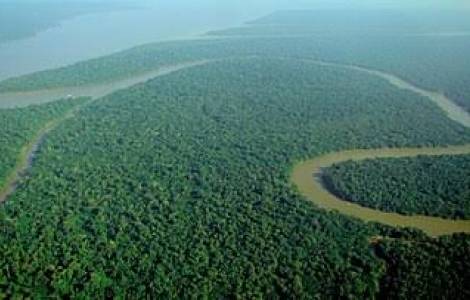
One of the issues on which the Special Rapporteur placed particular emphasis was the contradiction at the heart of the Amazon: a region containing one of the planet’s largest reserves of fresh water, where, nevertheless, numerous indigenous communities, traditional populations and residents of poor urban neighborhoods lack access to safe drinking water and adequate sanitation.
“The global water crisis is fundamentally not a problem of freshwater scarcity,” Arrojo said. Many people without access to safe drinking water live close to rivers or groundwater sources, but these are polluted or subject to economic activities that prevent communities from using them.
“Water cannot be a business,” he warned, “nor can it become a means of enriching a few at the expense of the health and lives of others.”
Turning rivers into channels for the disposal of waste from mining or oil operations, the Special Rapporteur stressed, contradicts the international human rights commitments undertaken by States. Healthy rivers and other aquatic ecosystems are essential for populations that depend directly on them for food and for their everyday activities.
In the face of this situation, Arrojo highlighted the value of indigenous peoples’ ancestral knowledge and community-based water management practices. “Indigenous, peasant, fishing and riverside communities preserve experience that demonstrates how water resources can be managed collectively, without excluding anyone or allowing water to be monopolized by particular interests.”
A disaster denounced for years
Pollution of Amazonian rivers and its consequences for local communities have been the subject of numerous complaints in several countries across the region, including reports published by Fides News Agency.
As early as 2014, the Apostolic Vicariate of Iquitos raised the alarm over pollution in the Marañón River basin and the Pacaya Samiria National Reserve. A report drawn up at the time indicated that water was unfit for human consumption in 17 localities because of the presence of various pollutants and oil spills (see Fides, 7/3/2014).
In April 2020, a ruptured oil pipeline caused an oil spill in the Coca and Napo rivers in Ecuador, affecting around 100 communities in Napo and Orellana, as well as northern Peru. Several towns were left without water, and the Apostolic Vicariate of Aguarico denounced the consequences for public health and food security (see Fides, 20/4/2020).
In May 2021, another oil spill in the Corrientes River affected indigenous communities in the Trompeteros area. Their representatives denounced the fact that their appeals had gone unanswered, despite having submitted evidence to the authorities (see Fides, 20/5/2021).
In September 2022, a forum organized by Cáritas Reyes Social Pastoral in the Bolivian Amazon raised the alarm over mercury pollution in the Beni, Tuichi and Quiquibey rivers, with consequences for the health of indigenous communities and the environment (see Fides, 14/9/2022).
More recently, in August 2026, the Apostolic Vicariate of Iquitos issued an urgent appeal to curb the expansion of illegal mining in the Amazon.
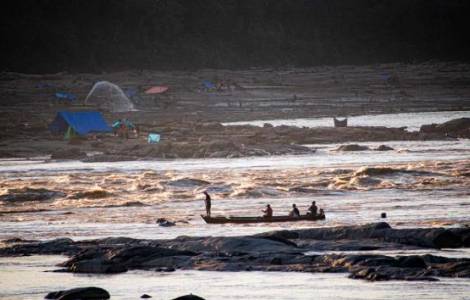
Particular concern centred on the Nanay River, the main source of drinking water for more than 500,000 residents of Iquitos and numerous indigenous communities. A study based on satellite imagery identified 1,518 instances of mining dredging in 13 rivers in the department of Loreto since 2017. Almost half of these had been recorded since the beginning of 2025, with 70% concentrated in the Nanay River. Mercury pollution poses a high-level risk to public health and food security (see Fides, 17/8/2026).
During his address, Arrojo also reaffirmed his commitment to promoting reform of the Rome Statute, (the international treaty that established the International Criminal Court), so that the progressive and irreversible pollution of territories, together with the resulting harm to communities, may be recognized internationally as a crime against humanity and as “ecocide”.
Pope Leo XIV’s visit and a process that continues
Cooperation between REPAM, local Churches, social organizations and Amazonian communities also takes shape through spaces for dialogue and coordination. One such initiative was the first Amazon Water Summit, held in Iquitos in October 2025. It brought together indigenous and peasant representatives, social organizations, ecclesial communities and other groups committed to defending water. Participants shared reports of mining activities, deforestation and river pollution, and the meeting concluded with an appeal to defend water as a human right and a common good.
The second Amazon Water Summit is scheduled to take place in 2027 in Puerto Maldonado, in Peru’s Madre de Dios region.
The apostolic visit of Pope Leo XIV to Peru, scheduled for 11 to 16 November, is also an opportunity to bring the emergencies facing the Amazon to the forefront of the Church’s attention.
On Sunday, November 15, the Pope will travel to the Apostolic Vicariate of Pucallpa, where he will meet missionaries and representatives of Amazonian communities at the Malecón of Puerto Callao and celebrate the Eucharist at the Villa Deportiva Regional in Ucayali. It will be the first time in history that a Pope will preside over Mass in the Peruvian Amazon.
As Arrojo reminds us, the Amazon can no longer be treated as a place from which resources are extracted and onto which the environmental costs of economic activities are dumped. “Water is the soul of life”: protecting it therefore means safeguarding the lives, health and dignity of the peoples who inhabit the Amazon.
(LGR) (Fides News Agency, 8/11/2026)
Oliver Mercado (Amigos de la Naturaleza)



 Egypt, Sudan, Eritrea and Somalia meet to discuss tensions and unresolved issues in the Horn of Africa
 AFRICA/ZIMBABWE - Government task force to tackle illegal mining
 AMERICA/ECUADOR - A milestone for the Amazonian Church: First Ecclesial Assembly of the Ecuadorian Amazon
 Poverty, education, access to water: a cry for help from the vicariates of the Peruvian region of Loreto
 Growing social alarm across Africa over the damage caused by illegal mining
 From a French pioneer of the American frontier to Pope Leo XIV: Sister Lyn Osiek's long missionary journey
 “Listen before proposing, accompany without replacing”: Caritas aid workers share their experience alongside communities
 Sixth General Assembly of the Ecclesial Conference of the Amazon (CEAMA). “Something new is being born”
 AFRICA/MOZAMBIQUE - 900,000 people in Cabo Delgado need humanitarian assistance
 The hidden tragedy of suicides in refugee camps
 AMERICA/BRAZIL - Leader of indigenous peoples of 6 countries at the Human Rights school
 AMERICA/BRAZIL - Conscious choices for the good of the Amazon and the community: Repam-Brazil campaign ahead of the elections