Information service of the Pontifical Mission Societies since 1927
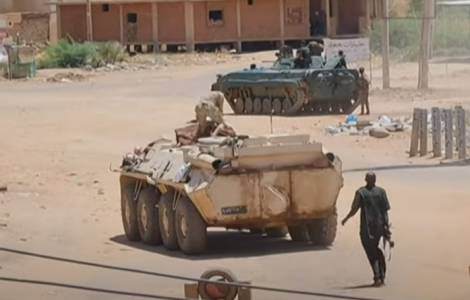
Khartoum (Fides News Agency) – The war in Sudan continues amid drone strikes and tensions with Ethiopia and South Sudan, increasingly taking the shape of a fragmented, technologically driven conflict.
As the Sudan Armed Forces (SAF) seek to consolidate territories they have recaptured, the militiamen of the Rapid Support Forces (RSF) maintain a strong presence in Darfur and are seeking to reopen the front towards Khartoum.
The most delicate point in recent weeks has been El Obeid, the capital of North Kordofan and a strategic hub linking central Sudan, Darfur and the southern regions.
The city has been under growing RSF pressure for months (see Fides, 3/8/2026). The United Nations has repeatedly warned that El Obeid could become a new El Fasher, the Darfur city captured by the RSF in 2025 after a prolonged siege and the scene of grave atrocities against civilians (see Fides, 28/10/2025). In June, the UN Secretary-General reported the arrival of significant RSF reinforcements around the city, raising fears of a possible ground offensive.
The most striking feature of the fighting, however, has been the extensive use of drones. According to the UN Office of the High Commissioner for Human Rights, at least 15 drone strikes in the El Obeid area between June 6 and 28 killed at least 45 civilians and wounded 41 others. The attacks also struck markets, schools, petrol stations, water infrastructure and vehicles.
Another significant development concerns the Blue Nile region in the southeast of the country, along the border with Ethiopia. In recent weeks, the Sudanese army has sought to consolidate its positions after regaining ground in the region. Control of areas such as Kurmuk is particularly important because it helps secure communication routes with Ethiopia and restrict the movement of opposing forces.
The situation, however, remains extremely fluid. On August 12, reports emerged of fighting in the Qaisan area, where Sudanese forces said they had repelled an attack by the RSF and allied groups.
The conflict can no longer be viewed simply as an internal confrontation between the SAF, led by General Abdel Fattah al-Burhan, and the RSF, led by Mohammed Hamdan Dagalo, known as “Hemedti”. Sudan has also become a battleground between regional powers and cross-border military networks (see Fides, 7/5/2026).
Accusations of external support for both sides have multiplied. Sudan has accused Ethiopia of allowing drones to be launched from its territory against Sudanese targets. At the same time, investigations and allegations have emerged concerning regional support for the RSF, particularly from the United Arab Emirates.
The dramatic humanitarian situation in Sudan was highlighted by Pope Leo XIV at the conclusion of the Angelus on Sunday, August 9. “I continue to follow with concern the tragic situation in Sudan, especially in the city of El Obeid,” the Pope said, renewing his appeal “to the authorities to ensure humanitarian corridors for the civilian population.” “At the same time, I urge the international community to support efforts to achieve an immediate ceasefire. Let us pray to the Lord to sustain those who are suffering, convert the hearts of those who sow violence, and grant the long-awaited peace,” the Holy Father concluded.
(L.M.) (Fides News Agency, 12/8/2026)