Information service of the Pontifical Mission Societies since 1927
Diocese of Dinajpur
by Paolo Affatato
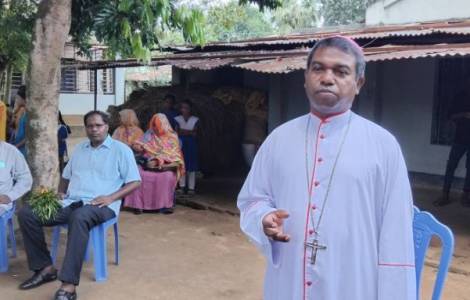
Dinajpur (Fides News Agency) – “The hope of the Church in Bangladesh lies in the tribal peoples. Therein lies the future of the Church,” Bishop Sebastian Tudu of Dinajpur emphasized in an interview with Fides about the development in the diocese in northwestern Bangladesh, where the Catholic community is steadily growing thanks to the proclamation of the Gospel among the indigenous populations, especially the Santal and Orao.
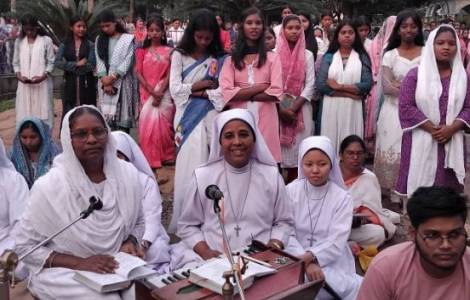
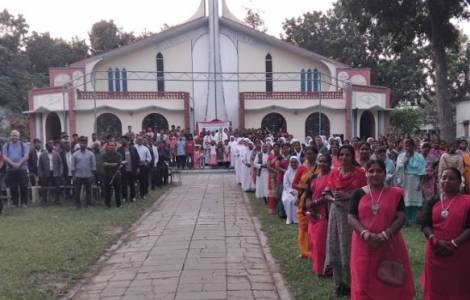
Founded in 1927, the Diocese of Dinajpur has around 100,000 Catholics, approximately 0.6% of the total population, in a country of about 18 million inhabitants. It is divided into more than 30 parishes and has numerous mission stations in the villages of the indigenous population. Priests, men and women religious, and catechists are active there in evangelization, education, and human promotion. The vast majority of Catholics belong to tribal ethnic groups, particularly the Santal and Orao, communities from which many families who choose the Catholic faith still originate.
“Numerous tribal communities live together in the Dinajpur area. It is one of the dioceses where the Catholic presence is particularly strong, especially among these groups,” the bishop told Fides. “Among the Santal and Orao, we see great potential for evangelization. The Church in Dinajpur is growing and expanding year by year.”
He explains that this development stems from the initiative of the communities themselves: “Our approach to evangelization primarily involves bringing initial evangelization and a first witness of faith to remote areas. We send catechists, priests, and nuns to villages where there are no Christians yet. Very often, the residents themselves invite us. They want to learn more about the Christian faith and express a desire to hear the Gospel.”
From this initial encounter begins a catechumenate that requires time and preparation: “Priests and catechists visit the village regularly, and some residents officially become ‘catechumens.’ After about a year, they can receive baptism; sometimes it takes longer, because we want them to be well-prepared. They learn about the liturgy and the prayers and gain a deeper understanding of Christian life. In this way, we prepare for the establishment of a Christian community in a village.”
It's not about individual conversions: “Sometimes we baptize ten, fifteen, or twenty families at once. Sometimes an entire village embraces the Gospel,” the bishop notes. “The Catholic community continues to grow steadily, thank God.” This growth is also reflected in the pastoral organization of the diocese: “We open a new parish almost every year,” says Bishop Tudu. “Every year we have more than a thousand new baptisms. The communities are there, they are ready. But to establish a new parish, we have to prepare everything necessary: the church, the rectory, the premises. Sometimes economic difficulties slow down this process. But the people are there. That is a great sign of hope for us.”
According to Bishop Tudu, the missionary dynamism of the Bangladeshi Church today is clearly linked to the indigenous peoples: “The Church in Bangladesh can grow particularly among the tribal peoples. The majority of Catholics in our country, which is predominantly Muslim, belong to these communities. That is why we say that the hope and the future of the Church lie precisely with the tribal peoples.”
In Bangladesh, there is no law that prohibits Muslims from converting to Christianity, and the Constitution formally guarantees freedom of religion, including the right to profess, practice, and spread one's faith. On a social and familial level, however, a Muslim's conversion to Christianity can lead to intense pressure, and a convert from Islam may experience isolation, family breakdown, discrimination, job loss, or even threats and attacks by extremist groups. To maintain interreligious peace in this context, the Catholic Church's preaching and proclamation are primarily directed toward the indigenous non-Muslim population.
Bishop Tudu also explains the reasons for these people's openness to Christianity: "Certainly, there are cultural factors that make it easier for them to encounter our faith, but that is not the main reason. When they receive an education, when they learn to think and judge, they rediscover their dignity. The Church promotes education, and for that they are deeply grateful." "But what really attracts them," he continues, "is the Gospel. Jesus' words, such as 'Blessed are the poor,' speak directly to their hearts. In the Gospel, they find a word of life. These people still practice traditional religions and forms of animism and they discover in the Word of God a guide for their lives. For them, it is a great gift and a firm point of reference, a sure guide.”
Bishop Tudu himself comes from the Santal people. “I am a Santal. My father was already baptized, and I inherited the faith from my family. Today I see so many members of our people embracing Christianity, and that fills me with joy.”
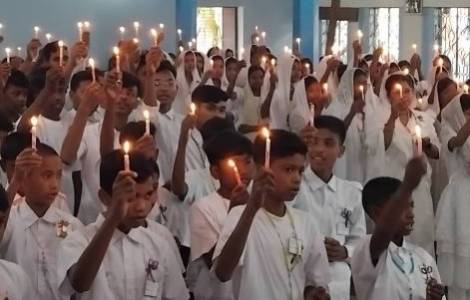
The growth of the Church is also reflected in the increase in vocations: “Among the tribal populations, there are many vocations to the priesthood and religious life. The enthusiasm is great because these communities have only recently discovered the faith. We see God at work in them. It is a great gift for us.”
The bishop also emphasizes the climate of peaceful coexistence that characterizes the villages of the diocese: “We have no problems with either the Muslims or the non-converted members of indigenous groups. They all live together peacefully. Among the indigenous groups, some still practice animism, others are Christians, but they participate together in social and cultural activities, weddings, celebrations, and village festivals. They are simple, peaceful, and happy people.”
Many of these families live in rural areas on the edge of the forest and are primarily engaged in agriculture. “The level of education,” he notes, “is still low. Therefore, supporting schools and guiding children and young people in their education is an essential part of the Church’s mission. The families greatly appreciate this service.”
Bishop Tudu recalls the history of the diocese and expresses deep gratitude to the missionaries who laid the foundations of the local Church. “We have received an immeasurable gift from missionaries, such as those of the Pontifical Institute for Foreign Missions (PIME). Many are now elderly or have already passed away. We are deeply grateful to them. They not only founded our Church but also contributed to the human, social, and educational development of our communities.”
Bishop Tudu looks to the future with confidence: “I am very hopeful. We hope that the universal Church will continue to support our small community. We still need this support because the mission continues, and the Lord continues to call new people to faith.” (Fides News Agency, 13/7/2026)