Information service of the Pontifical Mission Societies since 1927
OMI
by Paolo Affatato
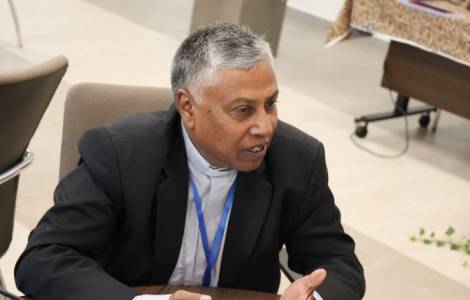
Rome (Fides News Agency) – A small, poor yet vibrant Church, sustained by deep faith and characterized by the active participation of its faithful. This is how Bejoy Nicephorus D'Cruze, OMI, Metropolitan Archbishop of Dhaka and President of the Catholic Bishops' Conference of Bangladesh, yesterday described the Catholic community in Bangladesh following the bishops' ad limina Apostolorum visit, during which they met Pope Leo XIV to present the reality of the Church in the country.
"It was a very encouraging meeting for us," Archbishop D'Cruze told Fides. "We shared with Pope Leo the life of the Church in Bangladesh and invited him to visit us, God willing."
In a largely Muslim nation of nearly 170 million people, Christians account for less than one percent of the population.
"We are a very small minority," the Archbishop said in an interview with Fides.
Catholics number approximately 433,000, representing just 0.3 percent of the country's population. Despite their small numbers, the Catholic Church has established a widespread and highly respected pastoral network throughout Bangladesh. More than 400 priests, over 1,200 men and women religious, and 153 major seminarians serve in the country, while more than 800 catechists play a crucial role in supporting local communities, especially in remote villages.
"Bangladesh is still a poor country striving for development, and the Church is poor as well, but we continue to work for the poor," Archbishop D'Cruze said.
Most Bangladeshi Catholics belong to indigenous and tribal communities living in different regions of the country, while others come from socially vulnerable groups such as the Dalits. "The majority of our faithful are poor, although some belong to the middle class," he said.
"Despite limited resources, the Church continues to carry out extensive pastoral and social work through schools, healthcare facilities, charitable activities and development programs run by Caritas. Catholic institutions run more than 700 educational facilities, including primary and secondary schools, technical and vocational institutes, 13 colleges and one Catholic university, Notre Dame University Bangladesh.
"Every year, thousands of Muslim, Hindu, Buddhist and Christian students attend these institutions, which are regarded among the most qualified in the country," the Archbishop said.
In addition to its educational work, the Church is active in healthcare and social assistance through hospitals, clinics, health centers and community development programs across both urban and rural areas.
Caritas Bangladesh plays a central role, implementing more than 80 programs across the dioceses in fields including education, vocational training, poverty alleviation, emergency response and local community development, reaching approximately 1.6 million beneficiaries.
"One of the most painful direct consequences of poverty is youth migration," Archbishop D'Cruze observed.
"Because of difficult economic conditions, uncertainty about the future and the lack of employment opportunities, young Bangladeshis want to leave the country and migrate as soon as they can."
The phenomenon is particularly evident in the diocese of Dhaka.
"Many young people seek higher education abroad, especially in the United States, the United Kingdom, Australia or Europe. Families invest in their children's education, but often many never return. As a result, the country loses some of its brightest minds."
Closely linked to migration is one of Bangladesh's most pressing social challenges: human trafficking.
"It is a very serious problem," the Archbishop said. "Many intermediaries promise young people jobs and a better life abroad, but very often it turns out to be a trap."
Poverty and unemployment leave many people, especially those from the poorest families, particularly vulnerable. Catholic organizations and religious congregations work to raise awareness and prevent trafficking, but, he noted, "in such a large country our presence remains limited, and it is difficult to identify criminal networks and traffickers operating under false pretenses."
The long-standing problem of unemployment, and its impact on emigration and its tragic consequences, "must be addressed through national policies," the Archbishop said.
In this regard, he expressed cautious optimism about Bangladesh's new political phase following February's elections and the formation of a new government led by the Bangladesh Nationalist Party (BNP) under Tarique Rahman.
"After a period of instability and the transitional phase of the interim administration, we now have a stable government and hope for a better future. We enjoy positive relations with the new government and seek dialogue in order to contribute to the common good of the country."
Religious freedom, however, remains a more complex issue.
"The government says it does not want to define us as a 'minority,' but rather as citizens of Bangladesh, and this is a positive approach," he acknowledged.
"Nevertheless, there are still real forms of discrimination between Muslim citizens and those who profess other religions. The Constitution guarantees equal rights to all, but social and political realities do not always reflect this."
The freedom to publicly proclaim the Gospel remains significantly restricted.
"We can preach inside our churches, but not outside them. For this reason we act prudently, seeking to safeguard both our pastoral ministry and the lives of our faithful."
In this context, interreligious dialogue, particularly between Muslims and Christians, is essential: "Our relations with many Muslim religious leaders are constructive. There are Muslims who help and support us," Archbishop D'Cruze said, while also recalling the presence of fundamentalist Islamic groups whose propaganda at times creates tensions or results in violence against non-Muslims, such as Hindus and Christians.
"At the same time," he added, "many politicians, public officials and Muslim leaders who studied in our schools maintain positive relations with the Church, listen to our concerns and remain close to us. This gives us hope."
Looking at the life of the Church, the Archbishop stressed: "we need additional schools, churches and chapels, particularly in villages where some Catholic communities still lack adequate places of worship.
The situation regarding vocations, however, remains encouraging. Vocations to the priesthood and consecrated life continue to be numerous. This is a very positive sign for the future of the Church."
The Church's pastoral priority, he said, remains faith formation. "We want to strengthen the Christian formation of the faithful and help them remain united, supporting one another in faith, hope and charity."
Lay people and catechists continue to play a fundamental role, particularly in rural areas:
"Catechists play an essential role in transmitting the faith, accompanying communities and serving as a bridge with the diocese."
The Archbishop also highlighted the vitality of Bangladesh's Catholic communities: "Our faithful are practicing Catholics. More than 80 percent attend Sunday Mass regularly. During major liturgical celebrations there is always a significant participation of the baptized:
"During our principal religious feasts, thousands of faithful move with faith and for faith, and our major pilgrimages regularly attract more than 50,000 participants."
Marian devotion remains particularly strong, together with devotion to saints such as St. Anthony of Padua, who enjoys widespread popularity among Bangladeshi Catholics.
"Every February, thousands of pilgrims travel to the Shrine of St. Anthony in Panjora, in the Archdiocese of Dhaka, for the country's oldest and largest Catholic pilgrimage."
The Archbishop also recalled the October pilgrimage to the Shrine of Fatima Rani (Our Lady of Fatima) in Baromari, in the Diocese of Mymensingh, which he described as "the main point of reference of Marian devotion in the country."
Looking to the future, Archbishop D'Cruze concluded on a hopeful note:
"Being a minority in Bangladesh does not mean giving up our Christian witness. Christian faith has the power to transform people's lives. The faith in Christ that we profess and bear witness to offers real hope and leads to the integral salvation of the human person. We hope that, in time, our country will grow in its respect for the dignity of every individual. We are doing our part." (Fides News Agency, 26/6/2026)