Information service of the Pontifical Mission Societies since 1927
Silsilah
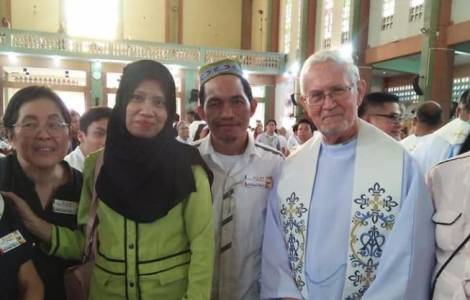
Zamboanga (Fides News Agency) – “It is not easy to take stock of 60 years of missionary life. I can only say what is in my heart, what the Lord has allowed me to experience. I can say what the commitment and the path of Islamic-Christian dialogue have been and are for me: It means growing together in spirit, walking together the path that leads to God,” said Father Sebastiano D’Ambra, an 84-year-old missionary of the Pontifical Institute for Foreign Missions (PIME), a few weeks after the 60th anniversary of his priestly ordination, which he celebrated on June 25, 2026. In an interview with Fides, he reflected on fifty years of missionary work in the southern Philippines, describing his journey, which made him one of the most important witnesses of dialogue between Christians and Muslims on the island of Mindanao, where he still lives in the city of Zamboanga.
Born in Aci Trezza, Sicily, he studied at the seminary in Acireale and chose the Pontifical Institute for Foreign Missions (PIME). He was ordained a priest in 1966 and initially worked in missionary animation. But even then, he recalls, he and his fellow confreres, Father Salvatore Carzedda and Father Antimo Villano, harbored a dream: “It was the early 1970s, and we wanted to embark on what were then, in the climate of the Second Vatican Council, called the ‘new paths of mission.’ We didn’t want to limit ourselves to just talking about mission: we wanted to live it, to bear concrete witness.”
This dream took shape in 1977 when PIME sent them to the Philippines and entrusted them with a special area of mission: interreligious dialogue. Father D'Ambra was transferred to Siocon on the island of Mindanao in the southern archipelago. It was a time marked by the martial law of Ferdinand Marcos' regime, armed conflict, and the presence of Muslim rebel groups: “When we arrived, there was violence. I tried to understand God's signs in this situation,” he told Fides. For this reason, he decided to take a pioneering step and live alone in a Muslim village. This experience would forever change his understanding of mission: “There, the Lord helped me understand what has become the central message of my entire missionary life: Dialogue comes from God and leads to God.”
From this spiritual intuition arose the “Silsilah” movement, an Arabic word for “chain.” A chain that, as the missionary explains, doesn't simply symbolize the connection between people of different religions: “Generally, dialogue with Muslims is understood as collaboration in certain areas. For us, it is something much deeper: a spiritual chain that unites Christians and Muslims with God. From this relationship grows the fraternity among us.”
However, the movement's path was not without difficulties, obstacles, and trials. In 1981, one of his Filipino colloborators lost his life in an attack. His superiors asked him to temporarily leave Mindanao and return to Rome. “It was a time of grace,” he recalls. In the Italian capital, he attended PISAI (the Pontifical Institute for Arabic and Islamic Studies) and deepened his studies of Arabic and Islam. “I was able to consolidate my reflections on the spiritual dimension and the foundations of interreligious dialogue,” he notes.
The most difficult test, however, came in 1992 when Father Salvatore Carzedda, a member of PIME, was murdered in Zamboanga City in an attack perpetrated by Islamist extremists. “Many felt it would be better to give up and abandon this path. But after profound spiritual discernment, we chose a different word: ‘Padayon,’ which means ‘Let’s move forward.’ If this work belonged to God, He Himself would sustain it.”
This decision marked a turning point. The Silsilah movement continued to grow and gave rise to new initiatives, such as Harmony Village, a place of formation, encounter, and coexistence between Christians and Muslims.
Over the years, Father D’Ambra was also appointed National Secretary for Interreligious Dialogue of the Catholic Philippine Bishops’ Conference and helped to disseminate the insights gained during the Silsilah experience throughout the country. From this movement also emerged a specifically Catholic community, the Emmaus Dialogue Movement, which is recognized by the Philippine bishops and brings together consecrated persons, lay people, and families who feel called to live dialogue as an authentic Christian vocation.
The latest milestone in this long journey is the Emmaus College of Theology, inaugurated five years ago. The college offers a four-year theology program with a specialization in interreligious dialogue, and students from different backgrounds earn a state-recognized academic. “The goal is to continue training missionaries of dialogue. It’s not just about learning how to live together, but about putting a spirituality of dialogue into practice,” he explained to Fides.
Today, the Muslim communities participating in the “Silsilah” movement are primarily located in the poorest neighborhoods of Zamboanga, and the mission has also spread to Basilan Island. Many religious and lay people who become acquainted with and regularly visit “Silsilah” carry this spirit to the dioceses of the Philippines and to other parts of the world.
In his reflection on 60 years of priesthood and 50 years of missionary work in the Philippines, Father D'Ambra focuses not on the results achieved, but on God's faithfulness: “I thank the Lord, for he has always guided me. I have learned that in everything we do, we are guided by him. Everything we are and do is a sign of hope for the Gospel, a work of proclaiming his love.”
He humbly notes that the work done over these decades “has contributed to establishing a spiritual focus on dialogue in the Philippines, a path that comes from God and leads to God," he says, recalling the four interconnected dimensions of the "spirituality of dialogue" cultivated within Silsilah: dialogue with God, dialogue with oneself, dialogue with one's neighbor, and dialogue with creation, but above all, he wants to clarify one key point: “A bishop once told me: In Mindanao, dialogue is necessary because there are Christians and Muslims; in my diocese, however, it is not necessary because we have no Muslims. I believe that is the wrong approach. Dialogue is not a strategy, not an instrument for shaping relationships with other religions. It means growing together in spirit, walking together on the path that leads to God. From this arise fraternity and peaceful coexistence.”
This, he says, is the legacy he wants to pass on to future generations as others prepare to lead the movement. “I place this entire work in God’s hands, for it is His plan. Years ago, I wrote a book entitled ‘A Call to a Dream,’ the dream of peaceful coexistence; and we published the collection ‘Dreaming Together.’ I hope that, with God’s grace, we can continue to dream together.” (PA) (Fides News Agency, 11/7/2026)