Information service of the Pontifical Mission Societies since 1927
MI
Mindanao (Fides News Ageny) – Hundreds of aftershocks continue to be recorded following the magnitude 7.8 earthquake that struck the southern island of Mindanao on June 8 (see Fides, 9/6/2026). Specifically, these were lower-intensity seismic events recorded on June 15, which fortunately have not worsened the already precarious situation of the affected populations. The death toll remains provisional; numerous people are still missing, while severely damaged infrastructure is causing serious accessibility problems in the affected areas.
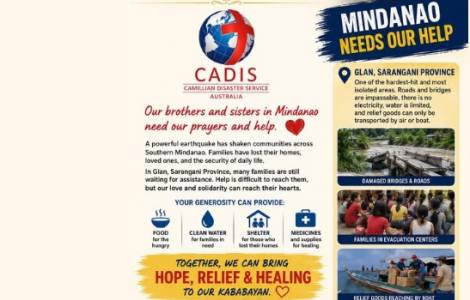
Among the aid efforts, Camillian Disaster Service (CADIS) International, the humanitarian organization of the Order of Ministers of the Sick (Camillians), is mobilizing a relief operation for survivors. According to the Camillians, vulnerable Indigenous populations, Moro communities, fishermen, and rural farming families are the most affected.
The toll provided by CADIS, dated June 11, 2026, indicates a devastating humanitarian impact that continues to worsen. There are 61 deaths, 688 injuries, 40 missing persons, 75,324 affected families, and 12,641 damaged homes (2,289 completely destroyed). Thousands of families remain displaced, sleeping outdoors in makeshift shelters or in overcrowded evacuation centers. The displacements are due to the fear of structural collapses caused by aftershocks, including a magnitude 5.9 earthquake on June 10. Preliminary estimates indicate damage to essential infrastructure such as hospitals and schools, roads, bridges, communication networks, and power lines. Furthermore, ongoing communication disruptions and impassable roads have left several ‘barangays’ on the coast and inland isolated, delaying aid delivery and a full damage assessment. Thousands of families are still waiting for assistance.
The humanitarian effort of the Camillian missionaries is being coordinated by the Mindanao branch of CTF Philippines, in collaboration with other local agencies such as the Consortium for People’s Development Disaster Response (CPDDR) and the Sisters Association of Mindanao (SAMIN). Following a rapid assessment, CADIS International emphasizes the urgent need for essential goods such as rice, food packages, and clean drinking water; emergency shelters, tarpaulins, plastic sheeting, building materials, blankets, and mattresses; first aid supplies, essential medicines, and hygiene kits; as well as psychosocial support, especially for displaced children and families. Local community organizations have already begun relief operations, albeit with extremely limited resources.
The Philippines has a long and dramatic seismic history. The country lies within the Pacific Ring of Fire, one of the most active areas on the planet. In recent years, it has been struck by several significant earthquakes: on September 30, 2025, a magnitude 6.9 earthquake destroyed or damaged numerous buildings in the northern part of Cebu Island (see Fides, 2/10/2025); in 2019, a series of devastating tremors in Mindanao caused severe damage (see Fides, 16/12/2019); in 2013, the 7.2 magnitude Bohol earthquake destroyed historic churches and left more than 200 dead (see Fides, 18/10/2013). In 1976, a powerful earthquake triggered a catastrophic tsunami that killed thousands of people. (AP) (Fides News Agency, 17/6/2026)