
Information service of the Pontifical Mission Societies since 1927
vicariatodeiquitos.org
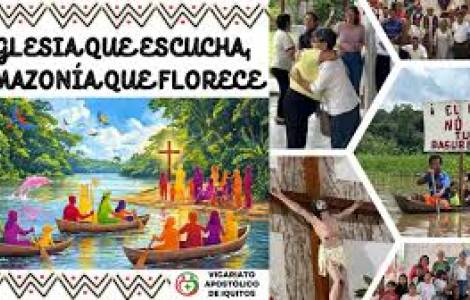
Iquitos (Fides News Agency) – The Apostolic Vicariates of the Peruvian region of Loreto are sounding the alarm: In light of the latest data from the National Institute of Statistics and Informatics (INEI) on economic poverty in 2025, they denounce a situation that is not improving, but rather worsening. It is characterized by blatant inequalities and a feeling of being abandoned by the state.
In a joint message, the bishops of Iquitos, Yurimaguas, and San José del Amazonas point out that Loreto is the second most poverty-stricken region in the country. Over 40% of the population lives in poverty or extreme poverty, and more than 32% are in precarious situations, meaning they are at risk of falling into poverty at the slightest crisis. The situation is even more dire for families whose head of household speaks an indigenous Amazonian language as their mother tongue; here, the poverty rate is over 46%. For Paolo Francesco Diaz Sevillano, spokesperson for the Apostolic Vicariate of Iquitos, this poverty is deeply multifaceted and structurally rooted. One of the most visible symptoms is access to drinking water: According to the National Center for Strategic Planning (CEPLAN), in 2024 only 74.1% of families in Loreto were connected to a public water network. This makes Loreto the worst-served region in the country, far behind other departments like Moquegua, where the connection rate is 96.7%. “Many families on the outskirts of Iquitos continue to wait for rain to collect water, or they buy water daily from suppliers whose drinking water quality is not guaranteed,” he explained to Fides. This situation puts a financial strain on families, as they ultimately have to pay significantly more than families connected to the public water network. In addition to the financial resources required to purchase water, the lack of access to drinking water facilitates the spread of diseases such as cholera, diarrhea, and dengue fever, leading to lost work time and additional healthcare costs for the state and especially for families. “When one family member becomes ill, the entire household is plunged into a very difficult economic situation,” he emphasizes. Access to education is another major problem. Loreto has only two public universities—the Universidad Nacional de la Amazonía Peruana in Iquitos and the Universidad Nacional Autónoma de Alto Amazonas in Yurimaguas—and a single private university, recently established in the regional capital, whose fees many cannot afford. For many young people, pursuing higher education means migrating to Iquitos or opting for short-term technical courses. According to INEI, approximately 65,000 young people between the ages of 15 and 29 are neither employed nor study. This situation fuels the informal economy, human trafficking, and criminal networks. Added to this are the very low levels of literacy and numeracy; Loreto ranks among the worst in the country in these areas. This socioeconomic instability is exacerbated by further factors specific to the Amazon region. Vast distances, the dependence on fuel for river shipping, and the presence of criminal economic networks that have infiltrated the state contribute to higher inflation than elsewhere. Those with capital speculate on prices, making it difficult for the poorest population to purchase even basic consumer goods. It is estimated that the cost of a basic food basket in Loreto is 15 to 30% higher than in Lima, while wages are generally lower. "You could say that Loreto has higher inflation and lower wages," summarizes the spokesperson for the vicariate. In light of this diagnosis, the bishops of the region speak unequivocally of "corruption" that perpetuates poverty and hinders development. “The regional government of Loreto and the municipalities have the necessary resources, yet the quality of life for the population is not improving. This means that those in charge lack the will to implement policies that serve the common good, and that decades of exploitation of the Amazon are now also burdening public budgets,” they explain. They denounce a situation of intense social conflict, tension, and outbreaks of violence—such as those that recently occurred along the Corrientes River—which will make Loreto one of the most fragile regions in the country by mid-2026. Given the urgency and severity of the situation, the bishops appeal to national and local authorities to “work with commitment and responsibility to reduce poverty among our population and to manage public funds honestly and transparently.” And they appeal to citizens to “exercise their right to vote.” and to fulfill their duty to vote by electing more competent and reliable candidates who are capable of putting the common good above particular or party interests.”
In this context, the role of the ecclesial community remains central. At the height of the COVID-19 pandemic, the ecclesial community of Iquitos assumed a leading role: According to a study cited by the spokesperson for the Vicariate, the paralysis of municipal and regional authorities in the face of the emergency made Loreto one of the hardest-hit areas, and the Church proved to be a key player by organizing one of the largest civil society fundraising campaigns nationwide. This led the Prime Minister, during a visit to Iquitos, to request a personal meeting with the Vicariate's diocesan administrator—a sign of the trust placed in the ecclesial institution. Even today, this trust is reflected in constant requests from parishes, although the Church can neither replace nor intends to replace the state. Nevertheless, the Vicariate of Iquitos has implemented a number of concrete initiatives. “We benefit from the support of key partners who help us carry out important projects, allowing us to support vulnerable populations in their struggle for access to drinking water, for the protection of waterways like the Marañón River, declared a subject of rights in 2024, for the repair of environmental damage, for the defense of indigenous leaders, for the prevention of abuse in church spaces, to provide housing for the homeless, and to be an integral part of the city's educational offering,” explains Paolo Francesco Díaz Sevillano. In total, five parish schools in this department, which suffers from very low academic achievement, offer high-quality education. Many of these initiatives remain discreet but are crucial for those who benefit from them. Paul Francis Díaz Sevillano acknowledges that some of these projects encounter resistance within church circles, but emphasizes: “Let us act in the light of the Gospel.” Inspired by the biblical call to “hear the cries of the poor and the weak” (Exodus 3:7–9), the Apostolic Vicariates of Loreto call for accountability and invite all of society to participate in this urgent task of social, political, and pastoral conversion. (ML) (Fides News Agency, 22/5/2026)



 AMERICA/ECUADOR - A milestone for the Amazonian Church: First Ecclesial Assembly of the Ecuadorian Amazon
 Sixth General Assembly of the Ecclesial Conference of the Amazon (CEAMA). “Something new is being born”
 BEATIFICATION OF FULTON SHEEN/VI — At the Vespers for Fulton Sheen, “made holy through his friendship with Christ”
 The seed of the Gospel and mission: Archbishop Sangalli concludes the formation Course for bishops in Nemi with a meditation on St Charles de Foucauld
 KOREAN MISSIONARIES IN THE WORLD/5 - Father Lim's 33 Bolivian chapels
 LEO XIV IN AFRICA - Eastern Angola: plundered riches, calls for autonomy, and witchcraft
 “Listen before proposing, accompany without replacing”: Caritas aid workers share their experience alongside communities
 AFRICA/ZIMBABWE - Government task force to tackle illegal mining
 ASIA - Central Asian countries seek to preserve water resources