Information service of the Pontifical Mission Societies since 1927
VaticanMedia
Annaba (Agenzia Fides) - Every person is called to be born again and to experience the gift of a new life as a sign and pledge of eternal salvation. And this rebirth is not achieved through the pursuit of moral perfection. It unfolds as a gratuitous gift in those who experience on this earth that “our lives can be changed because Christ rose from the dead.”
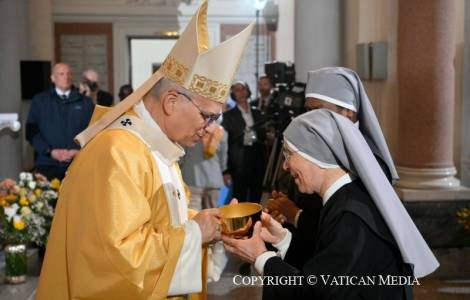
In Annaba, the ancient Hippo, Pope Leo XIV celebrated Mass this Tuesday, April 14, in the Church of Saint Augustine, concluding two intense days in Algeria. The Bishop of Rome, a member of the Augustinian Order, reiterated in the city where the “Doctor Gratiae” was bishop what his patron saint testified to through his life and works: that faith and the Church live only by the grace of Christ. And that is why the Church is always a “newly emerging Church,” and the accounts of the unity among the first disciples, as told in the Acts of the Apostles, are forever the “rule” for all ecclesiastical reform.
In his homily, which he delivered in French at the Basilica of Annaba, Leo XIV began with the day's Gospel reading, the account of the nighttime conversation between Nicodemus and Jesus, who entrusts his interlocutor—“and to us as well”—with a “surprising” task of being “born from above.” From Jesus' invitation, the Pope continued, “gives rise to the mission of the whole Church, and consequently to the Christian community in Algeria: to be born again from above, that is, from God.” An impossible mission, a command that no one can fulfill on their own. Yet “the Lord’s grace makes the desert blossom.” Jesus' words to Nicodemus are neither "a harsh imposition" nor "a condemnation to failure," since "we can be born anew from above thanks to God." And "while Christ invites us to renew our lives completely, he also gives us the strength to do so."
Pope Leo quoted the famous plea from the "Confessions" of Saint Augustine: "Give, O Lord, what you command and command what you will." No matter, the Pope continued, "how weighed down we are by pain or sin: the crucified One carries all these burdens with us and for us. No matter how discouraged we are by our own weaknesses: it is precisely then that God manifests his strength, the God who has raised Christ from the dead in order to give life to the world." And "each one of us can experience the freedom of new life that comes from faith in the Redeemer."
The authentic image of the new life of those who walk in the light of Christ's resurrection—said the successor of Peter in the second part of his homily— is revealed in the accounts of the Acts of the Apostles, where "the lifestyle that characterizes humanity renewed by the Holy Spirit" emerges. Therefore, Leo XIV continued, the "apostolic rule" of the Acts of the Apostles remains forever an "authentic criterion" for ecclesiastical reforms: a reform "that must begin in the heart, if it is to be genuine."
The Pope addressed the characteristics that distinguished the mission of the first Christian communities as described in the Acts of the Apostles: concordia, that is, "the communion of hearts that beat as one because they are united with the heart of Christ"; mutual charity extending to the complete sharing of goods, which is not a utopia, but rather because "faith in the one God, Lord of heaven and earth, unites people according to perfect justice."
Inspired by this law, inscribed in our hearts by God, the Church is continually reborn, for where there is despair she kindles hope, where there is misery she brings dignity, and where there is conflict she brings reconciliation. Charity, he said, is “more than a moral commitment; it is a sign of salvation: the Apostles proclaim that our lives can change because Christ has risen from the dead.”
In the concluding part of his homily, the Pope urged the Christians of Algeria: “to remain a humble and faithful sign of Christ’s love in this land.” The presence of Christians, a small flock scattered among the multitude of their Muslim compatriots, the Pope declared, “is like incense: a glowing grain that spreads fragrance because it gives glory to the Lord and joy and comfort to so many brothers and sisters. This incense is a small, precious element that does not draw attention to itself, but invites us to turn our hearts to God, encouraging one another to persevere amid the difficulties of the present time.”
The Pope recalled the history of the Church in Algeria, “characterized by generous hospitality and resilience in times of trial.” Here, Pope Leo XIV said, “the martyrs prayed; here Saint Augustine loved his flock, fervently seeking the truth and serving Christ with ardent faith. Be heirs,” concluded the Bishop of Rome, “to this tradition, bearing witness through fraternal charity to the freedom of those born from above as a hope of salvation for the world.”
On the afternoon of Monday, April 13, Leo XIV had met with numerous representatives of the Church in Algeria at the Basilica of Our Lady of Africa in Algiers. “This basilica is a place of encounter and fraternity; more than nine out of ten people who enter it are Muslims,” remarked the Archbishop of Algiers, Cardinal Jean-Paul Vesco, in his welcoming address. “Notre Dame d’Afrique,” as she is often called by the locals, is firmly rooted in Algerian cultural heritage and in the hearts of Algerians. The inscription welcoming them – “Pray for us and for the Muslims” – expresses Mary’s maternal calling to all humanity and the vocation of this basilica, which receives so many expressions of trust and hosts numerous cultural and religious events, including the Islamic-Christian Marian Days. “It is precisely love for their brothers and sisters that inspired the witness of the martyrs we have commemorated,” Pope Leo emphasized during the meeting, recalling the 19 Algerian martyrs beatified in Oran on December 8, 2018.
“In the face of hatred and violence,” he added, “they remained faithful to charity even to the point of sacrificing themselves alongside many other men and women, Christians and Muslims. They did so without ostentation or fanfare, with serenity and steadfastness, neither falling into presumption nor despair, for they knew the One in whom they had placed their trust.”
Also on Monday, April 13, the Pope addressed the Cardinals worldwide in a letter dated April 14, focusing in particular on the developments in the working groups dedicated to the Apostolic Exhortation "Evangelii Gaudium" during the Consistory last January, "especially with regard to mission and the transmission of the faith." Echoing the words of Popes Benedict XVI and Francis, Pope Leo XIV affirmed that the mission "spreads more by attraction than by conquest." In his letter, he further recalled that the mission of the Church "unites explicit proclamation, witness, commitment, and dialogue, without yielding to the temptation of proselytism or a logic of mere preservation or institutional expansion." Even though it recognizes itself as a “minority,” the Bishop of Rome added, using expressions that also apply to the small ecclesial community in Algeria, the Church is called “to live without complexes, as a small flock that brings hope to all, and to remember that the goal of the mission is not its own survival, but the sharing of the love with which God loves the world.” (GV) (Agenzia Fides, 14/4/2026)