Information service of the Pontifical Mission Societies since 1927
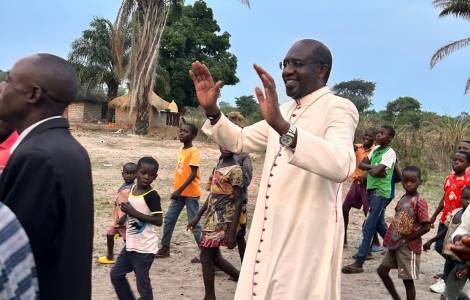
Luanda (Agenzia Fides) - "The Holy Father will find a mature Church, a Church that knows how to respond to the many challenges of faith as well as to social and cultural issues; a young, joyful, and missionary Church that looks to universality and begins to offer its sons and daughters for the good of humanity," said Msgr. José Manuel Imbamba of Saurimo, President of the Catholic Bishops' Conference of Angola, one of the four African countries the Pope will visit from April 18 to 21.
"I hope that the Holy Father's visit will strengthen and encourage us so that, in the face of the various problems we encounter, we do not waver, so that we may continue to be living witnesses of God's love, here in our concrete reality and in the reality of the world," the President of the Angolan Bishops' Conference continued.
The Angolan people have endured a long period of colonization and, at times, very severe conflicts, which have profoundly shaped the nation's soul and whose repercussions are clearly visible in the country's socio-political situation.
"The colonization process in Angola was a very lengthy process that profoundly shaped the consciousness of Angolan citizens—a process that humiliated, enslaved, discriminated against, and, in a sense, erased their cultural identity. And, of course, this is a burden, a very heavy legacy," Msgr. Imbamba emphasizes. "After independence 50 years ago, the country unfortunately entered a bloody war, which further shattered and delayed what little had been achieved and led to divisions, poverty, exclusion, and an excessive politicization of the population." According to the president of the Bishops' Conference, achieving a true Angolan identity remains a distant goal due to problems in national politics such as corruption, cronyism, greed, and a lack of love for their country.
"Today, Angola is very fragmented; political parties count for more than anything else. Angola is, in a sense, trapped by the parties, and when that happens, the country naturally falls behind," explains Msgr. Imbamba. "This is not yet the country we envision. Reconciliation is needed. There is a need for social forgiveness, a need to depoliticize minds, consciences, public institutions, and family life so that the dream of Angola is born from social embrace, born from the coexistence we all desire."
Poverty, unemployment, and national debt are among the major problems plaguing the country and its people. In this context, the Church is an essential point of reference for the most important issues facing Angola, given that 60% of the population is Catholic. "A vibrant and so fruitful Church that theological and philosophical seminaries no longer have room for our candidates for the priesthood," says Msgr. Imbamba, who specifies: "There are currently about 1,600 major seminarians, more than 1,500 diocesan priests, over 600 religious priests, and more than 1,700 religious sisters." "The Church in Angola is currently served by 20 dioceses and is a Church that establishing itself, expanding, and cherishing the dream of founding further dioceses to enable a more dynamic pastoral ministry, a pastoral ministry of closeness,” explains the President of the Angolan Bishops’ Conference. “We are also strongly committed to the laity, through whom we are represented in the world of science, culture, technology, politics, and sociology—in all these areas that we try to support through Catholic schools, our colleges, and the Catholic University.” Thus, it is a Church that wants to establish itself as a moral authority and a life-giving force within society and that eagerly anticipates the Pope’s visit. A very young, very welcoming Church, but one that also has many downsides due to the historical developments the country is currently undergoing. “It is about recognizing merits and fostering the harmony we all desire through open and honest dialogue, by building bridges of harmony and encounter so that we can reach a consensus in the name of Angola and the Angolans. All of these are problems that are becoming increasingly acute due to the current global situation,” concludes the President of the Angolan Bishops’ Conference. (E.G./L.M.) (Agenzia Fides, 9/4/2026)