
Information service of the Pontifical Mission Societies since 1927
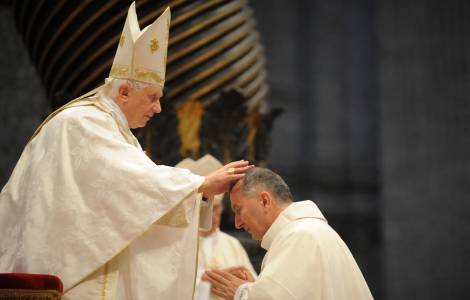
by Cardinal Pietro Parolin*
We are publishing excerpts from Cardinal Pietro Parolin’s preface to the volume “La fede del futuro, il futuro della Chiesa” (“The Faith of the Future, the Future of the Church”). The book, which contains selected texts, including an unpublished text by Joseph Ratzinger-Benedict XVI, was published by Edizioni Cantagalli and edited by Giuseppina Cardillo Azzaro (translated by Pietro Luca Azzaro, revised by Lorenzo Cappelletti).
***
Rome (Agenzia Fides) – What is faith for Joseph Ratzinger?
It means, first and foremost, entrusting oneself to another person, “like a child in his mother’s arms, certain that all the answers to my questions lie within her. Faith, trust, and love thus become one, and all the individual elements around which faith revolves are merely embodiments of the turning point that sustains everything: the ‘I believe in you,’ the discovery of God in the eyes of the man Jesus of Nazareth.”
If this is faith, then—as Leo XIV reminds us in his first message from the central loggia of St. Peter’s Basilica on May 8, 2025— the Church, in its essence, is our journey hand in hand on the path of life in the company of Christ, who sets our hearts ablaze like the hearts of the disciples who accompanied him on the road to Emmaus.
Why do so many today experience faith as a burden, and why does the Church no longer seem to care? And how can a new beginning flourish?
This, in essence, is the heart of all the texts collected in this volume, which, as a whole, presents us with the figure and message of a great master of the faith who, through his depth, immediate accessibility, and the power of his witness, follows in the footsteps of the great Fathers and Doctors of the Church from whom he continually draws inspiration, beginning with Saint Augustine, his true master.
Of great relevance and humanity, for example, are the texts about Augustine's conversion and the role of his mother Monica in it: "In his memoirs, Saint Augustine describes what his mother Monica meant to him: in her, he experienced the Church as a person, the Church personally, so that it was not for him some abstract apparatus, something one hears about from afar, structures that seem somewhat incomprehensible. In this woman, the essence of the Church was personally present. For him, she was the Church in person, and therefore he could trust the Church and become a man of the Church."
The texts published in this volume also clearly demonstrate that Joseph Ratzinger was never the “leader” of a “party” within the Church, someone who believed he possessed the “correct theology” to set things right and establish “his” Church. His writings contain a “theology of the heart”: that of a man who is entirely focused on Christ and who constantly strives to live, to bear witness, and to invite others to share with him this inseparable relationship with Jesus that we call faith. Rediscovering this source of ecclesial life is what truly matters.
This is precisely why Joseph Ratzinger repeatedly reminds us: “The Lord, who himself became a guest and a wanderer, calls us to be open to all the homeless of this world, open to the suffering, the forgotten, the imprisoned, the persecuted: He is in everyone.”
The deep connection with his successors, Francis and Leo XIV, is evident and gains even more strength in Ratzinger's words, with which he outlines an essential characteristic of the power conferred upon Peter: "The power conferred upon him," he writes, "to bind and loose, to open and close, which is spoken of here, is at its core the task of letting in, of welcoming, of forgiving" (Mt 16:19). The same is also found at the Last Supper, which inaugurates the new community beginning with the body of Christ and in the body of Christ. This becomes possible because the Lord sheds his blood "for the forgiveness of sins for many" (Mt 26:28). Finally, in his first appearance to the Eleven, the Risen One establishes the communion of his peace by giving them the power to forgive (Jn 20:19–23). The Church is not a community of those who “do not need a doctor” (Mk 2:17), but a community of converted sinners, who live by the grace of forgiveness and, in turn, pass it on to others. (Agenzia Fides, 28/2/2026)
*Secretary of State of His Holiness



 VATICAN - Funeral of Benedict XVI: "we too have come with the fragrance of gratitude and the balm of hope"
 ASIA/UZBEKISTAN - Benedict XVI, "a Good Shepherd who takes care of a small distant flock"
 ASIA/MONGOLIA - COP17: The gift of faith in Jesus and care for creation in the witness of a young Mongolian woman
 ASIA/PHILIPPINES - Archbishop of Cebu: Celebrations for the Feast of Santo Niño should not be financed by sponsors linked to the gambling industry
 In Malawi, a whole stadium celebrates 100 years of World Mission Sunday: “United in Christ, united in mission”