Information service of the Pontifical Mission Societies since 1927
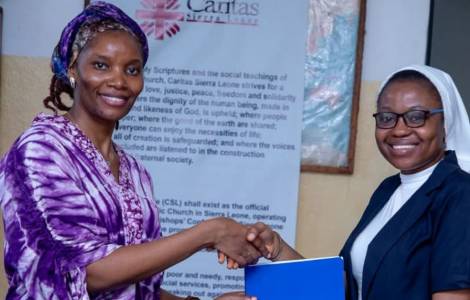
Freetown (Fides News Agency) – Psychological assistance to help people cope with trauma and social support to facilitate their reintegration into local communities; awareness-raising on irregular migration and research into migration trends. These are the main areas of intervention outlined in a cooperation agreement signed in early November between Caritas Makeni and the International Organization for Migration (IOM).
The agreement establishes a strategic partnership aimed at strengthening support for vulnerable populations and returning migrants in northern Sierra Leone.
Sierra Leone is characterized by complex migration patterns. On the one hand, the country hosts communities from neighboring states, including Liberia, Côte d’Ivoire and Guinea. The capital, Freetown, is also home to communities with origins in the United Kingdom, the United States and Lebanon. On the other hand, for several decades, Sierra Leoneans have been migrating to other African and European countries, often through irregular channels and with the help of criminal networks involved in human trafficking.
Some of these migrants are forced to return to their homeland for various reasons. According to IOM figures, since 2017 the organization has assisted more than 10,000 Sierra Leonean nationals who have opted for voluntary return. The circumstances prompting their return vary widely: migrants stranded in destination or transit countries, asylum seekers whose applications have been rejected, victims of human trafficking, unaccompanied or separated minors, older people and migrants with specific healthcare needs.
Returning home, however, does not necessarily mean that their difficulties have come to an end. Repatriated migrants often face serious challenges, including debts incurred with human smugglers and rejection by their families of origin. These two problems are frequently interconnected: many migrants have borrowed money from relatives, or received financial assistance from them, to fund their journey. Failure to reach their intended destination and returning home without financial resources can therefore lead to family tensions, demands for debt repayment, stigma and social exclusion.
Those who are unable to return to their communities of origin, or who come back without having achieved the goals that prompted their departure, may face severe social stigma. Creditors and members of the community exert pressure on them, fuelling feelings of shame, embarrassment and hostility. All this risks undermining precisely those family and social networks that are essential to successful reintegration.
The situation of women migrants returning to their homeland is particularly challenging. They often face greater barriers to accessing employment, training and essential services, difficulties that may be further compounded by the abuse and violence they have suffered along their migration journeys.
These challenges are compounded by psychological trauma and the need for psychosocial support arising from experiences endured along dangerous migration routes, including abuse, detention, violence and the loss of fellow travellers. Equally significant are the economic and social difficulties they encounter, such as unemployment, a lack of skills that can be put to use in the labor market, limited access to identity documents and essential services, and a shortage of income-generating opportunities.
It is against this backdrop that the partnership between Caritas Makeni and IOM has been established. Its aim is to accompany migrants through the difficult process of returning home and rebuilding their lives, providing psychological and social support while raising awareness of the risks associated with irregular migration.
(L.M.) (Fides News Agency, 9/11/2026)