
Information service of the Pontifical Mission Societies since 1927
by Marie-Lucile Kubacki
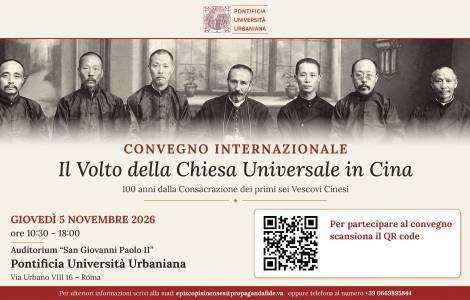
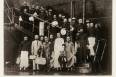
Rome (Fides News Agency) – On October 28, 1926, Pius XI consecrated six Chinese priests as bishops in St Peter’s Basilica, entrusting them with the leadership of apostolic vicariates and prefectures in their own country. One hundred years later, the international conference “The Face of the Universal Church in China”, held on Thursday, November 5, at the Pontifical Urbaniana University, brought together historians, cardinals, scholars and two bishops from China to retrace their story and reflect on the entire journey of the Catholic Church in the land of Confucius in the light of that “new beginning”.
From the missions to the local Churches
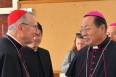
During the morning session, Joseph Li Shan, Bishop of Beijing, addressed the conference. He began by placing his own ministry within a much longer historical perspective.
“I am the Bishop of the Diocese of Beijing, and I myself was born in Beijing. Beijing was the first diocese in China. In 1294, the Franciscan friar John of Montecorvino, sent by Pope Nicholas IV, arrived in Beijing to proclaim the Gospel. It was then that the Chinese people were able to hear the Good News of salvation.”
He also recalled Matteo Ricci, who arrived in Beijing in 1601, convinced that “only by approaching local cultural traditions with a respectful attitude can the seed of the Gospel take root, grow, blossom and bear fruit”. He added: “My ancestors in the faith, and I myself, are the continuation of these fruits.”
The Bishop recalled the appeal made in the early decades of the twentieth century by far-sighted figures such as Archbishop Celso Costantini, missionary Vincent Lebbe, and educator and scholar Ma Xiangbo. They shared the conviction that pastoral care for Catholics in China and the leadership of ecclesiastical territories should be entrusted to Chinese pastors.
Following the episcopal consecration of Luo Wenzao in 1685, he observed, for more than two centuries the local episcopate in the Church in China continued to be entrusted exclusively to missionary bishops from other countries. The six bishops consecrated in 1926 “subsequently made an indelible contribution to the development of their respective dioceses and of the Church in China”.
Yet, before 1949, he noted, only 28 of China's 137 ecclesiastical circumscriptions had a Chinese bishop. Today, there are “more than 80” bishops in the Church in China.
Bishop Li Shan described the 1926 consecrations as “a right step in terms of ecclesiastical governance and a right step in the sinicisation of the Church”. He presented sinicisation as an opportunity for the Church to reflect on herself and adapt to China's present-day social and cultural context. Such adaptation, he explained, does not compromise the catholicity of the Christian faith; rather, it is demanded by that very catholicity and provides an appropriate starting point for its authentic realization in the particular Church in China.
Quoting the saying, “Where there is the bishop, there is the Church”, he also emphasized the importance of clerical discipline. “Today, the Church in China places particular emphasis on ecclesiastical discipline”, so that all Chinese clergy may be conformed to Christ and, before the world, work for the glory of God and the good of humanity.
He then recalled the commandment, “Render unto Caesar the things that are Caesar’s, and unto God the things that are God’s”, presenting observance of the law as “a natural expression of interior faith”.
Among the pressing issues facing the Church today, he mentioned the challenges posed by artificial intelligence, which are “particularly close to the heart of Pope Leo XIV”, and expressed his desire to “walk together” with “all the sister Churches throughout the world, members of the one Body”.
Also during the morning session, Professor Mario Luigi Grignani, who teaches the History of the Missionary Church and is Dean of the Faculty of Missiology at the Urbaniana University, placed the 1926 episcopal ordinations of Chinese bishops within the broader context of the “missionary turning point” that particularly marked the pontificates of Benedict XV and Pius XI.
For the historian, the 1926 consecrations, preceded by that of the first Indian bishop in 1923 and followed by that of the first Japanese bishop in 1927, marked “the transition from the missions to the local Churches”.
Grignani quoted Costantini’s memoirs, recalling his reaction upon learning that the Pope himself would consecrate the new bishops: “I was deeply moved, and my eyes filled with tears. My secretary, Father Philip Tchao, was with me.” The future Vicar of Xuanhua was not yet aware that he was among those chosen.
Following in the footsteps of Zhu Kaimin
The afternoon session opened with an address by Ignatius Ding Zuyao, who was consecrated on October 15, as the fourth Bishop of Haimen, a diocese whose first pastor was Simon Zhu Kaimin, one of the six bishops consecrated in 1926.
His successor, Ignatius Ding, began by quoting the Magnificat: “The Almighty has done great things for me, and holy is his name.” As the diocese marked its centenary, he explained, his journey to Italy had been “grace upon grace”: “I was able to retrace the footsteps left a century ago by Bishop Zhu Kaimin.”
The Bishop traced the history of the Catholic presence in the region, which dates back to 1637. He described Zhu Kaimin as a pastor who, during the years of invasion, “resisted pressure from the invaders”. He also recalled his successors: Matthew Yu Chengcai, consecrated in Nanjing in 1959, and Shen Bin, ordained in 2010, who is now Bishop of Shanghai.
At the heart of his reflection, Bishop Ding placed the relationship between synodality and inculturation. Referring to Pope Leo XIV, he described synodality as a style that “encourages particular Churches to begin from their own concrete reality” and “to build bridges of dialogue”.
The first chapter of his address thus called for “continuing the synodal journey and deepening the process of inculturation of Catholicism in China”.
The Bishop based this relationship in the ecclesiology of the Second Vatican Council, also reiterated by Leo XIV in the cycle of Wednesday Catecheses inaugurated at the beginning of 2026: “The Mystical Body is made up of different local Churches.”
It follows, he explained, that “each local Church should, in accordance with its own reality, explore a pastoral and evangelizing path suited to its community”.
For him, the listening that is intrinsic to walking together also extends to cultures. The Church, he said, once again echoing the Pope’s words, “must learn to listen to the voice of local cultures” and allow “the Gospel to be expressed in a language that the local population can understand”.
In Haimen, “synodality”, understood as “shared responsibility”, inspires the governance of ecclesial life. In the same missionary perspective, the diocese is training personnel with “dual expertise”: people who are well acquainted both with the classical doctrine of the Catholic Church and with China's rich cultural tradition, as well as the country's laws and policies.
Six bishops and a turning point
Elisa Giunipero, Professor of Chinese History at the Catholic University of the Sacred Heart, then offered a profile of each of the six bishops. Selected with significant input from missionary Vincent Lebbe, they all came from families that had been Catholic for generations. They had a thorough knowledge of Latin and were fluent in at least one European language, particularly French or Italian.
The Jesuit Zhu Kaimin, the first Apostolic Vicar of Haimen, was the eldest of the six and also the longest-lived. Following the arrest of Ignatius Gong Pinmei, the Jesuit Bishop of Shanghai, in September 1955, Zhu was confined to his room and subjected to questioning.
By then almost 90, nearly blind and without a successor, he wrote: “I openly profess my loyalty and devotion to the Chair of St Peter. I entrust everything to the Divine Heart of Jesus, who will certainly have mercy on us.”
The last news dates back to January 1959: “Please pray and ask for prayers for the Catholic religion in China, whose future is a cause of great concern.” He died on 22 February 1960, at the age of 91.
Philip Zhao Huaiyi, the only diocesan priest in the group and former secretary to Celso Costantini, had lost his father during the Boxer Rebellion. He died in October 1927, at the age of 47. A plaque in Xuanhua Cathedral recalls how he exhausted himself in an attempt to protect refugees who had taken shelter in the church during clashes between the armed militias of the “warlords.”
His episcopal motto was Impendam et superimpendar (“I will most gladly spend and be spent”) comes from Saint Paul's Second Letter to the Corinthians.
The Franciscan Odorico Cheng Hede, who had been sent to La Verna at the age of ten, wrote a grammar of Italian language for Chinese speakers and translated the Rule of Saint Francis into Chinese. Following his death in 1928, Costantini wrote that he and Zhao had inspired the indigenous episcopate, despite their very brief time as bishops.
The Vincentian Hu Ruoshan led Taizhou for 36 years, until his death in 1962. Another Franciscan, Aloysius Chen Guodi, founded a seminary in Fenyang in 1927 and died in 1930. Melchior Sun Dezhen, who was in poor health, resigned in 1936.
For Elisa Giunipero, these consecrations paved the way for local episcopates throughout Asia. “Until 1926, all bishops in East and Southeast Asia were Europeans.” Hence her conclusion: “The experience of the Church in China has had a major influence on the universal Church and on the processes of the localization of Catholicism.”
Episcopal ordinations in the history of the Church in China
Liu Guopeng, a researcher at the Institute of World Religions of the Chinese Academy of Social Sciences, placed the event within a chronology marked by five dates: 1685, 1926, 1946, 1949 and 2018.
Appointed Apostolic Vicar of Nanjing in 1674, Luo Wenzao was consecrated in Guangzhou only in 1685, owing to opposition from the authorities exercising the right of patronage.
Between 1865 and 1926, Liu recalled, the number of baptized Catholics rose from 271,227 to 2,394,962, while the local clergy increased from 167 to 1,219 members.
Liu emphasized Costantini's prudence and his concern to prevent the Church from being associated with European colonialism, “represented in particular by France”.
When Pope Pius XII established the ecclesiastical hierarchy in 1946, “almost 80 per cent of the bishops were still of foreign origin”, and only three of the twenty metropolitan archbishops were Chinese.
The professor then recalled the elections and episcopal consecrations that took place without the consent of the Holy See, beginning in 1958, as well as the Provisional Agreement between the Holy See and the People's Republic of China, which has governed the appointment of new Chinese bishops since 2018.
“The process of episcopal consecrations of Chinese bishops, which unfolded over three centuries, has been a long and complex historical process, marked by profound transformations,” he concluded. “This historical journey demonstrates that the sinicisation of Catholicism is the only right path to ensuring the healthy development and stable continuity of the Catholic Church in China. With the continued strengthening of mutual trust between China and the Holy See, the process of sinicisation of Catholicism will certainly yield new and more significant results.”
Law and the archives
In his address, which focused on canon law, Bishop Juan Ignacio Arrieta, Emeritus Secretary of the Dicastery for Legislative Texts, began by recalling the system of commissio, whereby the pastoral care of extensive territories was entrusted to a religious institute, as well as the “religious protectorate” exercised by France over the missions.
For Bishop Arrieta, the long and complex evolution of the Catholic Church in China and its institutions demonstrates “the flexibility of human norms in canon law, and the priority of pastoral needs over the formal wording of those norms”.
Monsignor Flavio Belluomini, Archivist of the Dicastery for Evangelization, presented a number of valuable documents concerning the 1926 episcopal ordinations of Chinese bishops, preserved in the Historical Archives of Propaganda Fide.
Among them was a memorandum of the audience granted by Pope Pius XI to Cardinal Willem Marinus van Rossum, Prefect of the Congregation of Propaganda Fide, on 4 February 1926.
According to the document, the Cardinal advised that particular delicacy should be exercised in discussing with the Apostolic Vicar of Beijing the proposed reduction of his ecclesiastical circumscription, with the aim of establishing a new Apostolic Vicariate to be entrusted to the Chinese clergy.
The audience memorandum records the Pope's response: “No, His Holiness said, Apostolic Vicars always want to retain the best parts and surrender the rest, and this must not be allowed.”
On 30 March, Van Rossum wrote to Costantini that the consecration by the Pope himself “constitutes a great event for the Churches and for the Church”.
The Conference's introductory presentation recalled that the journey undertaken by the six bishops “still crosses the paths” travelled today by Chinese Catholics, who are called to remain “steadfast in the faith of the Apostles”, within the communion whose “indispensable sign is the communion of every Bishop with the Bishop of Rome, the Successor of Peter”.
In January 1959, almost blind and without a successor, Bishop Simon Zhu Kaimin had asked people to “pray, and to have others pray, for the Catholic religion in China”.
Sixty-seven years later, the fourth Bishop of Haimen was in the city of Peter, retracing his footsteps.
(Fides News Agency, 7/11/2026)



 WYD Seoul 2027, Father Justin Choi Inbi: “We are preparing to welcome those who will come, without forgetting the young people who are always with us”
 Charity, family, work and saints: the treasures of the Argentine people blessed by Leo XIV
 LEO XIV IN PERU/III - Pope to Bishops: Along the Inca Trail, following in the footsteps of the Saints
 Bishop of Beijing at the Conference on the first Chinese Bishops: “Rooted in local realities, with hearts open to Catholicity”
 POPE IN FRANCE/VI - Leo XIV in Paris: A missionary topography
 One hundred years later. The long journey of China’s first Bishops to receive Episcopal Ordination from the Successor of Peter