Information service of the Pontifical Mission Societies since 1927
Kachin News Group
by Paolo Affatato
Myitkyina (Fides News Agency) – “The civil war remains intense, and the situation is very difficult. Armed groups continue to fight in various parts of our area and maintain their positions around the parish. I have been displaced and am now staying in a village, where I assist people who have been forced to flee their homes. We hope in God’s grace and pray for our parish.”
This is the testimony given to Fides by Father Stephen Sut Awng, parish priest of Katha, a town in the State of Sagaing and within the diocese of Myitkyina, in northern Myanmar, where the conflict continues to affect the civilian population and Christian communities.
Appointed to the parish in 2025, the priest told Fides that the situation in Katha District remains marked by intense fighting between the Kachin Independence Army (KIA) and Myanmar’s armed forces. The presence of the military and armed groups in the town has made everyday life difficult and forced the parish priest himself to leave the parish premises.
Father Sut Awng clarified an important detail to Fides: St Joseph’s Catholic Church, located in Katha town, has not been occupied by the military, contrary to reports published in the media in recent days. St Michael’s Catholic Church, however, in the village of Bye Malut, about eight kilometres from Katha, remains occupied by the army.
“It is not possible to celebrate liturgical services in the building,” he explained, lamenting that “a sacred place, a place of God, a place of peace, is being used as a place for weapons and war”.
The priest is currently staying in the village of Napa, also within the Diocese of Myitkyina, about 26 kilometres from Katha, alongside internally displaced people who have been forced to flee their homes because of the fighting.
“Far from my parish church, I continue my ministry by remaining close to those who have lost the security and stability of their everyday lives. We stand alongside the displaced, seeking to offer them some consolation and bear witness to the presence of God, who is our hope,” he said.
Amid the hardships of daily life and a conflict that has now lasted five years, “as Christians, we continue to call for dialogue and peace,” he added.
“I entrust to the Lord and the Virgin Mary my hope that the fighting, which has affected the lives of the population for far too long, will come to an end, and that I will be able to return to my parish,” he concluded.
The situation in Katha forms part of a wider pattern of violence affecting Christian places of worship in various parts of Myanmar. In Kachin State, in the north of the country, Christian leaders have denounced the use of a Baptist church for an activity involving a militia allied with Myanmar’s military.
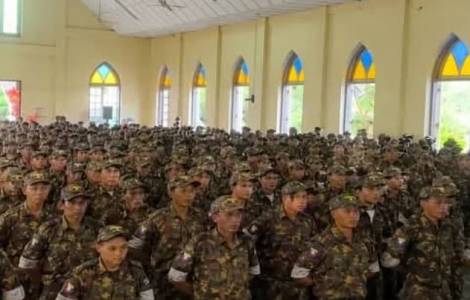
According to the Kachin news group, on 23 September more than 400 members of the Shanni Nationalities Army (SNA), a militia allied with the Myanmar military, attended a graduation ceremony at Nant Mun Baptist Church following a training course. The head of the Myanmar military’s Northern Regional Command was also present.
“Turning a sacred place of worship into a military site is a violation of religious freedom and an offense to Kachin Christians,” they said, urging United Nations intervention.
The incident took place amid widespread instability in a region where fighting has damaged both religious buildings and civilian infrastructure.
Another incident occurred in Chin State, in western Myanmar, where Baptist Pastor Dal Thawn Tuang, 49, was shot dead on 14 September. He was married and had two children.
An assistant pastor at Lamzang Baptist Church, he had served the community for 22 years. He was returning home after carrying out his ministry in a nearby village when he was shot near a bridge during a shooting. The circumstances of the incident remain unclear.
(Fides News Agency, 16/10/2026)