Information service of the Pontifical Mission Societies since 1927
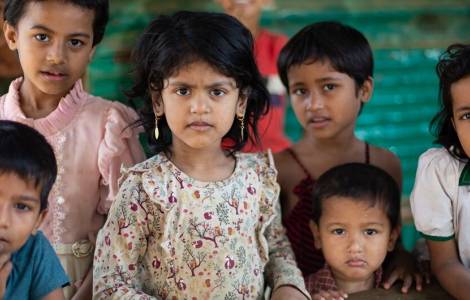
© UNICEF/Royena Rasnat
Kuala Lumpur (Fides News Agency) – The repatriation of the Rohingya to Myanmar is once again attracting international attention. In Malaysia, an initial operation to repatriate around 1,500 Myanmar nationals began on September 29, as part of a program that could eventually involve up to 5,000 people. In Bangladesh, however, where more than 1.2 million Rohingya live after fleeing mainly from the former Burma following the military crackdown in 2017, a return remains a distant prospect: the United Nations continues to maintain that conditions in Rakhine State are not yet in place for voluntary, safe, dignified and sustainable repatriation.
The starting point is the right of the Rohingya to return to their homeland, but the two host countries envisage different paths towards that goal. Malaysia is proceeding through a bilateral agreement with the Myanmar government, presenting the returns as “voluntary”. Bangladesh insists that political, legal and security conditions must first be established to make a genuine and lasting return possible.
Kuala Lumpur organized the transfer of 1,476 Myanmar nationals, who left on September 29 aboard two Myanmar naval vessels accompanied by a hospital ship and identified by Myanmar authorities. Myanmar has stressed that the operation concerns people whose nationality has been verified and does not necessarily involve Rohingya, many of whom do not hold Myanmar citizenship. The broader plan agreed by Kuala Lumpur and Naypyidaw envisages the possible return of 5,000 Rohingya, but the actual composition of the groups and the procedures for their repatriation remain unclear.
Malaysia’s decision also reflects an increasingly complex domestic situation. The country hosts around 200,000 registered refugees from Myanmar, including a very large number of Rohingya, but it is not a signatory to the 1951 Geneva Refugee Convention and has no national system for determining “refugee status”.
In this context, Prime Minister Anwar Ibrahim has opted for direct engagement with Myanmar authorities to organize the relocation of refugees, exposing the government to criticism. More than 160 civil society organizations have called for the deportations of Rohingya to be halted, warning that those returned could once again be exposed to violence or forced recruitment. The UN Refugee Agency (UNHCR) has also stressed that it is not involved in the operation and reiterated that Myanmar currently does not provide “adequate conditions” for a safe return.
The situation is different in Bangladesh. Nearly 1.2 million Rohingya live in the camps of Cox’s Bazar, after nine years in exile. The UNHCR stresses that an entire generation is growing up in the camps and that the conditions for a voluntary, safe, dignified and sustainable return do not yet exist.
On September 23, Bangladeshi Prime Minister Tarique Rahman presented a five-point plan to the United Nations, calling for: a credible roadmap for voluntary repatriation; an end to the violence in Rakhine State; agreed humanitarian funding; greater international accountability; and regional cooperation to combat human trafficking, arms trafficking and criminal networks.
Dhaka continues to stress that the crisis originated in Myanmar and that the solution must therefore be found in Myanmar. At the same time, it is calling on the international community not to leave Bangladesh alone in supporting a population that, after almost a decade, remains heavily dependent on humanitarian aid.
The main obstacle to repatriation is now the situation in Rakhine State, where most of the Rohingya refugees in Bangladesh originate. The region has become one of the main fronts of Myanmar’s civil war, with fighting between the Myanmar military and the Arakan Army, which has captured parts of western Rakhine and now controls almost all the areas where the Rohingya once lived. As a result, the central government in Myanmar can negotiate citizenship and the legal status of those returning, but it does not effectively control all the territory to which they would have to return. Under these circumstances, the prospect of a mass return appears difficult to reconcile with the criteria set out by the United Nations.
The issue of citizenship also remains unresolved. Myanmar’s 1982 citizenship law left the vast majority of Rohingya without citizenship, with related consequences for their legal status, freedom of movement and access to fundamental rights. For this reason, UNHCR continues to identify specific conditions for sustainable return: security, freedom of movement, access to essential services, the ability to establish livelihoods and a pathway to citizenship.
Another source of tension concerns international justice. Bangladesh supports the proceedings brought by Gambia before the International Court of Justice over “alleged violations of the Genocide Convention” committed by the government of Myanmar. The International Criminal Court is also examining individual responsibility for alleged crimes against humanity.
Myanmar authorities currently argue that the existence of these proceedings makes a solution more difficult. Bangladesh, however, maintains that repatriation and the establishment of accountability are separate issues.
The proceedings before the International Court of Justice concern the responsibility of the State of Myanmar, while those before the International Criminal Court concern the possible criminal responsibility of individuals.
The Rohingya crisis in Southeast Asia therefore presents two distinct approaches to a possible solution. Malaysia is relying on direct dialogue and gradual repatriation, seeking to engage Myanmar authorities on a bilateral basis. Bangladesh is calling for a broader political process in which repatriation is accompanied by an end to the violence, legal guarantees, humanitarian funding and the involvement of international organizations.
(PA) (Fides News Agency 3/10/2026)