
Information service of the Pontifical Mission Societies since 1927
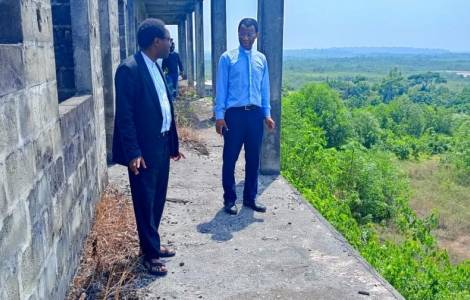
Libreville (Fides News Agency) – While Africa, along with Asia, remains one of only two continents where the number of priests continues to rise, and the only continent where the number of seminarians in major seminaries is also increasing, the quality of priestly formation remains a central concern for the Pontifical Mission Society of St Peter the Apostle (POSPA).
According to data published by Fides in October 2025, while the worldwide number of priests fell to 406,996 (-734 compared to the previous year), Africa recorded a significant increase (+1,451 priests) and an increase in the number of seminarians (+383), while all other continents registered declines.
"From 15 to 20 June we travelled to Gabon, especially to Libreville, to conduct a formation session for seminary formators," Father Guy Bognon, General Secretary of POSPA, a biblical scholar and former rector of seminaries in Benin, told Fides. The initiative brought together around twenty priests from all the seminaries in the country, along with parish priests and seminary formators who served as external formators.
Following the opening Mass, participants were invited to take part in a spiritual retreat centred on the Word of God and the meaning of consecration. "We began in this way to understand that seminary formation is not merely an intellectual matter; it is above all a matter of the heart. The retreat focused on meditating on what it means to be consecrated," Father Bognon explained. The aim was to contemplate "how Jesus, himself consecrated, lived this reality throughout his life, and then relate it to us who are consecrated today, taking into account the challenges we face and the practical means available to accomplish our mission."
Ongoing formation to become ever more like Christ
The following days were devoted to lectures and discussions. "We began with a reflection entitled 'The urgency and necessity of ongoing formation'," Fr Bognon continued. "Many wonder what they still have to learn, but we must understand that learning never ends. all of life is a learning process. Continuous conversion is necessary if we are to become ever more like Christ and constantly renew ourselves, especially as seminary formators, by deepening both our knowledge and our interior life."
The responsibilities of formators, the stages of seminary formation, and its spiritual, human, intellectual and pastoral dimensions were examined in detail, also in light of the Ratio Fundamentalis Institutionis Sacerdotalis, the official document of the Holy See, published in 2016 entitled The Gift of the Priestly Vocation, which establishes the norms and guidelines for formation of future priests in the universal Church.
"Particular attention was paid to the spiritual accompaniment of seminarians," Father Bognon noted. "This cannot be improvised: there are rules and knowledge that are acquired not only through academic study but also through experience. One may hold academic qualifications and be an excellent teacher, yet still lack what is needed to become a good formator."
The session also addressed "the delicate aspects of affectivity, which is essential in forming balanced individuals," the ability to "give an account of one's faith," and the pastoral purpose of every aspect of formation. Fraternal life was another key feature of these days. "These days were not limited to lectures: there was daily Mass, the Liturgy of the Hours, and moments of fraternal exchange,” explained the Secretary General of the Pontifical Society of St. Peter the Apostle. "We wanted to live as brothers so as to understand from within what formation really means."
The ‘number’ of vocations alone is not enough
The mission also provided an opportunity to meet several Church leaders in Gabon, including the Chargé d'Affaires of the Apostolic Nunciature, Msgr Grzegorz Piotr Bielaszka; the President of the Episcopal Conference, Bishop Jean-Vincent Ondo Eyene of Oyem; the Archbishop of Libreville, Msgr Jean-Patrick Iba-Ba; the Bishop of Franceville, Msgr Ephrem Ndjoni; and the recently appointed Apostolic Nuncio, Archbishop Relwendé Kisito Ouédraogo. Father Bognon stressed that "many aspects of formation require the direct involvement of bishops. Formators act in their name and cannot do anything without their support."
For Father Serge-Patrick Mabickassa, coordinator of the Episcopal Commission for Communication, Culture and Tourism and a formator at the National Major Seminary of St Augustine in Libreville, the session addressed very concrete needs.
Among these, he highlighted the need for "an intellectual formation that gives greater prominence to African theology," capable of shedding light on "the crises of faith arising from the relationship between the Christian faith, traditional religion and Gabonese culture"; the learning of Lectio Divina "to build a deeper relationship with God"; and "the call to cultivate charity towards the poorest and towards all Christians," in a context where "the laity too often reproach us for lacking closeness and attention to vulnerable people." "This formation session responded to those needs by providing us with the tools future priests require for a good formation, especially familiarity with the Word of God and the reading of the Church Fathers in addressing questions of faith, as well as the reminder that the priest must listen to his people,” he affirmed to Fides.
The session, he says "helps us rethink our pedagogical methods and our approach to spiritual accompaniment because it offered us an update on traditional methods." With the implementation of the Ratio, "we have discovered that the seminarian now stands at the centre of his own formation. He is responsible for his formation. Every seminarian is also, in a certain sense, his own formator and a formator of his fellow seminarians."
On the intellectual level, the formator observes that "with the advent of artificial intelligence and the internet," intellectual work risks being weakened if technological tools replace reflection. He therefore called for "ethical formation in the use of artificial intelligence, so that future priests do not become dependent on it when preparing homilies and catechesis," as well as "a revision of the methods used in presenting academic work, in order to foster a deeper exercise of the intelligence of faith."
In this context, POSPA is preparing similar initiatives "in several countries — soon in Tanzania, then in Malawi and Burkina Faso — because the formation of formators lies at the very heart of our mission," Father Bognon emphasized.
"It is essential that Episcopal Conferences take this issue seriously. The number of vocations alone is not enough; quality is equally important. Priestly formation does not simply mean rejoicing in having full seminaries. The quality of priestly formation depends directly on the quality of those entrusted with forming future priests, and this in turn requires ongoing formation. Priesthood does not end with ordination; it is a lifelong journey."
At the conclusion of the experience in Gabon, participants shared a common conviction: "Today, in the face of the challenges confronting the world, it is essential to have well-formed priests capable of providing authentic leadership," Father Bognon concluded. "The ‘quality’ of a priest depends first and foremost on his interior life and on his relationship with God, because it is from that relationship that he receives what he is called to pass on." (MLK-EG) (Fides News Agency, 13/7/2026)
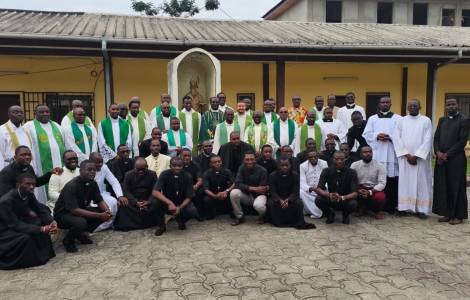



 AFRICA/MALAWI - Course for minor and major seminary formators promoted by the Pontifical Mission Societies
 "Here I am; send me." Priestly and religious vocations in Vietnam amid signs of decline and new vocational paths
 ASIA/CHINA - Catholic seminaries across China conclude the academic year
 100 YEARS SINCE THE ORDINATIONS OF THE FIRST SIX CHINESE BISHOPS - Bishop Joseph Hu Ruoshan and the Diocese of Taizhou
 New episcopal ordination in China: Ignatius Ding Zuyao ordained Bishop of Haimen
 “Gifts to give and gifts to receive”: The Church of the Sheaves opens its first international conference in Rome
 COLOMBIA - "Mission remains urgent": the Colombian Church renews its missionary commitment on the centenary of DOMUND
 100th WORLD MISSION SUNDAY - Pope Leo XIV: May the Church always remain faithful to the mandate of the Risen Lord