Information service of the Pontifical Mission Societies since 1927
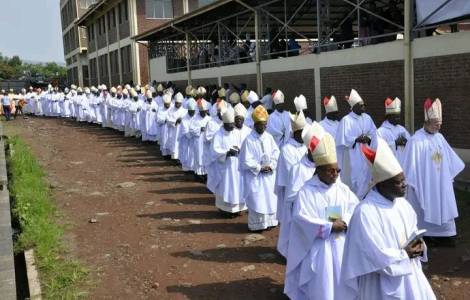
Nairobi (Fides News Agency) – “For some time now, we have been experiencing difficulties in the legal process of civil registration and legalization of marriage,” the bishops of Kenya affirmed in a statement released this Thursday, April 16, following a meeting at the Donum Dei Roussel House in Karen, Nairobi. “The processes of notification and obtaining certificates have become unnecessarily arduous. The clearance process is slow and at times insensitive to the time and dates set,” the statement continued.
“Furthermore, there is a shortage of marriage certificates. This can only cause moral harm to society and risks depriving weaker spouses of their rights,” the statement from the Kenyan Bishops' Conference (KCCB) reads.
“We as a country must protect and promote the institution of marriage as provided in the Constitution of Kenya. When our families and the institution of marriage are strong, our society thrives,” the bishops declared, referring to Article 45 of the Constitution, which recognizes the family as the fundamental unit of society. The bishops’ statement comes amid growing public discontent regarding delays in issuing documents such as birth certificates, identity cards, and passports.
The Bishops also express concern over mass murders that occurred in a ritual context, as in the case of Shakahola (see Fides, 4/5/2023).
“The Shakahola and Kware deaths scandal are still fresh in our minds, where unimaginable killings were exposed,” the bishops stated, lamenting the lack of social and state controls in this context, since “these people who were killed and buried in mass graves come from families and neighbourhoods. Questions of how such things happened, without anyone noticing and reporting to the authorities remain unanswered,” they emphasized.
The Bishops’ Conference stressed that similar incidents with new, unexplained deaths occur repeatedly. “The discovery of bodies of men, women, and children in gunny bags in Binzaro in Kilifi, and now Kericho are deeply disturbing because they show the total disregard for the sanctity and value of human life,” the bishops’ statement reads. The bishops denounce the fact that “investigations into these murders very quickly fizzle out and are easily forgotten” simply because “the victims were poor and seemingly insignificant.” The bishops argue that this contempt for human life is also evident in the rise of human trafficking. On a political level, they reiterate their criticism of the lack of verbal discipline in public debate (see Fides, 20/3/2026) and condemn the rise of controlled criminal elements (“goons”) who are “used to intimidate, bring disruptions in meetings, and even kill.” This phenomenon, they say, “can only thrive if it is sponsored and protected by powerful individuals.” (L.M.) (Fides News Agency, 17/4/2026)