
Information service of the Pontifical Mission Societies since 1927
VaticanMedia
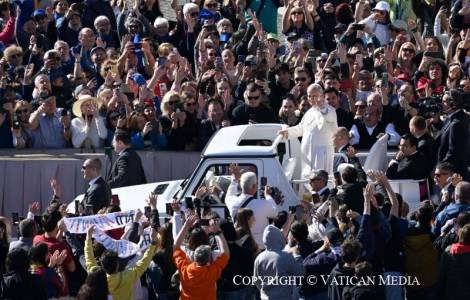
Vatican City (Agenzia Fides) - For Christians, holiness is not an achievement dependent on their own strength, nor a mere “ethical commitment,” but a gift from Christ himself, who calls every baptized person to live the mission of their own conversion within the context of daily life. Pope Leo XIV reminded the faithful of this on Wednesday at the General Audience in St. Peter’s Square, continuing the series of catecheses dedicated to the documents of the Second Vatican Council.
The Constitution of the Second Vatican Council Lumen gentium (LG), on the Church, the Pope noted, “dedicates an entire chapter, the fifth, to the universal vocation to holiness of all the faithful.” Holiness, the Pope said, is “not a privilege for the few, but a gift that requires every baptized person to strive for the perfection of charity, that is, the fullness of love towards God and towards one’s neighbour.” And “the level of holiness, as in the early days of the Church, is martyrdom, the ‘supreme witness of faith and charity.’”
It is Christ himself who “sanctifies the Church, of which He is the Head and Shepherd.” In this sense, holiness is “His gift, which is manifested in our daily life every time we receive it with joy and respond to it with commitment.”
Lumen Gentium describes the holiness of the Catholic Church as “one of her constitutive characteristics, to receive in faith, inasmuch as she is believed to be ‘indefectibly holy’.”
This—according to the Pope, citing Saint Augustine—“does not mean that she is so in a full and perfect sense, but that she is called to confirm this divine gift during her pilgrimage towards the eternal destination, walking ‘amid the persecutions of the world and the consolations of God’.”
Sin is a “sad reality” in the Church, one that invites everyone to a profound change of life, “by entrusting ourselves to the Lord, who renews us in charity.” This infinite grace, which sanctifies the Church, entrusts us with a mission “to fulfil day after day: that of our conversion.” Therefore, holiness does “not only have a practical nature, as if it were reducible to an ethical commitment, however great, but concerns the very essence of Christian life, both personal and communal.”
Leo XIV also referred to the “decisive role” played by “consecrated life, which the Conciliar Constitution considers in the sixth chapter.” It constitutes “a prophetic sign of the new world, experienced here and now in history.”
The evangelical counsels “that shape every experience of consecrated life: poverty, chastity and obedience.” These three virtues are not “rules that shackle freedom, but liberating gifts of the Holy Spirit, through which some of the faithful are wholly consecrated to God.”
In a final appeal, the Pope recalled “the past few hours of great tension in the Middle East and throughout the world” and declared that he welcomed “with satisfaction, and as a sign of deep hope, the announcement of an immediate two-week ceasefire.” “Only by returning to the negotiating table,” he added, “can we bring the war to an end.”
Leo XIV urged to “accompany this time of delicate diplomatic work with prayer, in the hope that a willingness to engage in dialogue may become the means to resolve other situations of conflict in the world.” Finally, the Bishop of Rome renewed the invitation “to join me in the Prayer Vigil for Peace, which we will celebrate here in Saint Peter’s Basilica on Saturday 11 April.” (GV) (Agenzia Fides, 8/4/2026)



 New episcopal ordination in China: Ignatius Ding Zuyao ordained Bishop of Haimen
 Leo XIV to the John Paul I Vatican Foundation Conference: peace is a daily Mission
 Mission beyond the illusions of efficiency: following in the footsteps of Venerable Little Sister Magdeleine of Jesus
 ASIA/SOUTH KOREA - Five “Patron Saints” for World Youth Day “Seoul 2027”
 Between political neo-messianisms and Augustinian realism: scholars and analysts revisit Leo XIV’s teaching on international politics and Global scenarios