Information service of the Pontifical Mission Societies since 1927
MM
Pourcine Pic Makaya (Agenzia Fides) – “The year 2026 is likely to be a turning point for Haiti, with elections planned for this year and the inauguration of the new president and parliament in February 2027. But everything is still very vague and very, very uncertain,” Father Massimo Miraglio, Camillian missionary and parish priest of the Church of Our Lady of Help, in the mountain village of Pourcine in Pic Makaya, told Fides, regarding the situation on the Caribbean island, which has been plagued by a severe humanitarian and socio-economic crisis for years.
“Currently, the country is governed by a prime minister appointed by proxy, who, along with his group of ministers, holds power and was actually only supposed to organize these elections, which have been awaited for more than ten years,” the missionary continued. “The economic situation is dire; inflation and the cost of living are extremely high. Due to the disrupted roads, there are enormous supply difficulties. Even in Jérémie, 300 km from the capital, Port-au-Prince, goods arrive only via arduous routes, partly by sea, partly by land. Everything that does arrive comes at a shocking cost in a country at a standstill, where there are no jobs, and where people struggle daily to scrape together the bare necessities.” “People live from day to day, and hope is gradually fading, as no significant changes are in sight to halt this terrible decline into which the country has plunged,” he continues. “There is a frightening institutional vacuum that has led to this situation, a truly tragic development in which millions of people are suffering and forced to live in the shadows in total fear because gangs continue to control the capital, Port-au-Prince.”
Despite everything, Father Miraglio continues working to keep the community alive, especially through parish activities with young people and the elderly. “The celebration of religious and civic holidays is an important moment that must once again be placed at the heart of community life to foster growth, solidarity, and communion.” These are moments when we share what is most important: faith in God, a generous God who loves us and gives us hope and strength to face life's challenges.
Although the parish is located in an isolated mountainous area, the country's crisis is also felt. "We are working under emergency conditions due to the disfunction of the state. However, we are continuing with projects started three years ago, especially the nursery and primary school with more than 200 students and the evening adult literacy school" (see Fides, 10/10/2025). Agricultural programs are also continuing, supported by an NGO that helps increase local production, the main source of sustenance for the population. Between March and April, we will resume our program to clean the roads and mule tracks. This program is essential for us to keep the roads clean and safe and to allow the transport of mules and, consequently, the agricultural products that people produce and then take to the surrounding markets.” “The difficulties remain enormous,” he continues, “since these mule tracks are located on very rugged terrain, and often the maintenance work we carry out is only temporary because we lack the resources to implement more structured measures. A priority for the parish remains keeping people together and organizing activities that foster social cohesion and community work. These activities contribute to a shared vision and the desire to persevere despite the difficult situation and the often very discouraging news from Port-au-Prince or Jerímie.”
Father Miraglio also points to the critical situation in the healthcare system: “One of the sectors facing difficulties is certainly healthcare,” he emphasizes. “In Jérémiè, the situation is dramatic; the patients who arrive every day are not finding adequate answers to their needs and problems. There are only small private clinics, which are often unable to respond to emergencies or more complex cases. Consequently, the situation is truly dire for the vast majority of patients. They are often then sent to other hospitals in the area, which are frequently in the same state and, especially if they are private hospitals, they are extremely expensive and therefore only serve a small segment of the population.
For us in Pourcine, too, building a small clinic capable of treating emergencies has become an urgent necessity (see Fides, 3/12/2025). "We are isolated, far from the hospital," the missionary explained. "Building materials are very far away, and transporting sand locally is extremely difficult. To solve this problem, we are exploring alternatives to build a small clinic that can serve 3,000 to 3,500 people and can also be used by the surrounding villages for emergencies. A clinic that will not only offer people the opportunity to see a nurse or doctor, but above all, provide preventative care and health education for everyone. For us, living so far away, prevention is fundamental, because often it is already too late by the time treatment becomes necessary. We will also try to establish a simple system for transporting the sick down to the valley so that the most serious cases can be quickly taken to Jérémie's hospital."
“In February and March, people are very busy working in the fields, which is very strenuous and often takes place in fields and areas far from their homes,” reports Father Miraglia. “It’s an effort they undertake generously and with great hope, because production during this time can secure them an income that allows them to cover a family’s essential expenses. In the coming months, we will see how we can strengthen local banana production. Unfortunately, Hurricane Melissa in October (see Fides, 5/11/2025) destroyed a large portion of the banana plantations, which represent a source of income and, above all, a source of food. The major challenge is to transition from a primitive, low-productivity agriculture to a more communal agriculture with higher productivity and also a greater capacity to cope with the various events that sometimes make working in the fields difficult.”
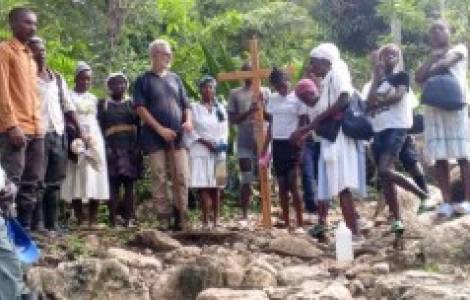
“We are in the season of Lent,” concludes the Camillian missionary, “and the community is busy with Sunday celebrations, the Rosary, and the Stations of the Cross—all important moments for reviving faith and hope and fostering unity. The hope is that this time will be a time of reflection and prayer for the community of Pourcine, a time to become aware of our mistakes and limitations. The goal is to create a Christian community filled with the Holy Spirit, a community that strives to live the values of the Gospel daily. A community that places the Lord at the center of its life and seeks a dignified life in which everyone has what is necessary for their own well-being.” (AP) (Agenzia Fides, 14/3/2026)