Information service of the Pontifical Mission Societies since 1927
N'Djamena (Agenzia Fides) – Pope John Paul II’s vision of the “Church as the Family of God” “was not only a theological ideal, but a true pastoral roadmap for a continent that had left behind colonialism, dictatorships, and divisions, but was characterized by a vibrant faith and great hope.” This is how Cardinal Fridolin Ambongo Besunguin, Archbishop of Kinshasa, praised the Post-Synodal Apostolic Exhortation “Ecclesia in Africa” 30 years after its publication in his opening address to the 13th Plenary Assembly of ACERAC.
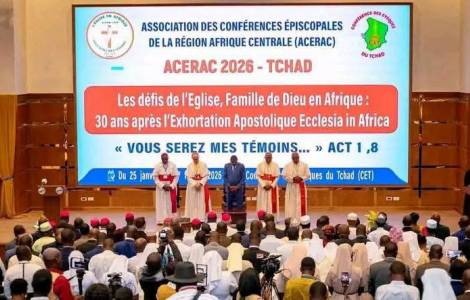
The Archbishop of Kinshasa Cardinal Ambongo, in his capacity as President of the Symposium of Bishops' Conferences of Africa and Madagascar (SECAM/SCEAM), opened the plenary assembly of the ACERAC, which is being held from January 25 to February 1 in N'Djamena, the capital of Chad, on the theme "The Challenges of the Church, the Family of God in Central Africa: 30 Years after Ecclesia in Africa."
"Thirty years ago, at the close of the Special Assembly of the Synod of Bishops for Africa, Pope John Paul II gave our continent a profound vision with his Apostolic Exhortation 'Ecclesia in Africa.' In it, he called on the Church to be wholly the Family of God, a communion rooted in love, characterized by reconciliation, animated by justice, and committed to peace," said Cardinal Ambongo. Thirty years later, he emphasized: "We are called to recognize that this vision is by no means outdated, but on the contrary, more urgent than ever." “Thirty years is not merely a chronological indicator, but a time of Church self-examination,” the Cardinal continued. “It calls us to clearly recognize what has borne fruit—especially the vision of the Church as the family of God—and what remains fragile or incomplete,” the Archbishop of Kinshasa added. “Above all, it revives the urgency of the mission entrusted to us: to be artisans of reconciliation, justice, peace, and hope, in fidelity to the Gospel and in dialogue with the concrete realities of our peoples.”
In this context, Cardinal Ambongo named three “pastoral priorities that have long guided our thinking and that this assembly is intended to deepen and further structure.” The first is the formation of peacemakers (“Our seminaries, Catholic universities, and secular educational institutions must train women and men who are capable of promoting peace, who are rooted in the Gospel, informed by the Church’s social teaching, and possess skills in dialogue and conflict resolution”). The second is synodal pastoral governance (“At the diocesan and parish levels, we are called to strengthen the processes of listening, shared responsibility, and transparency so that the Church truly moves forward united like a family, where decisions are made in communion”). The third point is prophetic social engagement (“The Church must continue to strengthen commissions for justice and peace, promote civic education, support victims of violence, and create spaces for dialogue that contribute to reconciliation and social cohesion”). (L.M.) (Agenzia Fides, 27/1/2026)