
Information service of the Pontifical Mission Societies since 1927
VaticanMedia
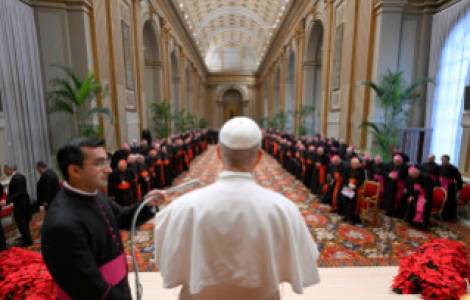
Vatican City (Agenzia Fides) – “By her very nature, the Church is outward-looking, turned toward the world, missionary.” And “the mission of Jesus on earth, which continues in the Holy Spirit through the Church, becomes a criterion for discernment in our lives, in our journey of faith, in ecclesial practices, and also in the service we carry out in the Roman Curia.” Pope Leo XIV recalled this today in his address in the Hall of Benediction of the Apostolic Palace for the exchange of Christmas greetings – the first of his pontificate – with his closest collaborators in the Roman Curia.
The Bishop of Rome's address, focused on "two fundamental aspects of the Church’s life: mission and communion," taking inspiration from several quotations from the Apostolic Exhortation Evangelii Gaudium, Pope Francis's "programmatic document," whom Pope Leo XIII referred to as "my dear predecessor."
The Curia's Mission for the Mission of the Church
The Church, the Bishop of Rome emphasized, "has received from Christ the gift of the Spirit in order to bring to all people the good news of God’s love." She herself is "a living sign of this divine love for humanity," and exists "to invite and gather all people to the festive banquet that the Lord prepares for us."
In Evangelii Gaudium, Pope Francis invited the entire Church to embrace a "state of mission." Missionary dynamism, Pope Leo XIII recalled, springs from the source of the mystery of the Trinity and from the fact that God himself, in Christ, has come "to seek us." The call to missionary conversion of all structures—the Pope reiterated—also applies “to the service we carry out in the Roman Curia.” Such structures “must not weigh down or slow the progress of the Gospel or hinder the dynamism of evangelization.” And the work of the Roman Curia is called to “foster pastoral solicitude in service to the particular Churches and their pastors.” “We need,” Pope Prevost urged, “an ever more missionary Roman Curia, in which institutions, offices and tasks are conceived in light of today’s major ecclesial, pastoral and social challenges, and not merely to ensure ordinary administration.”
The Communion that blossoms from grace
In the life of the Church, Pope Leo continued, “mission is closely linked to communion,” which also blossoms as a gift of the Son of God, from his action in history, which began with the mystery of Christmas.
It is urgent ad intra, because communion in the Church always remains a challenge that calls us to conversion. Sometimes, beneath an apparent calm, forces of division may be at play. We can fall into the temptation of swinging between two opposite extremes: uniformity that fails to value differences, or the exacerbation of differences and viewpoints instead of seeking communion. Thus, in interpersonal relationships, in internal office dynamics, or in addressing questions of faith, liturgy, morality and more besides, there is a risk of falling into rigidity or ideology, with their consequent conflicts.” Yet, the Pope reminded us, “we are the Church of Christ, his members, his body. We are brothers and sisters in him. And in Christ, though many and diverse, we are one: 'In Illo uno unum'.” “We are called, especially here in the Curia,” the Pope continued, “to be builders of Christ’s communion, which is to take shape in a synodal Church where all cooperate in the same mission, each according to his or her charism and role.” And yet, “after many years of service in the Curia, we observe with disappointment that certain dynamics – linked to the exercise of power, the desire to prevail, or the pursuit of personal interests – are slow to change. We then ask ourselves: is it possible to be friends in the Roman Curia? To have relationships of genuine fraternal friendship?”
On the other hand, the Pope continued, “amid daily toil, it is a grace to find trustworthy friends, where masks fall away, no one is used or sidelined, genuine support is offered, and each person’s worth and competence are respected, preventing resentment and dissatisfaction.”
Thus, communion in the Church can become “a sign also ad extra,” in a world “wounded by discord, violence and conflict,” where Christians are “called to be leaven of universal fraternity among different peoples, religions and cultures.”
After briefly recalling the Jubilee nearing its conclusion and the important ecclesial anniversaries celebrated during the Jubilee Year (the 1700th anniversary of the Council of Nicaea, the 60th anniversary of the end of the Second Vatican Council, and the 50th anniversary of the promulgation of Pope Paul VI's Apostolic Exhortation Evangelii Nuntiandi), Leo XIV concluded by quoting the Lutheran theologian Dietrich Bonhoeffer, murdered by the Nazis, on the mystery of Christmas: “God is not ashamed of the lowliness of human beings. God marches right in… God is near to lowliness; he loves the lost, the neglected, the unseemly, the excluded, the weak and broken.” (GV) (Agenzia Fides, 22/12/2025)



 EUROPE/POLAND - The "Star Singers" support their peers in Sri Lanka: the initiative kicks off with a press conference and appearances on national television TVP1
 OCEANIA/PAPUA NEW GUINEA - The nation gathers around St. Peter To Rot. Cardinal Ribat. "A gift for the Church and for the world"
 EUROPE/ITALY - Chinese priests and nuns "on mission" in the neighborhoods of Naples
 ASIA/CHINA - The closing of the Jubilee Year and the many "new beginnings" of Chinese Catholic communities
 EUROPE/SWITZERLAND - The Star Singers in Rome and the joy of meeting Pope Leo XIV
 EUROPE/GERMANY - Star Singers: "Child labor is not an inevitable fate"