
Information service of the Pontifical Mission Societies since 1927
by Marie-Lucile Kubacki
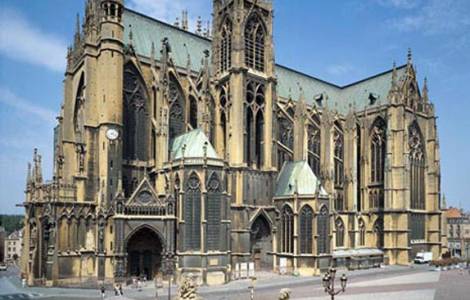
Metz (Fides News Agency) – In the late-summer light, the Jaumont stone on the façades of the city centre reveals, in places, deep scars carved into the rock. On these historic buildings, cavities left by shrapnel from 1944 bear witness to the violence of the Second World War battles witnessed by this city of three borders. It is here that Pope Leo XIV will conclude his apostolic journey to France on Monday, September 28, 2026, after visiting Paris and Lourdes. His programme includes an interreligious meeting and an event dedicated to the “roots of Europe for peace and unity”, before he travels through the city centre in the popemobile and celebrates Mass at Saint-Étienne Cathedral.
“We are losing our passion for Europe because we have forgotten why we created it,” a former ambassador who had been involved in building Europe once said. If one asks why the Bishop of Rome’s journey includes a stop in Moselle, the answer can be found in the fabric of the city and in the history of its people.
On September 28, following his arrival at Metz-Nancy-Lorraine Airport, Leo XIV will travel to the Robert Schuman Congress Centre. There, he will first take part in an interreligious meeting, followed by an event devoted to the roots of Europe. He will deliver two addresses before heading into the city centre. In the afternoon, a journey through the city in the popemobile will take him, in particular, from Avenue Foch to Saint-Étienne Cathedral, passing through Avenue Robert Schuman, Place de la République and the streets of the historic centre.
The memory of borders
The Moselle is not merely close to borders: for centuries, it has lived to the rhythm of their movements. Annexed to the German Empire following the war of 1870, it became part of France again in 1918, before being de facto annexed once more by the Nazi regime during the Second World War, until its liberation at the end of 1944 and definitively reintegrated into France in 1945.
“Like Alsace, the Moselle still carries the memory of the conflicts, annexations and divisions that have marked contemporary Europe,” Fr. Cédric Burgun, Dean of the Faculty of Canon Law at the Institut Catholique de Paris and a native of Metz, tells Fides. “This memory remains particularly vivid within families.” European integration, he stresses, “was not born of a technocratic abstraction, but of the desire to reconcile peoples who had long been enemies.”
Fr. Stéphane Jourdain, parish priest of the Saint-Privat parish community in Metz-Sud, recounts stories of individuals. “Some had a grandfather who was a partisan; others experienced forced labour. Some inhabitants were expelled to southern France before later returning.” In many families, older generations lived through changes imposed on language, nationality and administration. Local memory also bears traces of the successive arrival of Italian, Polish and Algerian families, and, more recently, of other communities.
This history has profoundly shaped the local Church. During the German annexation, under the episcopate of Bishop Willibrord Benzler, a Eucharistic Congress was organized in both French and German, reflecting the territory’s dual cultural identity. After the First World War, the German bishop was expelled by the French authorities. “The life of the local Church was overshadowed by the upheavals of political and national history,” Fr. Jourdain emphasizes.
Robert Schuman, son of the Moselle
The focus of the visit to Metz is, of course, Robert Schuman. Born in 1886 in the then-annexed Moselle department, the son of a Lorraine father who became German after the annexation and a Luxembourgish mother, the man considered one of the fathers of Europe embodied this history of shifting borders and intertwined identities.
“His life is rooted in a territory bordering Luxembourg, Trier, Germany and France,” explains Fr. Cédric Burgun, the initiator of Robert Schuman’s cause of canonization and president of the Institut Saint-Benoît, the diocesan association in Metz tasked with promoting the cause. “This experience instilled in him an awareness of the need to overcome national antagonisms and transform the former enemy first into a partner and then into a brother,” he explains.
In his declaration of May 9, 1950, Schuman proposed pooling French and German coal and steel production. The aim was, in the now-historic formulation, to make a new war “not only unthinkable, but materially impossible.”
The political insight was concrete: to organize interdependence precisely where industrial rivalries had contributed to conflict. It was also an insight of profound moral significance, rooted in the possibility of reconciliation between wounded peoples.
For Fr. Burgun, Schuman’s legacy remains “a genuine school of Christian commitment.” It shows that a commitment inspired by faith leads “neither to confessional retreat nor to an exclusively defensive stance,” but to service of the common good, peace and reconciliation.
“It would be wrong to imagine that Robert Schuman pursued his political commitment in a society that was unanimously Christian and supportive of his project,” Fr. Burgun explains. “When he was Prime Minister and later a minister, France was marked by strong ideological divisions and anti-clericalism. Vincent Auriol, President of the Republic, himself embodied a republican tradition far removed from Catholicism. Schuman’s European project was not immediately greeted with enthusiasm, even within his own political family, the Popular Republican Movement. His example therefore shows that it is possible to maintain a Christian commitment in a pluralistic and at times contradictory society.”
His public life was also inseparably linked to an intense inner life. Robert Schuman found in prayer, silence and the Eucharist the source of his political action.
“In his home in Scy-Chazelles, on the hills above Metz, he regularly went to the chapel of the Servants of the Heart of Jesus, where he would spend long periods in prayer. The villagers used to say that they knew him above all ‘on his knees and from behind’, so discreet yet regular was his presence in prayer,” the priest recounts.
His cause for canonization, supported locally through prayer, recalls that his political activity drew its inspiration from an intense inner life. Declared Venerable by Pope Francis in 2019, Schuman is still awaiting the recognition of a miracle required for his beatification.
A unique Church
The Diocese of Metz has another unique feature: the continued application of the Concordat regime in Alsace-Moselle. “This gives the Church a specific institutional role within a French context marked by a demanding and, at times, complex understanding of secularism,” Fr. Cédric Burgun points out. The regime applies to the various recognized religious denominations and, in everyday life, maintains a form of dialogue between civil authorities and religious leaders.
In parishes, the mayor or the mayor’s representative has a seat by right within the parish council, which is responsible in particular for financial and property matters. “This situation can sometimes give rise to difficulties, depending on the individuals involved or their political sensitivities, but it also requires regular relations between civil and religious authorities,” the canon lawyer explains. In his view, it allows for “a more peaceful and more conscious presence of religious communities in the public sphere.”
This unique feature also has a pastoral dimension. Fr. Stéphane Jourdain speaks of around 150 paid laypeople engaged in ecclesial missions, almost as many as the priests serving in the diocese. This human resource makes it possible to carry forward numerous initiatives, while also encouraging further development of volunteer involvement and the sharing of responsibilities.
A hope to be passed on
As in many other dioceses, the Church of Metz is currently going through a period of transition. Some rural areas retain a strong Christian tradition and regular participation in practices connected with ecclesial life. At the same time, many adults today are knocking on the Church’s door to ask for baptism or to deepen their faith.
“The Church is becoming younger,” Bishop of Metz likes to say, according to Fr. Jourdain. The paths are diverse: young adults who have retained a distant connection with faith, parents accompanying their children, and people who discover prayer, the Gospel or sacramental life later in adulthood. “Many come in search of meaning, direction or a new sense of purpose,” he observes.
This vitality does not erase existing weaknesses, particularly the absence of priestly ordinations for several years. But it nourishes a local hope that also gives added significance to the Pope’s visit.
“It is starting from this memory that the Pope’s visit can take on its full meaning: recalling the deeper reasons behind the building of Europe, renewing the appeal for peace, and recognizing in stories of migration, suffering and the mixing of peoples a possible source of fraternity,” Fr. Jourdain says.
In Metz, a land where the wounds of war are still visible in the stones of the city and in the memories of families, the Pope will come to draw from the sources of European peace, conceived as a historic, political and spiritual decision.
“The Diocese of Metz, with its history, its Concordat regime, its cross-border experience and the memory of Robert Schuman, can thus bear witness to a Church called to take its place in the life of the city,” Fr. Cédric Burgun concludes, “not to impose a confessional vision, but to remind us that the Christian faith can inspire a culture of encounter, responsibility, peace and hope.”
(Fides News Agency, 28/8/2026)



 Leone XIV at the Rimini Meeting: Jesus keeps his treasure in earthen vessels
 AMERICA/PERU - Edgard Rimaycuna, secretary to Pope Leo XIV, brings the Pope's blessing to Chiclayo
 “Research on the History of Catholicism in China”: A new “road map” tracing six centuries of Catholicism in China
 ASIA/PHILIPPINES - "A truly missionary Church does not impose political choices, but it helps the faithful discern wisely"
 Litoměřice: New commemorations for victims of anti-German massacres of 1945 during the “Jubilee of Reconciliation”
 What lies behind the diplomatic clash between Argentina and Brazil
 AFRICA/ZIMBABWE - Government task force to tackle illegal mining
 President-elect Keiko Fujimori visits the Presidency of the Peruvian Bishops’ Conference