
Information service of the Pontifical Mission Societies since 1927
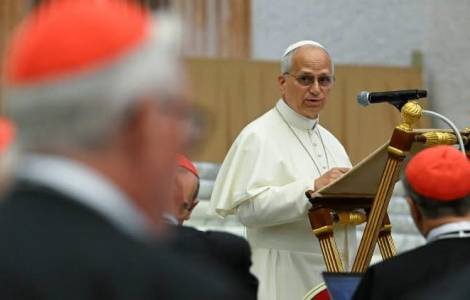
VaticanMedia
by Marie-Lucile Kubacki
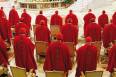
Vatican City (Fides News Agency) – Pope Leo XIV opened the Extraordinary Consistory on Friday morning, June 26, 2026, with the celebration of the Eucharist in St. Peter's Basilica, gathering cardinals from every continent ahead of the Solemnity of Saints Peter and Paul, Patrons of Rome. The liturgical feast, the Pope said, offers a spiritual key for the discernment that will guide the Consistory's work in the days ahead.
In his homily, the Pope placed the Consistory at the heart of the Church's apostolic mystery: "As we ask God to grant us strength and wisdom, it is significant that our Consistory takes place on the eve of the Solemnity of the holy Apostles Peter and Paul. Let us pause, then, to commemorate these two pillars of the Roman Catholic Church, the two missionary martyrs whose preaching became one with their lives, to the point of becoming part of Sacred Scripture."
Seen in this light, the gathering of the College of Cardinals around the Successor of Peter represents, above all, a return to the apostolic sources of mission.
Reflecting on the martyrdom of Peter and Paul, Pope Leo proposed what could be described as a missionary hermeneutic for the discernment entrusted to the Consistory. On the one hand, he recalled that the two Apostles "to share the true freedom of faith"—that springs from a personal relationship with Christ—a freedom that frees us from sin and fear and makes missionary witness possible "as successors of the Apostles."
On the other, he stressed that proclaiming the Gospel, celebrating the sacraments, and dedicating ourselves to the Lord’s flock "are realized and bear fruit to the extent that we believe in him, the Good Shepherd."
For Peter and Paul, mission was not a strategy, as he has already emphasized in various speeches and homilies, but the overflowing expression of a faith that embraced their entire lives, even to the shedding of their blood.
The Pope reiterated that "the living Church is the Church that believes," explaining that the Church’s faith precedes and sustains the faith of individual believers, just as grace nourishes the branches of the one vine. "Just as divine grace precedes human freedom, the Church’s faith precedes our own and calls for a fervent witness," he explained, recalling the Psalmist's exhortation: "Tell of his salvation from day to day; declare his glory among the nations” (Ps 96:2–3).
For the College of Cardinals gathered around the Successor of Peter, contemplating Peter and Paul means asking whether the Church's mission truly entrusts everything to the primacy of grace and faith.
Reflecting on the Gospel image of the vine and the branches, the Bishop of Rome said: "This diversity of emotions and thoughts now comes together and finds its luminous center in Christ, who himself addresses us, saying: “I am the true vine” (Jn 15:1). Through Jesus, grace and truth flow into our lives (cf. Jn 1:17), renewing us from within. These divine gifts are also the life-giving nourishment of the Consistory that we inaugurate today. The Gospel itself prepares the ground for it to bear fruit: “Remain in me, and I in you” (Jn 15:4)." In this context, the martyrdom of Peter and Paul appears as the ripe fruit of lives totally grafted onto Christ. Likewise, the Consistory is called to be nourished by that same "life-giving sap," so that its decisions may bear authentic evangelical fruit.
Alongside this Christological and apostolic foundation, Leo XIV indicated three major paths of discernment for the Church and her mission. The first concerns freedom of faith, born of the relationship with the Lord Jesus and witnessed to by Peter and Paul; the second is the gift of peace in unity; the third is harmony through obedience to the living Word that is Christ. Speaking in particular about peace, the Pope forcefully denounced the wars and tensions afflicting humanity, reaffirming that "war is never worthy of humanity, and it is never blessed by God" and that peace "is a duty of justice because we are one human family, a magnifica humanitas that finds its head and redeemer in Christ."
Referring to his encyclical Magnifica humanitas, signed on May 15, Leo XIV recalled the "civilization of love" outlined by Saint Paul VI as an alternative to the logic of power of his time. Today, the Pope said, Christian witness is called to become
"prophecy, evangelization and service for a new world, as well as a cultural and social project that promotes integral human development," while the Church, "amid both joys and persecutions," "is for everyone" and to each "addresses the same message of conversion and salvation."
This social and cultural vision, too, flows from the apostolic witness of Peter and Paul, who, the Pope stressed, proclaimed not an ideology but a new life in Christ capable of transforming both hearts and history.
Opening the Consistory's working sessions with an address to the cardinals, Leo XIV returned to the themes of apostolic memory, mission and synodality already outlined in his homily.
After presenting the principal topics for discussion—including the state of today's world, the relationship between the culture of power and the "civilization of love," the Church's contribution to the common good in light of Magnifica humanitas, and the ongoing implementation of the Synod—the Pope emphasized that these are "not separate dossiers," but "deeply interconnected," converging in a single question: how can we help our Churches today proclaim the Gospel with greater fidelity, freedom, and credibility?" In this way, the Consistory is presented as an exercise in missionary discernment.
Leo XIV clarified that mission is not simply one subject among many, but the criterion that shapes every aspect of the Church's discernment.
"Mission is not one of the Church's many tasks. It is the very reason for her existence," he said, inviting the College of Cardinals to examine whether pastoral decisions, ecclesial structures and styles of governance truly make Christian communities more available for the proclamation of the Gospel.
The question posed by the Pope is not abstract: "How can we help our Churches?" means concretely examining how the relationship with the world, the critique of power structures, the pursuit of the common good, and the synodal journey make evangelization more rooted in Christ, freer from fears and interests, and more credible in the eyes of the men and women of our time.
From this perspective, the three terms evoked by the Pope—fidelity, freedom, credibility—become criteria for missionary hermeneutics.
"Fidelity" points back to the apostolic source and to the "primacy of grace and faith" repeatedly emphasized by the Holy Father. To proclaim the Gospel faithfully means remaining grafted onto Christ and allowing the living Word to shape preaching, the celebration of the sacraments and service to the People of God.
"Freedom" recalls the authentic freedom of Peter and Paul, born of their personal relationship with the Lord and capable of overcoming fear. For the cardinals, this means allowing themselves to be continually converted by the Holy Spirit, speaking the truth to one another with fraternal parrhesia, and resisting every temptation to seek power or institutional self-preservation.
Finally, "credibility" directly links proclamation with witness. The encyclical Magnifica humanitas, the Pope's condemnation of war and his call for a "civilization of love" all demonstrate that the Gospel loses its persuasive force if it is not embodied in a style of life, governance and public witness that makes Christ's Good News visible in history.
This is also the foundation of the intrinsic relationship between mission and synodality.
The Pope insisted that synodality and collegiality "are expressions of Christian fraternity," and that the authority of the Petrine ministry belongs to "one who listens, and therefore guides; one who learns, and therefore teaches."
The synodal method proposed for the Consistory—mutual listening, shared responsibility and the common search for God's will—thus becomes part of this missionary vision. A Church that seeks to proclaim the Gospel with greater fidelity, freedom and credibility learns to discern together under the guidance of the Holy Spirit.
In this journey, the indications contained in Magnifica humanitas, together with those of the apostolic exhortation Evangelii gaudium, whose renewed reception Pope Leo had encouraged in a letter sent to the cardinals last April, provide important points of reference as the College of Cardinals seeks new paths in the service of the Gospel and of the human family in today's world. (Fides News Agency, 26/6/2026)



 Leo XIV to the John Paul I Vatican Foundation Conference: peace is a daily Mission
 CHINA/VATICAN - From “exceptional event” to a common practice: Chinese bishops take part in Holy See initiatives
 Mission beyond the illusions of efficiency: following in the footsteps of Venerable Little Sister Magdeleine of Jesus
 Missions in upheaval: World Mission Sunday during the years of war
 “The Lord is my Shepherd”: Cardinal John Tong’s autobiography, a sign of gratitude for a journey of joy and hope
 Cardinals Vesco and Marengo: "At the school of the Acts of the Apostles, in the deserts of the world"
 VATICAN - The Pope announces the creation of 21 new cardinals on September 30
 VATICAN - Consistory for 21 new Cardinals, among them 7 Ordinaries of jurisdictions entrusted to Propaganda Fide