
Information service of the Pontifical Mission Societies since 1927
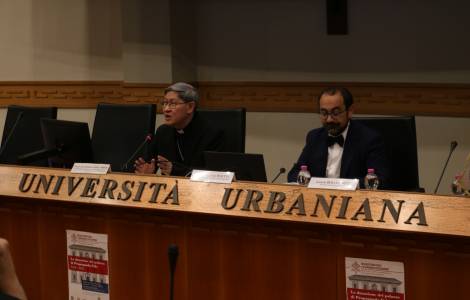
photo Raffaele Di Pietro
by Marie-Lucile Kubacki
Rome (Fides News Agency) – “The Palazzo di Propaganda Fide is not only a monument of Rome, but for four centuries it has embodied the concrete commitment of the Roman Catholic Church to the worldwide spread of the Gospel,” affirmed Cardinal Luis Antonio Gokim Tagle, Pro-Prefect of the Dicastery for Evangelization, at the study day on “The Donation of the Palazzo di Propaganda Fide: 1626–2026,” which took place on June 11 at the Pontifical Urban College “de Propaganda Fide” at the initiative of the Historical Archives of the Dicastery for Evangelization.
From Vives’ donation to the present-day Dicastery
In his opening remarks, Cardinal Tagle, Pro-Prefect of the Dicastery for Evangelization, Section for First Evangelization and New Particular Churches, linked the four-hundredth anniversary of the donation of Palazzo Ferratini to Propaganda Fide and the centenary of the relocation of Urban College to its present location on the Janiculum Hill into a single development that began with the founding of the Sacred Congregation for the Propagation of the Faith by Pope Gregory XV on January 6, 1622. “This building has above all historical and religious significance, as it is implicitly linked to the Propagation of the faith and thus to the mission of evangelization, which, despite the theological insights and changes in pastoral perspective that took place after the Second Vatican Council and the reforms of the Pacts, continues the work of the original Congregation founded by Gregory XV on January 6, 1622,” the Cardinal stated.
"For over four centuries, the Popes reformed the Roman Curia, and thus also the Congregation for the Missions, to meet the evolving needs of the Church and the world. The most recent of these reforms was the Apostolic Constitution 'Praedicate Evangelium' of the late Pope Francis, which established the Dicastery for Evangelization. This Dicastery, under the leadership of Pope Leo XIV, now works to spread the Gospel worldwide. One of the Dicastery's two sections, the Section for First Evangelization and New Particular Churches, remains housed in the 'Palazzo di Propaganda Fide,'" the Cardinal continued.
The building, once known as Palazzo Ferratini, was presented to the Holy See on June 1, 1626, by the Spanish prelate Monsignor Juan Bautista Vives, on one condition: the establishment of a missionary college. According to the wishes of Vives and the deed of gift itself established the building as the seat of a missionary college, canonically founded on August 1, 1627, by Pope Urban VIII with the papal bull Immortalis Dei Filius. According to current research, the college began its activities in 1633, the year after Vives' death on February 22, 1632. This institution was named "Urban College de Propaganda Fide" and was intended from the outset to welcome students of all peoples and nations so that they could become missionaries, preachers of the Gospel, and founders of local churches. In 1633, the building also became the official headquarters of the Sacred Congregation for the Propagation of the Faith (Sacra Congregatio de Propaganda Fide).
The figure of Juan Bautista Vives
The two sessions of the Study Day were coordinated respectively by Professor Pierantonio Piatti, Secretary of the Pontifical Committee for Historical Sciences, and by the Portuguese Jesuit Nuno da Silva Gonçalves, Director of “La Civiltà Cattolica” and Professor at the Faculty of History and Cultural Heritage of the Church of the Pontifical Gregorian University. The figure of Monsignor Vives was the focus of several contributions that provided insights into the personality whose donation gave substance to an entire institutional structure. Father Flavio Belluomini, archivist of the Historical Archive of Propaganda Fide demonstrated, using archival documents, how the plan for a missionary college began to take shape during the first meetings of Propaganda Fide, in January 1622, and how Vives' building, despite a lengthy dispute over the ownership of Palazzo Ferratini, was gradually conceived as the headquarters of the Congregation for the Propagation of the Faith.
Monsignor José Jaime Brosel Gavila, Rector of the Spanish National Church of Santa Maria in Monserrato in Rome and of the Spanish Institute of Church History, completed this picture by placing Monsignor Vives within the political and ecclesiastical networks of the early 17th century. "We are standing before an extraordinary figure of exceptional importance and surprising complexity, whose human and Church history still needs a critical biography that does justice to his role in the history of the Church’s missionary institution,” he remarked. “Vives was an agent of King Philip III and the Spanish Inquisition; he was ambassador of the Kingdom of Congo to the Holy See, regent in Rome for the Archdukes of the Netherlands, and prelate of the young Congregation for the Propagation of the Faith from its inception.”
As rector of the Spanish National Church, Msgr. Brosel noted that he was “the custodian of his grave”: Bishop Vives, according to his last will, was buried “without an inscription in our presbytery.” The exact location of his grave is unknown; “even the most recent investigations using radar technology have not yet enabled us to identify it.”
As rector of the Spanish Institute of Church History, he added that he saw himself “in a certain sense as the custodian of his memory.” On June 18 of last year, a research project on Monsignor Juan Bautista Vives, led by Professor Francisco Juan Martín Rojas, was presented at the Institute's headquarters under the chairmanship of Cardinal Tagle; initial findings will be presented at a conference scheduled for December. Monsignor Brosel recalled that Vives "had attempted to found a first college near Piazza del Popolo for the conversion of Protestants, a second for diocesan priests who wished to become missionaries, and the college in Palazzo Ferratini was the third." He quoted a letter from late 1625 to Pope Urban VIII in which Vives reinterpreted the purchase of the building as an act of service to the propagation of the faith. In it, he wrote that he had acquired Palazzo Ferratini "for the service of spreading the faith" and hoped the new project would "significantly increase the number of the faithful," thus foreshadowing the creation of the future Urban College. For Monsignor Brosel, the best way to honor Vives' memory is "to continue to study him with scientific rigor and thus preserve him from oblivion and the creation of legends, so that his figure can once again take its rightful place in the history of ecclesiastical missionary institutions."
Urban College: reform without loss of identity
Regarding the Urban College, its rector, Father Armando Nugnes, described the 1626 donation as both a legal and a spiritual gesture, motivated by the missionary zeal of Vives and his associates, with the aim of establishing a "papal college" dedicated exclusively to the missionary clergy. “This donation was first and foremost a concrete expression of the missionary zeal of Monsignor Vives and all those who shared his ambitious project,” he explained, emphasizing that the college was founded “as a kind of papal college for the missions” and that, only from 1641 onwards, it would be placed under the jurisdiction of the Dicastery founded in 1622. Father Nugnes highlighted that a seminary, by definition, is always both a community and a home, recalling how “the seminary is home, family, and community all at once” and how the original core of Palazzo Ferratini was fundamentally transformed over the centuries to meet the needs of a growing community. This culminated a century ago in the decision to initiate the college's relocation to the Janiculum Hill, where the new premises were officially inaugurated in 1931. For Father Nugnes, the coincidence of the anniversaries of the donation and the relocation is an eloquent sign of the “legal, spiritual, and material” continuity of the Urban College. He noted that it is capable of reforming its structures and educational programs without ever losing its identity, unlike other Roman institutions such as the Roman College. He recalled that the Urban College was one of the few educational institutions from which other institutions—the Urbaniana University and the other colleges of Propaganda Fide—emerged without “losing its own identity and autonomy.” This, he said, is a unique case, especially compared to the Roman College. Within its modest framework, he added, the college has been and remains “a living reflection of that Church which constantly renews itself, not to follow the fashions of the times, but to become ever more faithful to the missionary mandate of its Lord.”
The rector describes today's multicultural and multi-ritual community as a place "where one can directly experience that the essence of mission lies in a rich exchange of gifts: mission is never one-sided." In the daily life of the seminary, "the missionary approach can only exist in dialogue, as suggested by the Second Vatican Council and explicitly affirmed by Saint John Paul II in the encyclical Redemptoris missio."
In light of this tradition, the reforms that await the Urban College in the future are “not possible without the synodal approach,” because—as Pope Francis repeatedly emphasized—“synodality is the path God expects of the Church today.” Any revision of structures, legal forms, and economic affairs, he affirmed, must “place the real community, with its riches and needs, at the center.”
Space crisis and relocation to the "Hill of Silence"
One of the central themes of the study day was the slow but inexorable realization that Borromini’s palace in Piazza di Spagna could no longer bear the increasing burden of a Dicastery for Mission and a steadily growing college on its own in the 20th century.
Father Belluomini has already demonstrated how the close connection between the Congregation and the College was essential to the original project: the two institutions were conceived as “the Pope’s two arms,” one for the central direction of the missions, the other for the formation of priests sent ad gentes. Based on the dossier from the late 19th century, Luca Balducci of the Urbaniana University Library reconstructed the repeated, failed attempts at expansion—from the connection with a building on Via dei Due Macelli to the plan for an underground tunnel between Palazzo Mignanelli and Propaganda, to the search for alternative buildings—and the stark judgment of a 1924 report that described makeshift dormitories, cramped spaces for 126 seminarians, and incessant noise pollution from trams and traffic.
In this context, the choice of the Janiculum Hill—which Martial and Giosuè Carducci had already praised as a “hill of silence” overlooking the city—appears not as an aesthetic peculiarity, but rather as a response to the need for a place better suited to study, prayer, and community life, while simultaneously offering a privileged visual dialogue with the dome of St. Peter's Basilica. Balducci described in detail the negotiations for the purchase of part of the former Santa Maria della Pietà hospital, the complex mediation negotiations with the North American College regarding the division of the Villa Gabrielli site, the archaeological and geotechnical requirements for the northern sector allocated to Propaganda Fide, and the financial commitment of the American bishops. He particularly recalled Cardinal George B. Mundelein, Archbishop of Chicago, who obtained a substantial bank loan to finance the new headquarters and the Mundelein Memorial Library, leaving a legacy that is still visible in the Urbaniana University complex today.
Architecture as a theological expression
The presentations dedicated to art history and architecture demonstrated that the history of the Propaganda Fide can be traced not only in archival documents but also in stone and light. Professor Marisa Tabarrini (Sapienza University of Rome) illustrated the layering of the building in Piazza di Spagna: the 16th-century Ferratini nucleus, the interventions by Gaspare De Vecchi and Gian Lorenzo Bernini—with the college wing, the assembly hall, and the first Chapel of the Three Kings—and finally Borromini's major reconstruction, which enclosed the building, created two-story corridors, and implemented remarkably sophisticated circulation and lighting systems. In his presentation, read by Silvia Calogero, Professor Joseph Connors (University of Notre Dame) proposed an exemplary micro-history: the transition from Bernini's "small chapel" of the Three Kings (1634, soon filled with the tombs of great benefactors) to Borromini's "large chapel" (1660–1667) against the backdrop of liturgical, financial, and internal needs. Inspired by the models of Giacomo della Porta, the transformation of the oval typology, and the ribbed vault in which the Holy Spirit seems to descend through the fabric of light, Connors illustrated what he calls the "Borromini paradox": an architecture based on great treatises and ancient as well as modern examples, yet radically unique. Connors compares the façade of the “Palazzo di Propaganda Fide” to that designed by Bernini—Borromini’s contemporary and rival—for Sant’Andrea, and observes: “Bernini presents his Renaissance; he addresses the cultured viewer who thinks of Bramante’s Palazzo dei Tribunali and the Palazzo Senatorio on the Capitoline Hill. He vigorously adheres to the idea of hierarchy by placing the main elements on a higher structure, while controlling the space with low side wings, populating it with statues like actors on a stage. Borromini's Propaganda façade, by contrast, is entirely different. He doesn't place it high above, but at eye level for passersby. He doesn't define the horizon with the statue, but with a curved frame. One doesn't have to step back to view it; rather, it is the frame that curves inward, drawing the viewer along the street. Bernini populated his architecture with figures like actors on a stage. Borromini, on the other hand, opted for a purist architecture, yet still managed to create a dramatic effect.
Laboratory for Missions in the 21st Century
The conference, through its successive presentations, outlined a coherent picture: that of a unified whole—building, dicastery, college—conceived from the outset as a "papal domus for the propagation of the faith," which has always combined the centralized management of the missions with the decentralized training of the local clergy. The announcement of a multi-year research program, supplemented by a new study day in December on the origins of Propaganda Fide and an international conference in 2027 to mark the 400th anniversary of the “Urban College,” demonstrates how the Dicastery for Evangelization continues to draw upon this rich history, which is viewed not as an immutable legacy but as a constant work in progress at the service of the Church’s mission. (Fides News Agency, 17/6/2026)



 VATICAN - Cardinal Luis Antonio Tagle is the new Dean of the Sacred College of Cardinals
 VATICAN - Sister Mary Teresa Barron appointed adjunct secretary of the Dicastery for Evangelization and president of the Pontifical Mission Societies
 COLOMBIA - "Mission remains urgent": the Colombian Church renews its missionary commitment on the centenary of DOMUND
 100 YEARS SINCE THE ORDINATIONS OF THE FIRST SIX CHINESE BISHOPS - Bishop Joseph Hu Ruoshan and the Diocese of Taizhou
 Bishop Martinelli at the Inter-Christian Symposium in Thessaloniki: Migrants have made the Arabian Peninsula a “Laboratory of an Intercultural Church”
 EUROPE/HUNGARY - Message of the annual gathering of the Pontifical Society of the Holy Childhood: Different yet united in the love of Christ
 POPE IN FRANCE/VI - Leo XIV in Paris: A missionary topography
 One hundred years later. The long journey of China’s first Bishops to receive Episcopal Ordination from the Successor of Peter
 ASIA/SOUTH KOREA - Catholic Culture Fair in Seoul serves as a “trial run” ahead of World Youth Day 2027
 12 theatre Companies at the XXXIV Slovak Christian Theatre Festival inspired by Saint Francis