Information service of the Pontifical Mission Societies since 1927
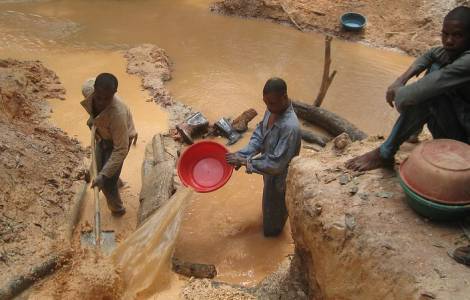
Kinshasa (Agenzia Fides) – A tragedy caused by the “rampant and illegal exploitation of Congolese natural resources orchestrated by Rwanda and the M23/AFC.” This is how the Ministry of Communications and Media of the Democratic Republic of Congo described the deaths of more than 200 miners – including several minors – in a collapse on January 28 at the Luwowo mine in Rubaya, Masisi territory (North Kivu).
Expressing the condolences of the Kinshasa government, the statement published on January 31 recalled that the Rubaya mining area was classified as a “red zone” since February 2025 by ministerial decree, a measure that was renewed in November 2025. This means that “all extraction and commercialization activities, including artisanal mining, are formally prohibited,” the document states.
The Congolese government also emphasizes that this year’s tragedy is not an isolated incident. “Back in June 2025, more than 300 civilians died in similar circumstances in the same mining area. For the authorities, these events reflect a recurring pattern in which the civilian population is exposed to extreme risks in a completely lawless environment.”
Large areas of North Kivu province are under the control of the M23/AFC (Congo River Alliance) rebels, supported by Rwanda. Exactly one year ago, on January 31, 2025, Goma—the provincial capital in eastern DRC—was taken by the rebels (see Fides, 31/1/2025). Coltan, a mineral essential for the modern electronics industry, is extracted at the Luwowo mining site. Congolese authorities denounce the systematic plundering of mineral resources in national territories that have fallen into the hands of the M23. From the Rubaya mine alone, the Kinshasa government states, “between 112 and 125 tons of coltan are extracted each month and transported to Rwanda without adequate traceability.”
The DRC government thus points to the responsibility of the international community, arguing that “the failure of regional and international mechanisms designed to certify the origin of minerals is evident, particularly the mechanisms of the ITSCI and the CIRGL.” “These systems, it seems, have not prevented the certification and commercialization of minerals from sites classified as ‘red zones,’” the Kinshasa authorities emphasize, also denouncing “the lack of awareness of the end consumers and international economic actors” who continue to source their minerals through Rwanda.
The International Tin Supply Chain Initiative (ITSCI) is a traceability program for tin, tantalum, and tungsten minerals (the so-called 3Ts; coltan is an aggregate containing tantalum; see Fides, 1/2/2023), implemented in the Great Lakes region: Burundi, DRC, Rwanda, and Uganda.
The International Conference on the Great Lakes Region (CIRGL), for its part, is the intergovernmental organization responsible for resolving regional disputes.
AFC/M23 spokesperson Lawrence Kanyuka has rejected the accusations from the DRC government, which he accuses of exploiting the tragedy for political purposes. “Instead of taking responsibility "Without bearing responsibility for its long-standing failures in managing the mining sector, the regime is seeking to exploit a tragic accident caused by torrential rains in the artisanal mines of Rubaya for political gain," Kanyuka stated. The AFC/M23 has finally emphasized that the Rubaya disaster has nothing to do with their control of the area, recalling that similar tragedies have occurred repeatedly in regions under the control of the Government of the Democratic Republic of Congo. (L.M.) (Agenzia Fides, 2/2/2026)