
Information service of the Pontifical Mission Societies since 1927
Wikimedia Commons
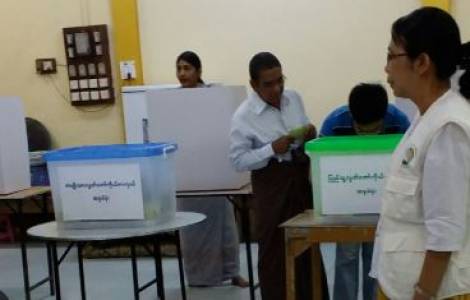
Yangon (Agenzia Fides) – In Myanmar, where a civil war has raged for almost five years since the coup attempt of February 1, 2021, the military junta has launched elections to form a bicameral parliament. Opposition parties, such as the National League for Democracy, which was in power in 2021, are barred from participating. The election is divided into three phases: The first round took place on December 28 in 102 municipalities; the second phase will be held on January 11 in approximately 100 municipalities across 12 states; and the final round is scheduled for January 25. The election has been boycotted by both the exiled civilian government of national unity (NUG), which is linked to the resistance forces, and ethnic armed organizations that have historically been present in Myanmar.
Polling stations are opening as fighting rages in more than a third of the country. According to a recent analysis published by the BBC, based on data from local organizations, the military junta controls about 21% of central Myanmar; resistance forces and ethnic militias control 42% of the territory in peripheral areas, while the remaining 37% consists of disputed areas where fighting continues and voting will not be possible. Specifically, in the states of Kachin, Kayah, Chin, Shan, and Rakhine, citizens of only a few municipalities are voting, a tiny minority compared to the total number of municipalities in the country. In the first round of voting, in which the election commission reported a turnout of around 70%, the Union Solidarity and Development Party (USDP), whose lists include regime officials and politicians, received about 90% of the vote. Despite the limitations of an election organized by a military regime, “the elections are nevertheless a step that raises expectations and hopes for change among the population,” John Aung Htoi, a priest of the Diocese of Myitkyina, a city in Kachin State where citizens are allowed to vote, told Fides. “People are going to vote partly out of fear of reprisals if they don’t, and partly because they hope for something new that will break the stagnation the nation has fallen into,” he noted. “In Myanmar’s past,” the priest continued, “the military has acted according to the same pattern, gradually transferring power to a civilian government while maintaining firm control over the country.” “The USDP party, which won the majority of the votes, is an expression of the military, so it is to be expected that it will form the government, thus ensuring that representatives of the junta remain at the helm of the country,” he concluded.
“The population hopes, however, that with a civilian government, the chances for dialogue will increase, especially since the People’s Defense Forces and the government-in-exile have always maintained that dialogue is only possible with a civilian government. We shall see: What the Burmese people desire is that this election leads to a development in the political system, creating space once again for talks and negotiations with the opposition,” he affirms. There are also signs of openness among the ethnic minority armies: The Kachin Independence Army (KIA), one of the most powerful and best-organized groups, has stated that it might enter into a dialogue with the new civilian government. “If this happens, all the other ethnic armies will follow. Then there is the prospect and the hope for a national dialogue,” Father John observes. “The Catholics in Myanmar fervently hope for this,” he concludes. “We stand for dialogue and peace and hope that by 2026 this country will be able to overcome this conflict, which has brought death, destruction, and displacement. Christian communities are experiencing this time in intense prayer and continue to provide assistance to the entire population, which is suffering from a severe humanitarian crisis caused by the ongoing war, which has created 3.5 million internally displaced persons.” (PA) (Agenzia Fides, 9/1/2025)



 AMERICA/COLOMBIA - The results of the legislative elections reveal new trends ahead of the presidential elections
 ASIA/BANGLADESH - Bishop Gomes on the parliamentary elections: "Bangladeshi Christians have great hope for a future of stability and peace"
 ASIA/MALAYSIA - Malaysian Ambassador Assan: "Respect for international law, and the protection of human dignity is the path to peace in the Middle East and Southeast Asia"