Information service of the Pontifical Mission Societies since 1927
OMIworld
Vientiane (Fides News Agency) – “Among you as one who serves.” This was the motto chosen by Alessandro Staccioli, a missionary of the Missionary Oblates of Mary Immaculate (OMI), when he was ordained a bishop in 1968 and appointed to lead the Church in Luang Prabang, one of the Apostolic Vicariates of Laos. The motto sums up a life wholly devoted to mission and, in particular, to his bond with the Laotian people – a bond that endured even after he was forced to leave the country, along with the other missionaries, in 1975.
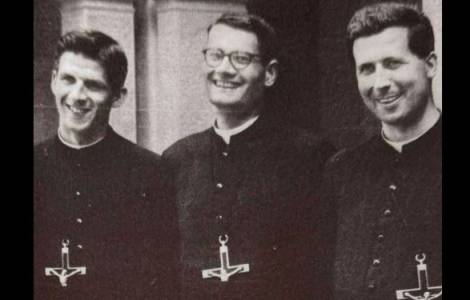
Bishop Staccioli returned to the Father's house on the evening of November 4, 2026 in Battipaglia, Italy, at the age of 94. Born in Trieste on November 13, 1931 to a family originally from Siena, he grew up in Siena and entered the Missionary Oblates of Mary Immaculate in 1951. Ordained a priest on March 17, 1956, he left for Laos the following year with the first group of Italian Oblates, embarking on a missionary journey that would profoundly shape his life.
He spent 18 years in Laos, a country then ravaged by war, where missionary work meant facing harsh climatic conditions, a complex language and an increasingly dramatic political situation. The young missionary learned Lao and devoted himself to proclaiming the Gospel and serving local communities. Together with his confreres, he took part in translating the Gospel and caring for the sick, regardless of their religious affiliation.
In 1968, following the death of Bishop Leonello Berti, OMI, he accepted responsibility for the episcopal leadership of Luang Prabang. His appointment, conferred by Pope Paul VI on September 26, 1968, was initially accepted with some reluctance, but Staccioli did not wish to leave his fellow missionaries facing difficulties on their own. He was consecrated bishop on December 8 of the same year.
His call to the episcopate thus arose at the very heart of the Laotian mission and was first and foremost a call to pastoral care for the communities of this small Southeast Asian country. Guided by his motto, “Among you as one who serves”, he exercised his episcopal ministry in a spirit characterized, according to the testimonies of his confreres, by “availability, simplicity and closeness to the people”, as Father Pasquale Castrilli, OMI missionary and former editor of his Congregation’s missionary magazine, told Fides.
In 1975, the political situation forced foreign missionaries to leave Laos. Bishop Staccioli was the last to depart. Before leaving the country, he handed over the keys to the schools and dispensaries to the authorities, expressing the hope that the work carried out by the missionaries would continue for the benefit of the population. The Buddhist patriarch also wished to bid farewell to Staccioli and the Oblate missionaries, acknowledging the good they had accomplished.
Leaving Laos, however, did not mean the end of his mission among the Laotian people. Upon his return to Italy, Staccioli was appointed Auxiliary Bishop of Siena and entrusted with the pastoral governance of the Diocese of Montalcino. He was just 44 years old. He continued his pastoral ministry until 1990, but throughout those years Laos remained at the centre of his life.
In 1986, in fact, he received a mandate from the Holy See to provide spiritual care for Laotian refugees living in the diaspora. They numbered more than 400,000 and were scattered across several countries, from Thailand to the Philippines, from Australia to the Americas and Europe, with a particularly significant community in France.
A new chapter in Bishop Staccioli’s missionary journey thus began: an “itinerant ministry” that took him to Laotian families scattered by war, as he sought to rebuild bonds, accompany their communities and help them become integrated into the local Churches.
The Bishop travelled extensively to meet Laotians in the diaspora and maintain close ties with their communities. He engaged in dialogue with the various local Churches to facilitate the integration of refugees, supporting them in their practical needs, accompanying them in their human and Christian journey, and helping them in their development.
Among the initiatives he promoted during this “second mission” were poultry cooperatives and the preparation of the official Lao translation of the Order of the Mass. His commitment therefore extended well beyond pastoral care: it also sought to preserve the language, culture and ecclesial life of a people whom the course of history had forced to live far from their homeland.
From 1995 to 1998, Bishop Staccioli also served as Secretary General of the Pontifical Missionary Union (PMU), one of the Pontifical Mission Societies, while simultaneously carrying out an international ministry as Apostolic Visitor for Laotian faithful throughout the world.
In these hours, numerous tributes have been paid by confreres and Laotians who knew him. Their recollections repeatedly evoke the frankness, simplicity and sense of humour that marked his life.
“Even when he told jokes, he always left me with a profound sense of God,” recalls his confrere, Father Stefano Messina, OMI. “For me, he was a model of an Oblate missionary, like the Good Shepherd, especially when he travelled around the world to meet Laotians scattered across different countries, sharing in their humble way of life and often sleeping on the floor,” Father Messina notes.
Another Oblate, Father Roberto Sartor, OMI, remembers Staccioli as the bishop who ordained him to the priesthood and today entrusts his memory to prayer: “May the Lord reward him for the offering of his life, which this Oblate and bishop made for the missionary Church.”
For Bishop Staccioli, mission could never be separated from charity. When asked what a bishop should never do, he would reply: “He must never lack charity!” The same principle, he would add, applied to every Christian, according to the Oblates who knew him.
His bond with Laos remained, until the very end, one of the deepest expressions of his missionary vocation. “When an Oblate goes to heaven, a part of us, and of our Oblate and human history, goes to heaven with him too. Thank you, Father Alessandro,” wrote Father Danilo Fiori, OMI.
The funeral of Bishop Alessandro Staccioli will be celebrated on Sunday, November 8, in the Cathedral of Siena, where he will later be buried in the Bishops’ Burial Chapel. The Church, together with the Laotian communities he accompanied for decades, entrusts him to the Lord with the words of a prayer he often repeated: “Thank you, Lord. I love you because you have loved me.”
(PA/PC) (Fides News Agency, 7/11/2026)